Published by Qomvia, , 13 min read
Key takeaways
- Product results are not ad placements: OpenAI says its shopping results are selected independently and are not influenced by its partnerships.
- Merchant data must agree: keep product names, variants, availability, prices and landing pages aligned across owned pages and feeds.
- A feed improves product information: keep catalog fields and the merchant page aligned, then review how products appear in the shopping surface.
- Checkout is a separate step: Instant Checkout has its own merchant and transaction conditions, and product inclusion does not require enabling it.
- Measure the offer path: inspect whether a product is represented accurately, linked to the right page and purchasable under the stated terms.
What is ChatGPT shopping?
ChatGPT shopping is a product-discovery experience that presents items and supporting information to help people compare options. OpenAI says results are independently selected, not ads and not influenced by its partnerships. Merchants can improve published product information while placement remains part of that independent selection process.
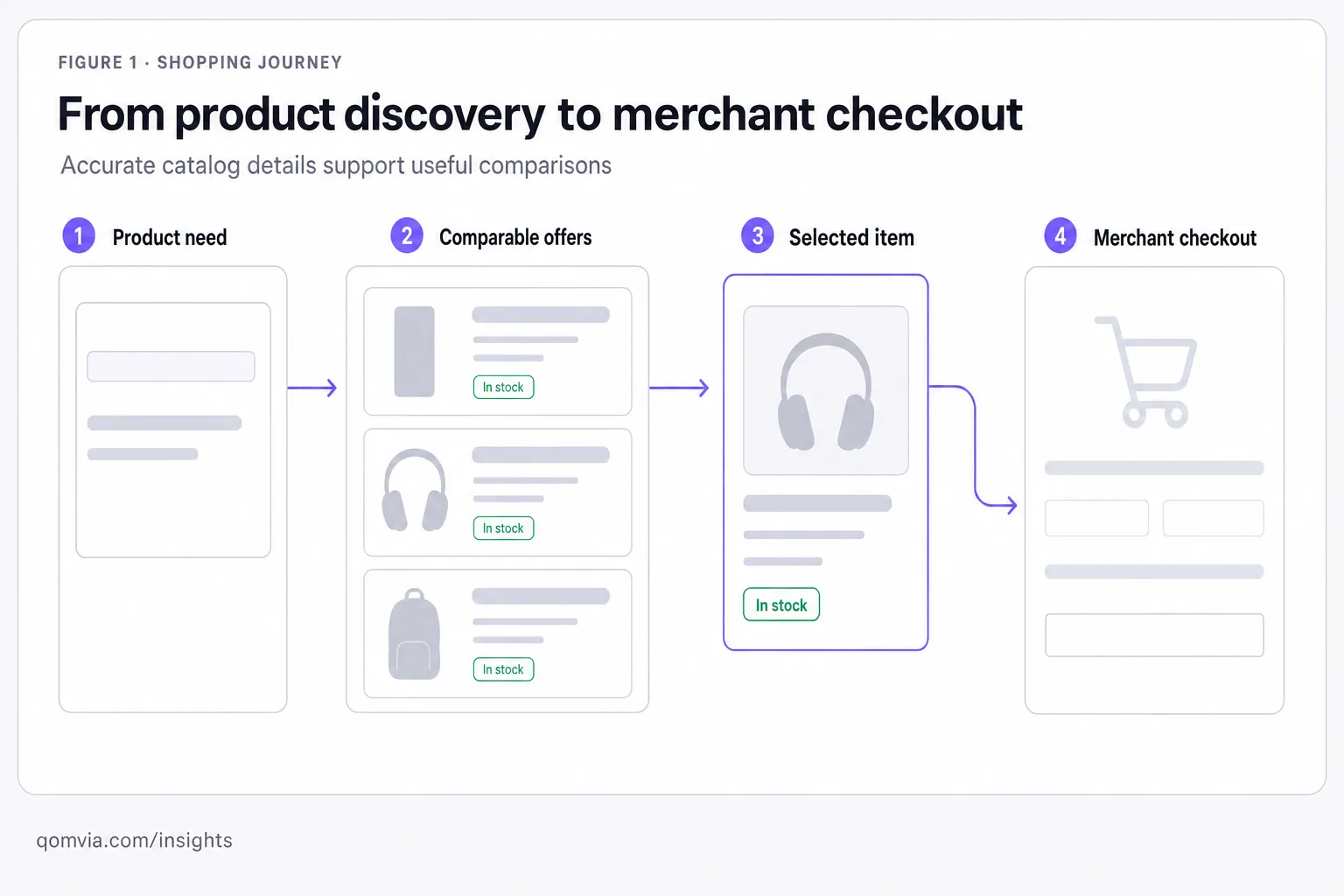
A shopping answer is not a product page in a new frame. It can combine item information, descriptions, reviews and links, then lead to a merchant's site or a supported checkout path. OpenAI says it may generate simplified titles and descriptions and labels such as “Budget-friendly.” Review summaries are generated from public reviews and are not verified by OpenAI. A polished summary should therefore be treated as a convenience for comparison, not a substitute for checking the original listing.
The merchant's role is to make the offer easy to identify and verify. An answer surface can reduce a long catalog to a few options, but the original listing still needs enough context for the shopper to confirm fit, seller, price and terms. This is a content and operations problem as much as a discovery problem: product data can be correct in one system and misleading at the point of purchase if a variant or condition is lost.
This guide focuses on the merchant's catalog and purchase path, not the full agentic-commerce protocol landscape. For that broader view, see the agentic commerce guide. For site readiness beyond shopping, use the AI agent readiness guide and AI search optimization checklist.
How are products selected for shopping results?
Products are selected independently
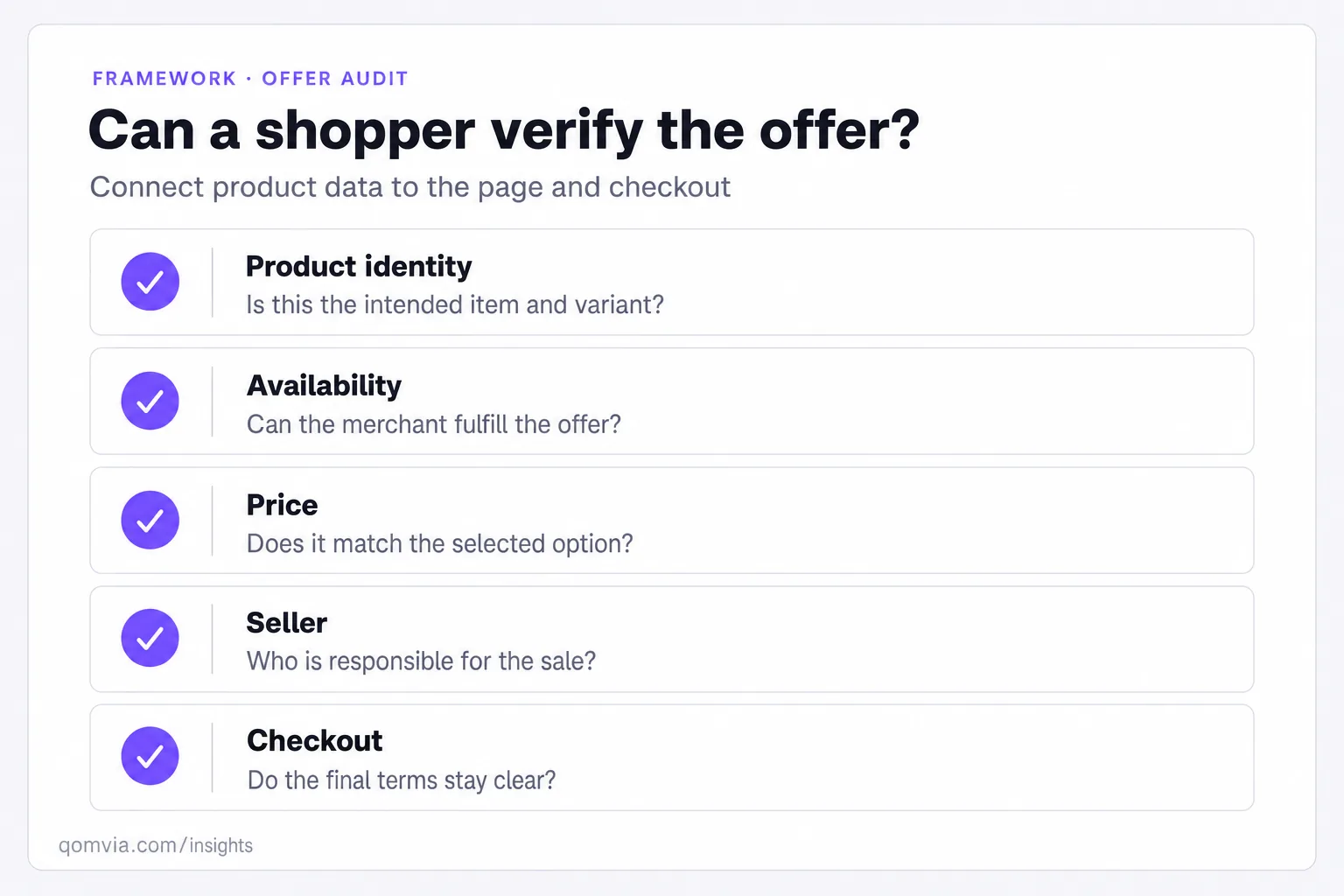
OpenAI says products are selected independently from advertising and partnerships. Its shopping guidance describes merchant-ranking factors that include availability, price, quality and whether the merchant is the maker or primary seller. A later Instant Checkout announcement adds whether checkout is enabled as a factor, while clarifying that products with Instant Checkout are not preferred in product results. These published factors give merchants a practical set of offer checks without exposing the complete scoring formula.
Availability is only useful when it is accurate. If a product is presented as in stock but the landing page says otherwise, the shopper encounters a mismatch. Price needs a clear relationship to variant, currency, region and applicable conditions. Quality should be substantiated by product specifications and credible customer information, not asserted through a slogan. Maker or primary-seller status should be clear from the business identity and the offer page.
Treat selection as a buyer-relevance problem. The product must match the actual request, and its details should help a person decide whether it fits. A title that repeats broad keywords may be less useful than a name that distinguishes model, size or compatible use. A merchant can audit those fields before asking whether a surface has displayed the item. That audit creates a better product record even when selection remains outside the merchant's control.
This article's offer integrity loop is a practical way to act on the published factors: identify the product, verify the offer, explain the evidence, connect the correct seller and test the purchase path. Each step checks whether the merchant can stand behind the representation that a shopper may encounter, from first comparison through fulfillment.
Order the work by customer impact. A missing variant can make the offer impossible to compare. A vague title can cause the wrong item to be interpreted. A stale price can damage trust at the final step. A checkout failure can prevent a purchase after a shopper has already chosen. Record the exact field and landing page that failed instead of labeling every issue “product SEO.”
What product data should a merchant prepare?
Make one offer internally consistent
Start with one canonical record per sellable offer. The product name should distinguish the item from its family. The description should identify its purpose, compatible use and material limits. Variants should be explicit rather than hidden in a marketing paragraph. Include the identifiers your commerce system already uses consistently, then check that product pages, feeds and checkout resolve to the same offer.
Keep price and availability synchronized with the merchant system of record. Make it possible to identify the selected size, color or configuration on the landing page. Explain shipping and return conditions in the context where shoppers need them. If the price depends on a bundle, subscription, region or promotion, state those conditions where the product is described. A recommendation interface may simplify the display, so the destination page must remain the authoritative place to verify the complete offer.
Shopify merchants' product data is integrated through Shopify Catalog, according to OpenAI. Merchants can also apply to provide a direct product feed. In either route, treat the source record as a maintained publishing interface: assign an owner, validate required fields, catch discontinued items and document how quickly changes reach the public listing. Do not assume that one feed export automatically resolves contradictions in the product page or catalog.
Use a feed audit that connects each data field to the visible page. For each product, compare the name, description, current offer, stock state, canonical URL, variant choices and seller identity. Then visit the destination as a shopper and follow the exact offer through checkout. This audit checks merchant-controlled information against the visible page and purchase path, making the product representation reliable wherever a surface may retrieve it.
Give every important field a named owner. Merchandising may set the displayed name, operations may maintain stock, finance may own price rules and customer support may know the common compatibility questions. A publishing workflow should resolve those responsibilities before an incorrect value spreads to a page or feed. Keep an edit record when a critical field changes so an analyst can separate catalog maintenance from a later answer observation.
Set a clear rule for resolving conflict between the catalog and the product page. Decide which system owns price, inventory, variant naming and seller identity, then make downstream pages reflect that source. If the business uses temporary promotions or region-specific offers, define how those terms appear to a shopper and how an exported record is refreshed. An unexplained discrepancy is a customer experience problem regardless of whether it affects a shopping result.
| Merchant field | Question to verify | Failure to watch for |
|---|---|---|
| Product identity | Does the name identify this item and variant? | Similar variants collapse together |
| Offer details | Does the displayed price match the selected offer? | Conditions appear only after checkout |
| Availability | Can the merchant fulfill the stated option? | Feed and page disagree |
| Landing page | Does the URL open the same product? | Redirect reaches a generic collection |
| Seller | Is the responsible seller clear? | Brand, marketplace and merchant are confused |
How do product feeds and product pages work together?
A feed is a structured way to communicate a catalog. A product page is where a person can read, compare and confirm the offer. Neither should contradict the other. If the feed lists an old variant while the page has changed, the merchant has two competing descriptions. If the page uses a product nickname but the feed uses an opaque internal code, a shopper may not recognize that both refer to the same item.
Build the feed from the same source of truth that publishes the site where practical. Validate changes before they are sent, and log when a record was exported. Use canonical landing URLs and avoid sending shoppers through unrelated campaign or search pages. Product names should remain stable enough to connect feedback and stock status to the correct item, while descriptions can explain differences that matter to a particular use case.
Review public reviews carefully. OpenAI says review summaries are model-generated from public reviews and are not verified by OpenAI. Merchants should not manipulate that material or imply that a generated summary is a certified rating. Respond to the original customer service issue, publish accurate product details and make the merchant's own warranty and return terms easy to inspect.
If the shop uses separate systems for inventory, the product page and customer support, define how a correction propagates. A discontinued color should not remain available in an exported record. A new return condition should appear on the policy page and in any relevant offer description. A retailer that resells another brand's products should not describe itself as the manufacturer. These consistency checks reduce confusion for both people and automated retrieval systems.
Treat a price discrepancy as a customer issue before treating it as a visibility issue. OpenAI says prices come from third-party providers and may lag merchant updates. If an answer shows an outdated offer, check when the merchant changed the source price, where the public listing reflects it and whether the selected variant still exists. Keep the investigation factual. A page owner can correct its own display and feed, while the third-party refresh behavior remains outside the merchant's direct control.
What is Instant Checkout, and does it affect product inclusion?
OpenAI announced Instant Checkout as a way for a shopper to complete an eligible purchase from within the answer experience. In the announcement, the merchant remains the merchant of record and handles the order, payment, fulfillment, returns and customer support. That role is central: an interface can assist with discovery or checkout while the merchant remains responsible for the transaction and its terms.
The original announcement described a limited launch for U.S. users buying a single item from U.S. Etsy sellers, with Shopify merchants described as coming soon at that time. This article does not infer current eligibility for a particular seller or catalog. Merchants should consult the live provider requirements before changing checkout or describing the feature to customers.
Product selection and checkout eligibility should remain separate in the merchant's plan. OpenAI says an enabled checkout option can be a merchant factor in the relevant ranking context, while also stating that products with Instant Checkout are not preferred in shopping results. A feed-ready product can therefore be relevant even if it uses the merchant's own checkout. Do not redesign the purchase flow solely on the assumption that in-product checkout is a ranking shortcut.
Before enabling any new transaction path, test the customer's consent, selected variant, price, tax or shipping display, order confirmation and support handoff under the provider's current terms. State who is taking payment and who handles returns. Ensure staff can reconcile the order with the merchant's catalog, and use the provider's terms to confirm applicable transaction conditions.
A merchant should also model the exceptions: an item becomes unavailable, a shopper changes a variant, an address cannot be served or a payment needs review. Make sure the shopper can cancel or ask for help through a real support route. If the purchase path is not appropriate for the catalog, a clear handoff to the merchant site can be a better customer experience than forcing an incomplete integration.
How should merchants measure product visibility?
Use a catalog sample that includes different product types and purchase questions. For each test, record the exact prompt, market, product configuration, date, answer and source links. Classify whether the intended item appears, whether a competitor or substitute appears instead, whether the description is faithful, and whether the linked offer is current. Keep “not shown” distinct from “shown with an error” because they suggest different next steps.
Repeat the same task after a meaningful feed or page change, while recording any changes to the test conditions. A product can be omitted because the question was too broad, because the catalog is incomplete, because availability changed or because the system selected another option. Do not attribute the outcome to one field without supporting evidence. When the answer paraphrases a specification incorrectly, compare it against the visible source page before changing the data.
Use a small issue taxonomy: wrong identity, missing offer, stale price, unavailable variant, unsupported description, misleading seller or broken destination. Assign the correction to the owner of that source, then preserve the original answer and page state for comparison. This makes a catalog review useful across channels and stops a team from treating every mismatch as a reason to rewrite product copy.
Qomvia's E-commerce add-on checks product signals and commerce protocol evidence as described in the feature inventory. Merchants can use the E-commerce add-on for public readiness checks or explore Qomvia Market as a separate commerce offering. These tools address different parts of a merchant's workflow; use the published shopping criteria to evaluate the third-party interface.
What should a merchant do first?
Pick a representative set of products and follow each one from the catalog record to the public page and the final purchase step. Resolve stale prices, ambiguous variants and missing seller information before expanding the audit. Write down the source of truth for each field. If two systems disagree, choose an owner who can correct the root record rather than patching each downstream copy separately.
Then review how a shopper would interpret the offer without knowing the internal catalog vocabulary. Can the person tell which product is being recommended, what makes it different, who sells it and what happens after checkout? Does the page support the performance or compatibility claims? Are limitations easy to find? A feed can carry concise attributes, while the page explains the evidence and conditions that do not fit neatly into a field.
Finally, establish a feedback loop for answer errors and catalog changes. A wrong summary may reflect incomplete source information, stale data or an answer that compressed a qualification. Correct the page or feed where the source is wrong, then sample the same task again. Do not publish an artificial “best product” page to counter a weak answer. Improve the offer and evidence that a human customer can verify.
Close the offer integrity loop with the buyer's outcome. If the product was selected but could not be purchased, investigate the destination and checkout. If the answer described it inaccurately, trace the wording back to the public source. If the item did not appear, first verify that it matched the request and was available under the tested conditions. Use those observations to strengthen every controllable part of the merchant experience.
Document the transaction handoff for customer support. Staff should be able to identify the product, selected variant, displayed terms and order state without relying on a shopper to reconstruct a confusing conversation. If a third-party interface handled part of discovery or checkout, define how the merchant receives the relevant details and where the buyer can get help. This operational readiness is separate from whether a product is included in a result.
Sources and further reading
Questions
- How do I get products in ChatGPT shopping?
- Publish accurate product information, keep the product page and catalog aligned, and consult the provider's current merchant guidance. OpenAI says results are selected independently; review product visibility separately from feed access.
- Does ChatGPT shopping use product feeds?
- OpenAI says Shopify product data is integrated through Shopify Catalog and merchants can apply to provide a direct product feed. The merchant remains responsible for keeping the source information accurate.
- Are ChatGPT product results ads?
- OpenAI says shopping results are not ads and are not influenced by its partnerships. Advertising is described separately from product selection.
- Does Instant Checkout improve product ranking?
- OpenAI says checkout availability can be a factor in the relevant merchant ranking context, while Instant Checkout items are not preferred in product results. Evaluate product visibility against those published factors.
- Can ChatGPT shopping show an outdated price?
- OpenAI says prices come from third-party providers and may lag merchant updates. Merchants should make their own product page and checkout the authoritative place to confirm current terms.
- How can merchants make product data easier to compare?
- Use stable product identities, explicit variants, current availability and offer-specific prices, then verify each record against its public landing page and checkout.
Score your own site against the rubric this is written from.
Is your site agent-ready?
Free score against the same rubric, in under a minute.
Sign up free to keep the fixes and track the score.
AI monitor
PreviewHow often each model names your site across 11 tracked questions.