Published by Qomvia, , 14 min read
Key takeaways
- AI agent readiness is a chain, not a badge: discovery, access, legibility, identity, performance and protocols each remove a different reason an assistant may fail to use a site.
- Make the page useful before making it clever. Search engines and answer systems still need crawlable, indexable, text-rich pages with stable URLs.
- Separate the route from the model. A crawler can make a page eligible to be considered; it cannot guarantee a recommendation or citation.
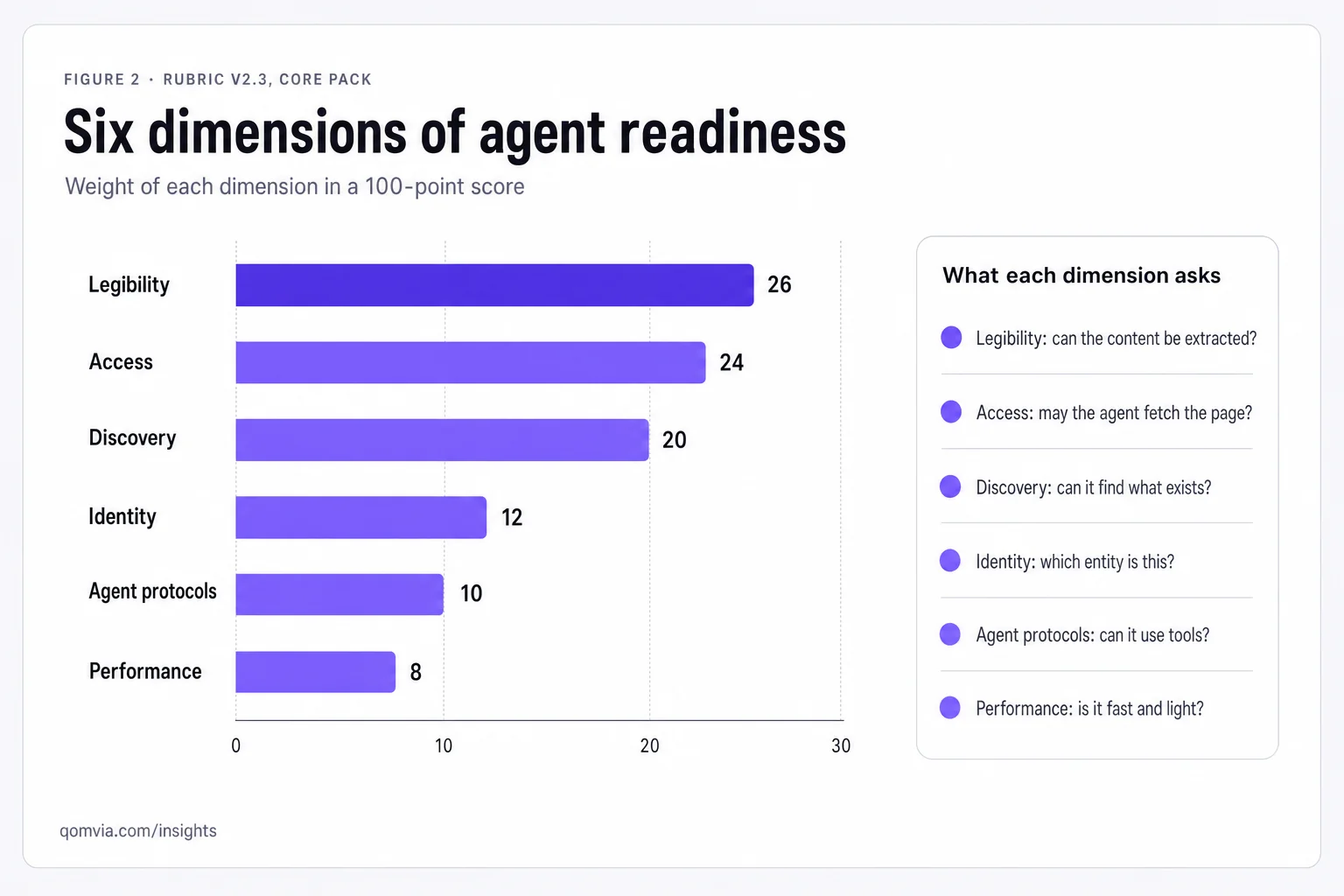
- The Qomvia core rubric assigns weights to implementation work, not to an engine's secret ranking formula. Its six dimension weights are published and auditable.
- Measure answers separately from readiness. A technical pass is not a mention, citation, click, product comparison or purchase.
What is AI agent readiness?
AI agent readiness is a website's capacity to be discovered, fetched, rendered, interpreted, attributed and used by an AI system without relying on a human to repair missing context. It joins search visibility with machine-readable identity and safe action, so a page is not only findable but usable when an assistant needs to answer, cite or complete a task.
The definition matters because an answer engine is not a single crawler. A user may ask a model to recall an answer from existing knowledge, request live search, open a cited page, or ask an agent to perform an action. The path varies by product and query. Readiness is the condition of the site across these paths, not a promise that one platform will choose it. Google's own guidance, for example, says its AI Overviews and AI Mode require a page to be indexed and eligible for a search snippet, while other systems publish distinct user agents for search, training and user-triggered fetches.
For a compact companion to this model, see what agent readiness measures. That article groups the same work into fetch, read, trust and act. This flagship goes deeper into the six diagnostic dimensions and how they connect to search and agent use.
How do AI agents discover a website?
Discovery is the path by which a system learns that a relevant URL exists. Search indexes, crawlable navigation, XML sitemaps, feeds, canonical links, API catalogs and explicit protocol declarations each contribute a different kind of map. A sitemap helps a crawler find URLs; internal links explain how pages relate; a product feed represents an inventory in a structured form. None makes content authoritative by itself, and a discovery file cannot make inaccessible content readable.
The first readiness test is therefore not whether a site has every fashionable machine file. It is whether a new, important page can be found from the home page or a relevant category page, has a stable canonical URL, and is named consistently across the sitemap and its links. For an update, a sitemap lastmod should reflect a real material change rather than reset on every deployment. Where IndexNow is available, treat it as a notification to participating search engines, not as a request that compels them to index.
Discovery also varies by product. Qomvia does not claim that a single index feeds every assistant. In the Bing infrastructure guide, the practical distinction is between what Microsoft documents about its own search and grounding services and what remains opaque about other providers. Your work is to reduce avoidable ambiguity on your own domain, then measure the outcomes in each platform you can actually observe.
Build an inventory before adding more discovery endpoints. Record which important page types appear in navigation, the sitemap and any feed; identify the canonical host; and mark where a user or crawler must sign in. For a product catalog, include a stable identifier and a route from each feed item to its public detail page. For an editorial site, check that category and related-story links expose the central guides. This surfaces orphan pages and duplicate versions without assuming that one file has special status.
Keep the distinction between discovery and permission visible in the audit. A machine-readable catalog can name a page that returns an error. An internal link can point to a page that canonicalizes elsewhere. A public endpoint can expose only stale inventory. Record which system generated each signal, when it was updated and who owns its accuracy. That context helps an engineer decide whether to repair navigation, change a feed, or correct the business system that supplied the data.
Can AI crawlers fetch and render the page?
A discovered URL must still survive a request. Robots rules, authentication, firewall policy, rate limits, regional restrictions and bot challenges determine whether the relevant fetcher receives the content or a denial page. The useful unit is not the phrase “AI bot” but the operator, user agent and task. OpenAI documents OAI-SearchBot for ChatGPT search, GPTBot for potential training use, and ChatGPT-User for certain user-requested visits. Those are different policy choices, not aliases for one permission.
Test the actual response rather than trusting a robots file that looks reasonable. Check status code, redirect chain, content type, canonical URL and body for the user agents that matter. A CDN can challenge a request even when robots.txt allows it. Conversely, blocking a training crawler does not automatically block a search crawler if the platform publishes separate controls. Read robots.txt for AI crawlers, bot protection and AI agents and how to get cited by ChatGPT before changing edge rules.
Rendering is a separate gate. If the initial HTML contains only a shell and the product name, price, explanation or answer appears after a client-side API call, a simple fetch may not see the useful evidence. Server rendering, a clear main landmark and text alternatives make the content resilient across crawlers, previews, accessibility tools and low-bandwidth clients. Review client-side rendering and agent visibility and main and article landmarks for implementation detail.
What makes a page legible and attributable?
Legibility is the difference between receiving bytes and recovering the intended claim. Use one descriptive page title, one primary heading, meaningful subheads, paragraphs that state a complete answer, and lists or tables when they clarify relationships. Put the main subject in the page's main content, not in a modal, image alone, hidden tab or vague cluster of cards. The goal is not to write for a model; it is to make the page's meaning apparent to a hurried reader and a plain text extractor at the same time.
Attribution asks the system to connect the passage to a publisher, organization, product or author. Stable names, contact information, Organization or Product structured data that matches visible claims, canonical URLs and a credible editorial trail help prevent one page being confused with another. Structured data is corroboration, not a license to make claims that the visible page does not support. See Organization JSON-LD and sameAs, title, description and canonical signals and why ChatGPT recommends your competitor.
Useful evidence has a shape. A claim about a product should be adjacent to the product name, price, availability and conditions it depends on. A claim about a policy should identify scope, effective date and accountable owner. A claim about a result should identify its method and limitations. This is why a page with a concise answer, a transparent explanation and a source trail can outperform a longer page whose important qualifications are scattered across unrelated screens. Editorial precision is a technical advantage because extraction depends on context.
What does it mean for an agent to act?
Reading is not the same as acting. A user may want an assistant to compare a plan, retrieve a support policy, check stock, reserve an appointment or place an order. Each action needs an interface with explicit inputs, outputs, permissions, error handling and a safe boundary. A link to an API catalog or MCP endpoint can tell a capable client where an interface exists; it does not grant consent, authorize payment or make the operation safe.
Commerce makes the distinction concrete. A product page needs a stable identifier, accurate price and availability, and a reachable checkout path. A machine protocol may standardize part of the exchange, while the merchant remains responsible for its catalogue, terms, fulfillment and customer support. Do not implement a protocol because a competitor announced one. Map it to the buyer journey, the channels you intend to support and the operational owner who will keep the data correct.
| Dimension | Question to ask | Evidence to inspect |
|---|---|---|
| Access | Can the relevant user agent fetch the page? | Robots rules, HTTP response, firewall logs |
| Legibility | Can a reader identify the answer in initial content? | HTML, headings, main content, text alternatives |
| Discovery | Can an engine find the right canonical URL? | Internal links, sitemap, feeds, redirects |
| Identity | Can the page be attributed to the right entity? | Names, organization data, publisher context |
| Performance | Does the request complete without needless friction? | Response time, payload size, failing resources |
| Agent protocols | Is an action interface stated and bounded? | Documented endpoint, permissions, transaction rules |
The boundaries around actions deserve the same attention as the interface. Read-only discovery and a purchase are not equivalent permissions. Require explicit user intent for irreversible steps, surface the merchant and total before confirmation, reject malformed or stale offers, and return an understandable failure when stock or price changes. The agentic commerce guide separates catalog readiness from transaction readiness; the Qomvia Market pages and QMP protocol overview describe Qomvia's own beta offering without implying that it is a universal standard.
How is agent readiness different from SEO?
SEO is the established discipline of helping search systems discover, understand and rank pages. Agent readiness includes much of that technical foundation, then asks whether a system can attribute facts, retrieve a useful passage and use a site capability safely. There is overlap, not a replacement. Google's public guidance says existing SEO practices remain relevant for AI Overviews and AI Mode, with no extra technical requirement for eligibility. A business should distrust advice that says the basics no longer matter or that a secret file guarantees inclusion. The Google AI Overviews and AI Mode guide examines those Search controls.
The unit of work is different by outcome. A classic SEO brief often begins with a page and a query. A visibility program begins with a customer question and measures an answer. A protocol program begins with an action and specifies permissions, data and failure modes. The taxonomy in AEO vs GEO vs SEO shows how the disciplines overlap without treating their names as standards recognized by every platform. The GEO guide adds a research-focused view of generated responses.
This gives teams a practical allocation rule. Keep crawlability, information architecture and useful content in the SEO backlog. Assign entity consistency and source corroboration to brand and communications work. Put answer sampling and citation review in measurement. Put feeds, API contracts, checkout permissions and monitoring with product and engineering. Shared ownership is normal, but each item needs one accountable person and a way to know when it is complete.
How should a team measure readiness?
A useful baseline pairs a fixed set of URLs with a fixed set of tasks. For each page, record the template, last material change, declared canonical, availability in initial HTML and the source of its key facts. For each answer sample, record prompt, product, mode, region, language, date, mention, citation and rival. This creates two related but separate views: one about public site conditions and one about observed responses.
Keep a history of the conditions around each test. If the site changes its edge provider, an assistant changes its answer format, or a team rewrites the prompt, the next result may not be comparable to the baseline. Note the change rather than smoothing it away. A series with a clear break is more useful than a continuous chart that quietly changes what it measures.
A finding should lead to a next decision, not just a higher score. If the product page cannot be fetched, fix the access path and retest. If it is fetched but the answer is wrong, inspect the source passage and the page's current evidence. If the answer is accurate but names a rival, assess fit and differentiation before treating the result as a technical fault. Separate a measurable repair from a strategic choice.
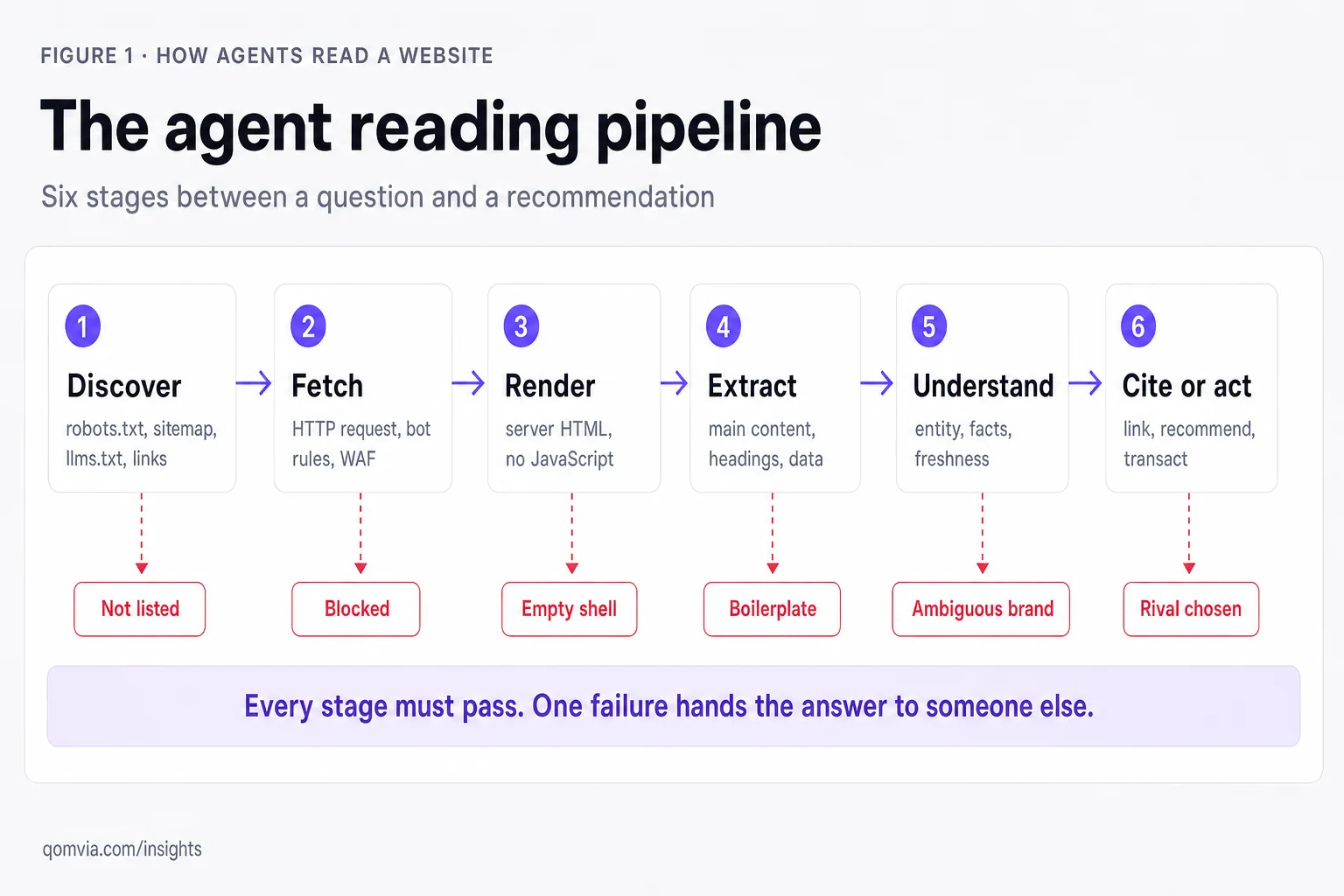
Begin with the failure order: can a system discover the page, fetch it, identify the useful content, attribute the source and complete the intended task? Record evidence at every gate. A denied request is not a copywriting problem. A page that loads but contains no answer in its initial HTML is not an outreach problem. A strong citation rate with low brand recommendation may indicate a positioning or entity question rather than a technical defect. The AI search visibility framework defines how to measure the answer separately from readiness.
A readiness score is a structured diagnostic, not an outcome guarantee. Qomvia's free Site monitor checks public HTTP evidence and scores a site's core readiness under Rubric v2.3. The AI monitor separately tracks answers to owner-selected questions across ChatGPT, Gemini and Grok, with Claude and Perplexity available as add-ons. It does not claim to measure Microsoft Copilot, Bing answers or Google AI Overviews. Compare those measures, and keep a written log of the page, query, market, model and observation date. Use Qomvia's methodology to inspect its public scoring model and the 40-check audit to structure the technical review.
How should teams operationalize readiness?
Turn the readiness chain into an owned backlog. Start with a small set of page templates that carry business value: a category page, product detail page, core service page, help article and company profile. For each template, trace one representative URL from discovery to action. Save the request, final response, initial HTML, rendered content, extracted title and headings, structured data, canonical and any action endpoint. That evidence lets engineering and content teams discuss the same failure rather than trade screenshots from different pages.
Separate a technical blocker from a selection question. If the crawler receives a 403, the next step is access. If it receives a 200 response with a blank shell, the next step is rendering. If it extracts text but misses the offer's conditions, improve legibility. If facts are clear but attached to the wrong organization, resolve identity. If the information is accessible and accurate but no answer includes it, investigate source quality, relevance and the sampling conditions. Each stage changes the owner and the likely fix.
A useful operating record names the URL pattern, user agent or product, observed status, business task, evidence, owner, priority and retest date. Record what could disprove the diagnosis. A CDN change may resolve a bot challenge, but if it only affects one region, test another region before closing the work. A product feed cleanup may resolve mismatched stock data, but compare the next imported catalog against the live storefront. Keep the record short enough to maintain and precise enough that another person can repeat it.
Prioritize by dependency, not novelty
Access and extraction failures usually deserve attention before a team experiments with new protocol files, because later stages depend on a system receiving the page. That does not make every technical check urgent. Prioritize the scale of the affected template, severity for the user, evidence strength and cost to fix. A blocked checkout policy page can be more consequential than an inaccessible low-traffic post. An identity mismatch on the corporate homepage can affect many product pages, while an isolated typo can be fixed within normal editorial review.
Treat the score as a map, not a target to game. The Qomvia rubric's weights describe how its public readiness diagnostic groups checks. They do not describe hidden weights in ChatGPT, Gemini, Google Search or a merchant agent. A team can use the score to find implementation gaps, then choose business-specific fixes. A higher readiness grade with no change in customer answers is not a failure of the measurement; it may show that the repaired condition was not the reason for answer selection.
The best review cadence follows material site changes and the risk of stale information. A new commerce integration deserves a transaction-path check. A new content template deserves rendering and extraction checks. A provider policy change deserves a crawler test. An unchanged legal definition may need less frequent review than product availability. Keep the baseline and selected retest sample stable enough to compare, but do not postpone a high-impact fix merely because the next scheduled report is weeks away.
Finally, make readiness a cross-functional practice. Content owners maintain evidence and dates. Engineering owns HTTP behavior, rendering and interfaces. Brand and communications maintain entity clarity and external corroboration. Product and security define permitted actions, consent and failure paths. Analytics owners preserve the distinction between technical checks, sampled answers, referrals and conversions. One person may coordinate the program, but each class of evidence needs an accountable specialist.
Sources and further reading
Questions
- What does AI agent readiness mean for a website?
- It means the site can be found, fetched, understood, attributed and used by an automated assistant without hidden dependencies. It is a readiness condition, not a guarantee of ranking, mention, citation or sale.
- How do AI agents decide which website to recommend?
- There is no single public formula shared by all assistants. A system may use its existing model knowledge, live search, retrieved pages, product data or other signals, then apply its own relevance and safety rules. A site can improve eligibility and clarity but cannot force selection.
- Is AI agent readiness the same as SEO?
- No. It builds on technical SEO and useful content, then extends into source attribution, machine interfaces and safe actions. Search fundamentals remain valuable, but they do not measure every agent task.
- What are the six dimensions of agent readiness?
- Qomvia Rubric v2.3 uses access, legibility, discovery, identity, performance and agent protocols. Its point weights describe Qomvia's public scoring system, not a search engine's internal ranking formula.
- Does a high readiness score guarantee ChatGPT citations?
- No. A score tests public technical evidence. ChatGPT still decides which sources fit a particular query, and citations can vary with wording, retrieval and context. Measure the actual answers separately.
- How can I check whether my site is ready for AI agents?
- Inspect the rendered HTML, crawl rules, redirects, canonical URLs, structured data, sitemaps and relevant action interfaces. A Site monitor can organize those checks, while an AI monitor measures answers to tracked questions.
Score your own site against the rubric this is written from.
Is your site agent-ready?
Free score against the same rubric, in under a minute.
Sign up free to keep the fixes and track the score.
AI monitor
PreviewHow often each model names your site across 11 tracked questions.