Published by Qomvia, , 13 min read
Key takeaways
- Google says AI Overviews and AI Mode use the same foundational SEO practices as Search, with no special optimization requirement.
- A supporting link must be indexed and eligible to appear in Search with a snippet. Eligibility is not a guarantee of inclusion.
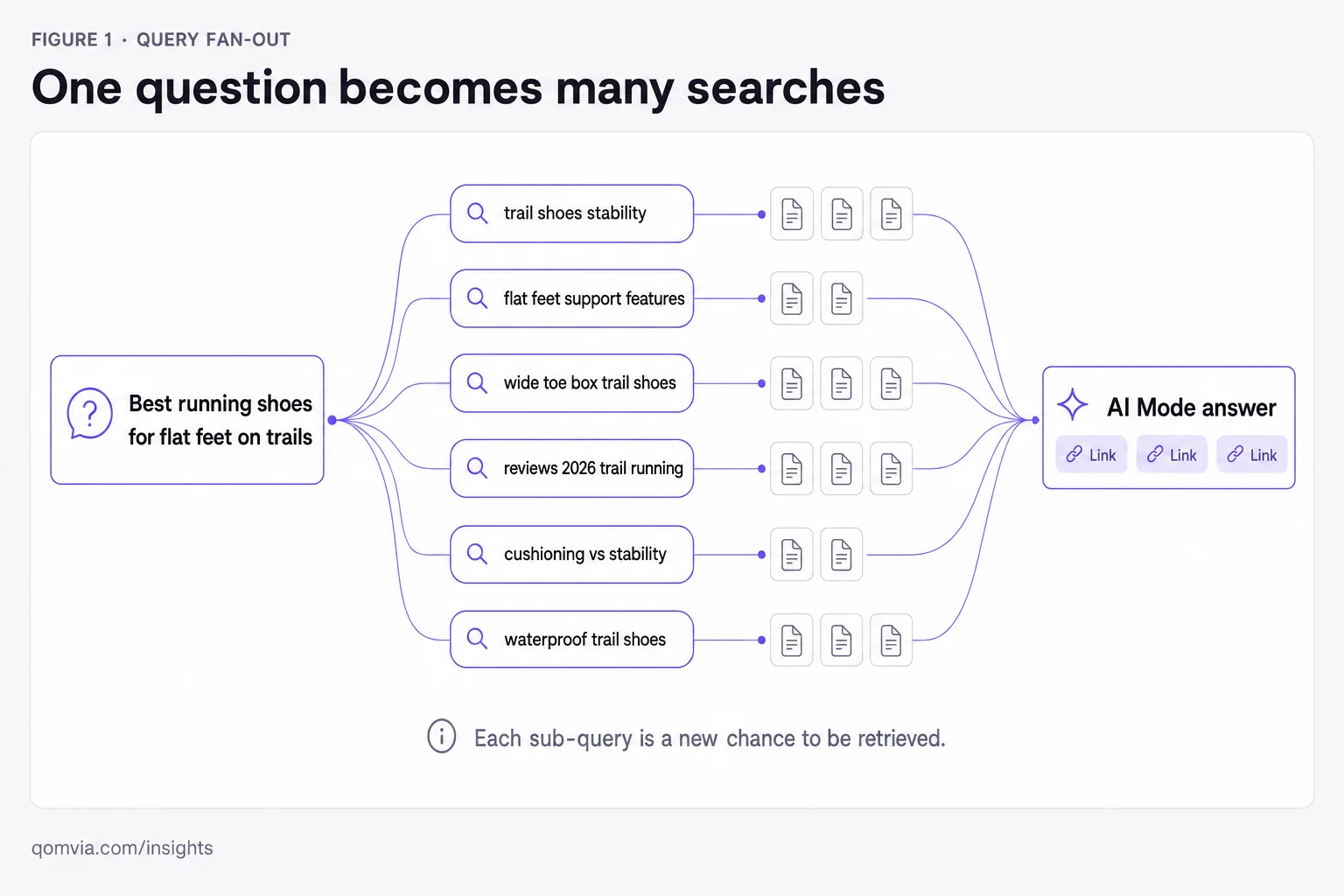
- Query fan-out can expand a complex question into related searches across subtopics and data sources.
- Googlebot and Search snippet controls govern Search content; Google-Extended is a separate control for some other Google systems.
- AI summaries change the page experience, so track clicks, impressions and conversions with the limits of each data source in mind.
What are AI Overviews and AI Mode?
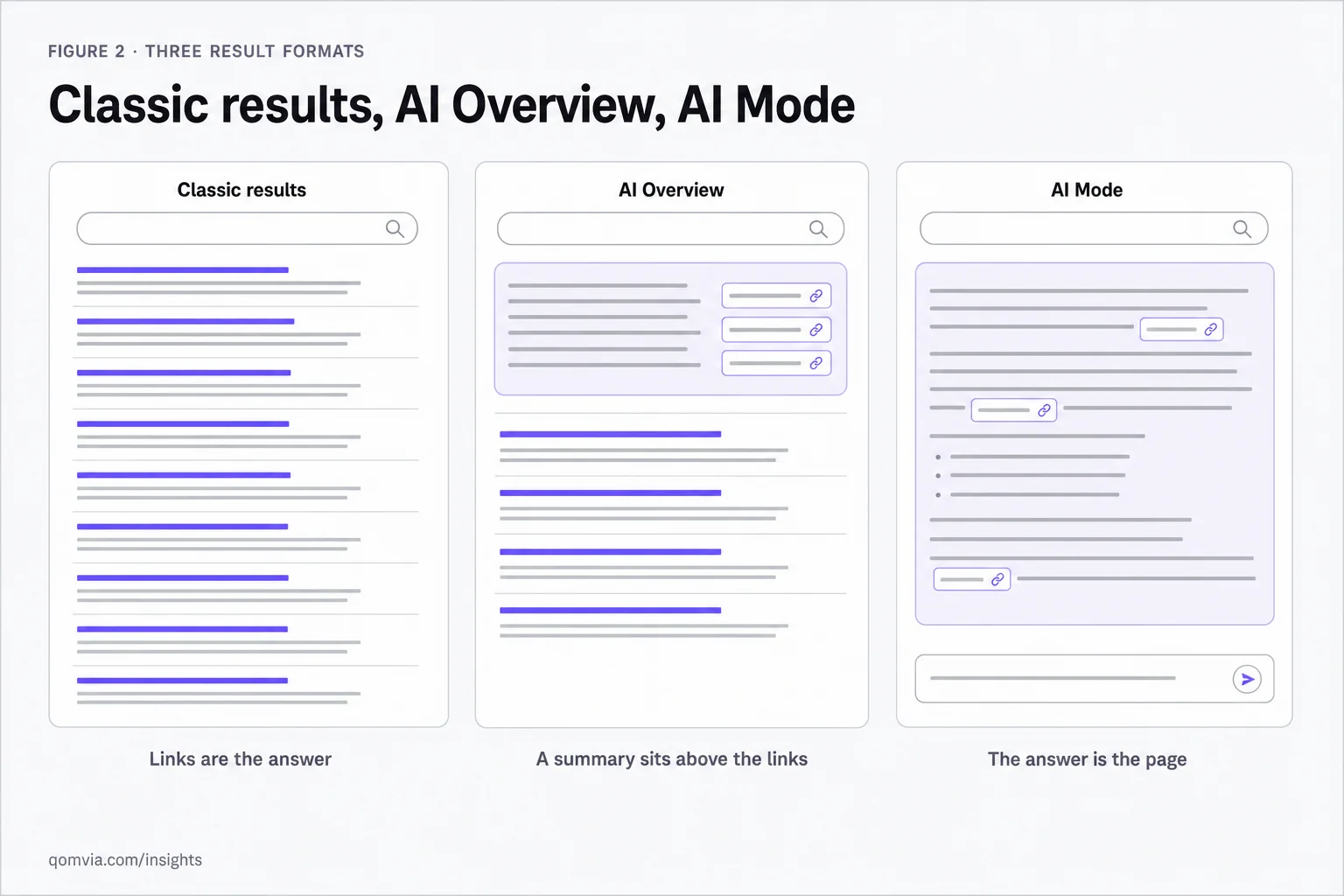
Google AI Overviews and AI Mode are Search experiences that present generated answers with supporting links. Google describes Overviews as summaries for some complex questions, while AI Mode supports exploratory and comparison queries. They are distinct experiences, and appearance in one does not ensure appearance in the other.
Google's Search Central guidance says the foundational practices for Search remain relevant and that there are no additional technical requirements for these AI features. The practical interpretation is less glamorous than many vendor claims: make pages eligible for Search, provide useful and reliable content, and avoid technical barriers. Google says eligibility requires a page to be indexed and eligible to appear with a snippet. It also states that meeting requirements does not guarantee crawling, indexing or serving.
Do not mistake interface visibility for a new secret ranking system. A page can satisfy technical requirements and not be selected for a particular answer. Another page can appear as a supporting link because it contributes a passage to a subtopic. The operator chooses what it serves. A publisher's job is to make the source clear, valuable and accessible, then measure what actually changes.
How does Google choose sources for AI Overviews?
Google describes AI features as drawing on Search systems to surface relevant pages and supporting links. For eligibility, it points site owners to the same Search technical requirements: the page must be indexed and able to appear with a snippet. Google does not publish a checklist that guarantees a citation for a chosen query. A compliant page may still be omitted because systems decide that another source better supports the response or that an AI Overview is not useful for that search.
That distinction gives publishers a controllable sequence. Confirm crawl access and indexing. Check that the page is eligible for a snippet and not excluded by nosnippet, data-nosnippet, max-snippet or noindex. Make the important content available as text. Build internal links that expose the page's role in the site. Ensure structured data is consistent with visible text. Then evaluate whether the page answers the real question well enough to deserve a supporting link.
Google also says AI Overviews are shown when its systems determine that they add value beyond classic Search and that they often do not trigger. That makes impressions an important context for click analysis: if the AI feature does not appear for a query, the user experience and available citations differ. Do not use a ranking report alone to infer the view the searcher saw. The Google documentation should be the reference for current controls.
| Control | What it controls | What it does not promise |
|---|---|---|
| Googlebot access | Crawling for Google Search | A supporting link in an AI answer |
| Snippet directives | How much page content may be shown in Search snippets | A guaranteed AI Overview appearance |
| Google-Extended | Some uses in Google's other systems | Search crawling or AI Overview inclusion |
| Structured data | Machine-readable description matching visible content | A ranking boost or inclusion guarantee |
Google-Extended is often misapplied in AI Overview advice. It is a token for controlling some use of content in Google's other AI systems, not a replacement for Googlebot's Search crawl controls. For an AI Overview, focus on whether Google Search can crawl and index the page and whether snippets are allowed. The crawler overview and Google-Extended documentation describe the separate mechanisms.
What is query fan-out?
Google says AI Overviews and AI Mode may use a technique it calls query fan-out: issuing multiple related searches across subtopics and data sources to develop a response. A broad question can therefore lead to searches for narrower supporting facts. The company says this can help identify more supporting pages and show a wider range of links than a classic search. That is Google's public description, not a reproducible recipe for predicting every query expansion.
For a content team, the useful implication is to answer the whole decision, not just the headline question. A guide to choosing software might need clear evidence about implementation, security, price and support, each in a page or section with a precise heading. This is not an invitation to create a separate thin URL for every possible subquery. It is a reason to make information architecture legible and connect related evidence with internal links.
Write for a person following the thread. State the core answer, name its boundaries, then explain the adjacent questions that change the decision. A cited page should not force the reader to infer whether a number is annual or monthly or whether a recommendation applies to a particular market. Query fan-out may increase the range of relevant source paths; it does not excuse loose facts or content that only repeats a search phrase.
A practical content map starts with a decision and its subquestions. A homeowner comparing heating systems may need installation requirements, operating costs, maintenance and local eligibility. A business comparing software may need integrations, security controls, onboarding and contract terms. Organize these answers where the reader expects them, and link related pages when the evidence deserves a separate home. Do not create a new URL just because a hypothetical query could contain another phrase.
For each important subtopic, ask whether the page contains original and attributable evidence. A general paragraph repeated on many competitor sites gives little reason to choose your source. A product specification, documented process, transparent method or qualified expert explanation can provide the missing context. Make the evidence easy to find and keep it close to the statement it supports. A useful source should remain useful even when no AI interface appears.
Do not reverse engineer a single screenshot into a permanent content template. A source may be selected because it answers one subquestion, because of current retrieval results or because the interface chose a particular way to expand the search. Record the query and source, then look for repeated patterns across a question set. Treat each pattern as a hypothesis about content fit, not proof of an undocumented rule.
How do snippets and robots controls affect eligibility?
Google's published guidance says a page must be indexed and eligible for a Search snippet to appear as a supporting link in AI Overviews or AI Mode. Site owners can manage crawling with robots.txt and control Search snippets with directives such as nosnippet, data-nosnippet, max-snippet and noindex. These controls have different effects. A robots block can prevent crawling; a snippet directive limits the use or display of text; noindex asks that a page not be indexed.
Choose the control that matches the policy. If you want a page excluded from Search, noindex is more direct than hoping a blocked crawler will infer your preference. If you want a page available but not excerpted, review the snippet directives and their tradeoffs. Test the live page and inspect rendered HTML. A meta tag that a crawler cannot fetch cannot communicate a preference on that page, and an edge challenge can block access even when the robots file allows it.
The same separation appears across AI platforms. OpenAI publishes OAI-SearchBot for ChatGPT search and GPTBot for potential training uses. Do not copy a Google-specific robots token into a policy for another vendor and assume it has meaning there. Read robots.txt for AI crawlers and training, search and user-fetch bots for a broader explanation of separate crawler purposes.
What does the click evidence say?
A July 2025 Pew Research Center analysis found that users in its browsing sample clicked a traditional Google search result in 8% of visits to pages with an AI summary, compared with 15% of visits without one. A click on a link in an AI summary occurred in 1% of visits to pages with such a summary. Pew analyzed 900 U.S. adults' browsing activity and matched observed searches to sampled result pages. The sample covered Google searches, not every search engine or all future AI layouts.
The finding is important because it gives a public, behavior-based view of the question publishers often ask: do users click sources when a generated summary appears? But it should not be stretched into a universal click-through forecast. The data describes a defined panel, time period and classification method. A site in another market, category or result layout may behave differently. Read the primary Pew analysis alongside your own analytics.
Google says Search Console reports traffic from AI features in the overall Web search type rather than as a separate performance type. Combine Search Console impressions and clicks with referral analytics and conversion data where possible. Preserve the limitations: an aggregate click trend does not identify the exact AI feature on every visit, and a referral from a product does not prove which source supplied a particular answer.
What should publishers do now?
Audit whether important pages are indexed, snippet-eligible, internally linked and available in text. Check titles, canonicals, status codes, robots rules, structured data and page experience. Make facts direct and specific. Add original evidence where the page currently paraphrases generic advice. For product information, synchronize the page, feed and structured data so a price or availability statement does not disagree across channels.
Then build a small question set and record where your pages appear, if the tool or manual checks can observe the answer. Compare repeated samples instead of collecting a single screenshot. Track clicks and conversions separately from citations. This keeps the work grounded in real outcomes rather than the promise that a certain paragraph format will unlock a feature.
Qomvia's Site monitor evaluates public readiness evidence, while its AI monitor measures configured questions across ChatGPT, Gemini and Grok, with Claude and Perplexity add-ons. It does not measure Google AI Overviews. For Google's products, use Search Console and Google's own documentation. The measurement guide explains how to label each sample and avoid claiming coverage a tool does not have.
Prioritize a page when it supports a real user need and contains evidence that is missing or difficult to find. A high-volume query alone is not a content brief. Ask what the visitor must understand, what facts the page can verify and what would make the answer incomplete. This keeps work focused on substance rather than the hope that adding another section will trigger a feature.
Review technical controls on the exact URL. A page may be crawlable while a snippet directive limits how much can be shown. A page may be eligible but not selected for one result. Confirm the directive, canonical and status response together, then inspect the current Search guidance before changing a sitewide policy. Broader restrictions can affect ordinary Search in addition to AI features.
Use separate notes for a Search Console trend, an observed AI Overview, a source link and an analytics visit. These observations may inform one business question, but each comes from a different surface. A tidy report can place them side by side while preserving their units and caveats. Avoid translating a change in one series into a claim about another without supporting evidence.
How should publishers measure Google AI search?
Start with Google Search Console and a clearly defined time window. Google's guidance says traffic from AI features is included in the overall Web search type in the Performance report. That aggregate can reveal changes in impressions and clicks, but it does not create a separate AI Overview report for every query. Compare like periods and keep seasonality, site releases and broader Search changes in view.
Use landing-page and query data to form a shortlist, then inspect live results for the questions that matter. Save the date, country, exact wording, device context when relevant, whether an AI feature appeared and which URLs were visible. An AI feature can appear for one search and not another. Do not use the classic ranking position as a substitute for recording the actual layout a person could see.
A manual sample is a snapshot, not a census of Google's results. Preserve a small, stable group of important queries and repeat them under documented conditions. If results vary by region or language, treat those as separate samples. Record when the feature is absent as carefully as when it appears, and do not infer that an AI Overview was shown from a click pattern alone.
Join search reporting to analytics carefully
Search Console reports impressions and clicks from Search. Web analytics can report sessions, engagement and conversions after a person reaches the site. The data sets use different definitions and attribution rules. Align dates and landing pages, note consent or tracking gaps, and avoid pretending every visit can be attributed to a specific AI feature. A referral source can show where a session began without revealing the exact answer or citation that preceded it.
Pew's 2025 analysis is a useful external reference because it used observed browsing rather than asking participants to recall what they clicked. Its sample, Google-only scope and result-page collection window still matter. A team should not apply the reported rates directly to its own category. Instead, use the study to frame a question, then test what happens for your own pages and customers.
Separate feature presence, source inclusion and downstream action. A supporting link may receive no click, while a user may later visit through another route. A rise in organic clicks may follow an AI Overview appearance without being caused by it. Label what the instrumentation observes and reserve causal language for a design that supports it. When evidence is incomplete, state the gap and preserve the decision that can still be made.
Use a release log to interpret a movement in traffic. Note major page updates, internal-link changes, technical incidents and changes in query coverage. A comparison of two periods can show that a metric moved; it does not explain which change caused it. If the business needs a stronger causal answer, design a test that has a plausible comparison group and record the assumptions before looking at results.
Treat a citation as one form of visibility, not the entire business outcome. Some pages exist to answer a question before a purchase, while others support a user who already knows what they need. Measure the result appropriate to the page: qualified visits, useful actions, customer understanding or fewer repeated support questions. AI feature presence alone does not tell you whether the experience helped the user or the site.
For broader answer-engine measurement, do not merge Google Search Console data with chatbot sample data into a single unqualified visibility rate. The AI search measurement guide defines a separate sampling contract for models and modes. The two views can sit in one report if each retains its source, denominator and scope.
Sources and further reading
Questions
- How does Google choose sources for AI Overviews?
- Google says a supporting page must be indexed and eligible to appear with a Search snippet. Its systems select links for a particular response, and meeting technical requirements does not guarantee inclusion.
- Do I need special SEO for Google AI Overviews?
- Google says there are no additional requirements or special optimizations for AI Overviews or AI Mode. Its published guidance recommends the same foundational SEO practices used for Search.
- Does Google-Extended control AI Overviews?
- Google-Extended is a separate token for some uses in Google's other AI systems. Search crawling and snippet eligibility are governed by Google Search controls such as Googlebot access and snippet directives.
- What is query fan-out in Google AI Mode?
- Google describes query fan-out as issuing multiple related searches across subtopics and data sources to develop an answer. It can help the system identify supporting pages beyond one classic query.
- Can max-snippet prevent a page from appearing in AI Overviews?
- Google identifies snippet directives as controls for Search content and requires snippet eligibility for supporting links. Review the current documentation and test the exact directive because controls can limit what Search may show.
- Do AI Overviews reduce website clicks?
- Pew found lower traditional result clicks in its 2025 sample when a Google AI summary appeared, with cited summary links clicked rarely. Its study scope does not establish the outcome for every site, query or later interface.
Score your own site against the rubric this is written from.
Is your site agent-ready?
Free score against the same rubric, in under a minute.
Sign up free to keep the fixes and track the score.
AI monitor
PreviewHow often each model names your site across 11 tracked questions.