Published by Qomvia, , 13 min read
Key takeaways
- AI visibility is an answer-level observation, not a single position on one shared results page.
- Define the question set, market, language, model and mode before comparing results.
- Report mention rate, citation rate, position, sentiment and share of voice separately.
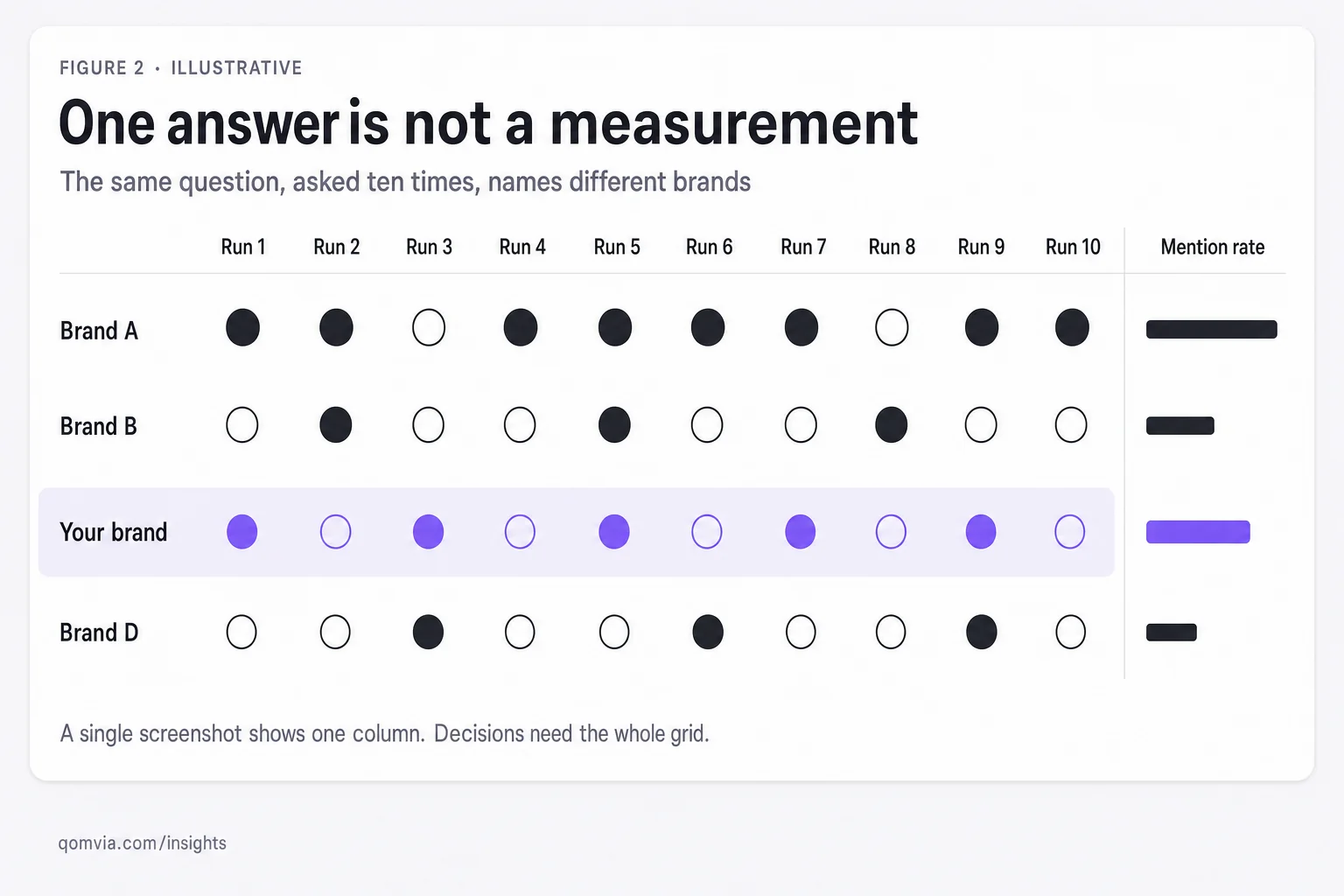
- Repeat samples and preserve the denominator. A screenshot can illustrate an answer, but it cannot establish a trend.
- Connect answer observations to site, analytics and business measures without claiming one caused the other.
What is AI search visibility?
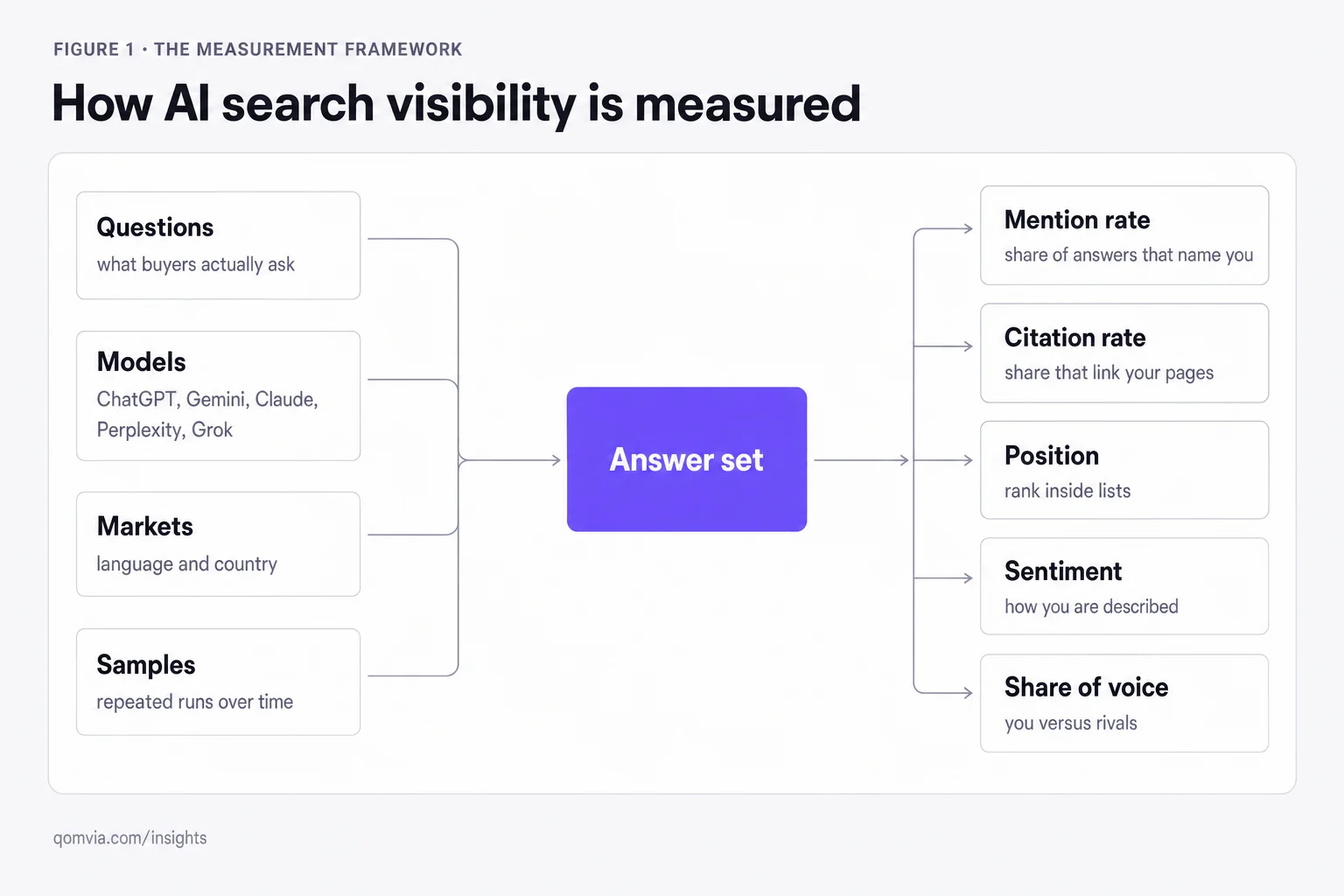
AI search visibility is the measured presence of a brand, product or source in answers returned by a specified AI search or assistant system for a defined set of questions. It is not one universal rank. The observation depends on the question, model, mode, market, language, time and whether the answer links to a source.
That operational definition prevents a common reporting error: combining unlike observations into one percentage. A mention from model memory, a citation after live search, a product card, and a referral visit are all different events. The framework here, the answer measurement contract, requires every metric to travel with its sampling conditions. It turns a collection of interesting answers into a test another analyst can repeat.
A 2025 Pew Research Center analysis offers a good example of why scope belongs beside a result. It analyzed browsing activity from 900 U.S. adults and found different click rates on Google search pages with and without an AI summary. Those are observations from that sample and period, not a forecast for every query, platform or brand. The Pew report shows why citation presence and referral behavior should not be collapsed.
How should you build a question set?
Start with real decisions. Ask sales, support and customer research teams for the questions buyers ask before they choose, renew, troubleshoot or compare. Include the words people use, not only the names the company prefers. Segment by intent: category exploration, shortlisting, comparison, product fit, price, implementation and post-purchase support. Each question should have a reason to exist and a content owner who can explain what a good answer would include.
Create a question record with its exact wording, intent, audience, market, language, expected evidence and relevant landing page. Keep one version stable for trend analysis. Put paraphrase variants in a separate robustness set rather than silently changing the baseline every month. Remove near-duplicates that ask the same thing with cosmetic word changes, but do not merge questions whose answers depend on different products, locations or buyer risks.
Avoid selecting only prompts where your brand already appears. That creates a success-shaped sample and overstates visibility. Include branded questions, non-branded category questions, competitor comparisons and questions where your company is a plausible but not inevitable option. Review the set with a subject matter expert and a customer-facing employee. They can catch wording that sounds like a marketing brief instead of something a person would type.
Define the unit of analysis
A run is one question asked to one model under one configuration. An answer is the response returned by that run. A citation is one linked source inside an answer. A mention is a brand occurrence in the answer text. A session or click is a downstream visit recorded by analytics. Keeping these units distinct stops a report from counting three citations in one answer as three successful answers or treating one visitor as proof that a model recommended you widely.
Which models, markets and modes should you sample?
Choose systems based on your audience and the business decision, not on the length of a vendor list. Name the exact product or model family, the experience mode and whether live search is available. ChatGPT Search and a non-search ChatGPT answer are different conditions. A model called Gemini can also be surfaced in different products or configurations. If the interface does not disclose a setting, record that limitation rather than inferring it from an answer's tone.
Market and language change the evidence. A question about local service should be tested from its target country, in a language used by customers there. Product availability, competitors, currency and source coverage may differ by geography. Record the region and language with every observation. If a provider uses personalization, account history or location, label the test environment and keep it consistent for repeated samples.
| Control | Record | Why it matters |
|---|---|---|
| Question | Exact text and intent | Small wording changes can retrieve different evidence |
| Model and mode | Product, model, search setting | Memory and live retrieval are not interchangeable |
| Market | Country, language, local context | Availability and sources can differ by market |
| Time | Timestamp and run window | Answers and indexes change |
| Sample | Run count and failures | Rates need an explicit denominator |
Do not imply that a measurement tool can observe a surface it does not query. Qomvia's AI monitor tracks ChatGPT, Gemini and Grok, with Claude and Perplexity available as add-ons. It does not measure Copilot, Bing answer experiences or Google AI Overviews. The Bing SEO guide and Google AI features guide explain how to use official documentation without blending distinct products.
Which AI visibility metrics should you report?
Mention rate is the share of eligible answers that name the brand under a declared matching rule. Decide whether alternate brand spellings, parent entities and product names count. Citation rate is the share of answers that link to a first-party URL, or the share with any relevant citation, depending on the question. Define which one you mean. The numerator and denominator should be visible in the report.
Position describes where a brand appears in a ranked list when the answer provides one. Do not invent a rank for prose answers. Sentiment should use a documented coding approach and preserve mixed or neutral cases. Share of voice compares eligible brand mentions across a fixed competitor set; define whether the denominator counts mentions, answers or list positions. These are useful views, but none is a substitute for the full answer.
Add source quality and answer usefulness when the decision requires more than presence. Is the citation the right page? Is it current? Does the answer preserve key conditions? Did it name a competitor for a reason supported by the source? A high citation rate can coexist with factual errors or a poor fit. Pair quantitative trendlines with periodic qualitative review, and keep examples that expose how the metric behaves.
How many samples are enough?
There is no magic sample count that turns a changing answer engine into a survey with fixed probabilities. A small repeat set is useful for operational monitoring; it is not necessarily sufficient to estimate a stable population rate. The right design depends on how costly an error would be, how much variation the team sees and how frequently answers can be collected. Begin with a pilot, measure run-to-run variation and size the next sample around the decision you need to make.
If answers are expensive or only a handful of questions matter, prioritize consistent conditions and honest uncertainty. Report the count, window and failed runs. Do not remove difficult questions after seeing poor results without showing the change. If the sample contains repeated versions of one question, explain how those variants are weighted. A stable time series usually teaches more than an oversized one-off sweep that cannot be repeated next month.
Use a holdout set when changing prompts or definitions. Keep one portion untouched to test whether a change generalizes beyond the examples used to design it. Where practical, compare a changed page with a similar page that did not change, while acknowledging that the two may not be equivalent. The purpose is not to claim perfect causal inference; it is to reduce the chance of telling a story from noise.
How often should brand teams report visibility?
Set the cadence to the speed of the business decision. A product launch may need short-interval checks for a defined question set. An evergreen category review may need a slower monthly or quarterly conversation. The data collection schedule should not create a false sense of precision by producing daily movement that teams cannot explain or act on. Pair an operational view for owners with a leadership view centered on trend, business relevance and confidence.
For each reporting window, summarize the question set, model coverage, run count, mention and citation rates, notable source changes, competitor shifts and any measurement caveats. Link a few full answers that illustrate the pattern. Distinguish what changed on the site from what changed in the provider or question. Treat a sudden jump as a prompt to investigate, not as proof that a recent content edit worked.
Connect visibility to referral traffic, assisted conversions and sales feedback where the data permits. These are related stages, not a single causal chain. Pew's 2025 analysis of Google users found that clicks differed when AI summaries appeared, while the study's sample and platform scope limit how far the finding can travel. Use your own analytics to understand your own audience. The GEO guide shows how to keep a benchmark result separate from a commercial outcome.
How do you make a measurement brief reproducible?
A measurement brief should let another analyst reconstruct what the team did without asking the original operator to remember it. Define the business question, the population of questions, the sample unit, eligible models and modes, market, language, date window, repetition rule and treatment of failed runs. Add a version number when a prompt set changes. Preserve retired prompts with a reason rather than deleting them from the historical record.
Write matching rules before collecting results. Decide whether a product name counts as a brand mention, whether a parent-company name qualifies, how aliases are treated and what qualifies as a first-party citation. For a comparison prompt, decide in advance whether a product must be recommended or merely named. If analysts make these decisions after seeing the outputs, subjective coding can drift toward a desired story.
Keep raw observations alongside aggregates. Store the question, timestamp, surface, response, citations, coded fields, reviewer and any notes about the configuration. Redact personal data from examples. Where a provider or tool's terms restrict storage, retain only the information allowed and document the limitation. A summary that cannot be traced to its underlying answer is difficult to audit when an executive asks why a score changed.
Make the sampling plan proportional to the decision. A brand team checking a handful of priority queries may need a consistent weekly pulse. A research team estimating a broader pattern may need more questions, repetitions and review. Do not borrow a sample size from another project without asking whether its population and error costs match yours. A small, well-described sample is more honest than a large collection with an unclear unit.
Document how the test is run. Note whether the operator is signed in, whether a search or browsing option is enabled, what location settings are visible and whether the session begins from a clean state. Personalization may not be fully observable, so do not claim to have removed it unless the method supports that claim. These notes help explain why two analysts may see different responses even when they type the same words.
Separate collection, coding and interpretation
Collection captures what the interface returned. Coding applies declared labels such as mention, citation, position or sentiment. Interpretation connects the pattern to a business decision. Keep those stages visible. For example, “three of 20 answers cited the pricing page” is an observation. “The pricing page is difficult to retrieve” is a hypothesis. “Rewrite the pricing page” is an intervention. The data can support the first statement while leaving the next two open for investigation.
Review ambiguous cases with a second person. Define how to handle a brand that appears only in a source list, an answer that links to an affiliate page, or a competitor mentioned as a counterexample. Track disagreement and revise the codebook if the same ambiguity recurs. The purpose is not to make interpretation mechanical; it is to reveal where judgment entered the process.
Keep a distinction between source validity and brand value. A cited URL may be relevant but outdated; it may also be current but not independent. A brand mention can be neutral, negative or conditional. Review a sample of coded answers and report disagreements rather than converting every mention into a positive outcome. When sentiment is part of the score, give reviewers examples of the boundary between a factual comparison and an endorsement.
Treat provider changes as part of the measurement environment. If the model label, web-search setting or response format changes, record the transition and avoid presenting the resulting trend as a clean apples-to-apples comparison. Continue a stable core set if possible, and add an explicitly versioned test when the business needs to learn about a new surface. A break in the time series is preferable to hiding a change that affects interpretation.
Finally, tie the report to decisions. An executive summary should say what changed, what evidence supports that reading, what remains uncertain and what the team will do next. Avoid a single composite score that mixes mentions, citations, sentiment and visits unless the weighting has a clear use. One well-selected answer can explain a pattern, but it should be labeled as an example rather than presented as a representative sample.
Before publishing a report externally, review whether quoted answers contain personal information, confidential details or third-party material that should not be reproduced. Preserve a private audit trail and share only the evidence that is appropriate for the audience. A measurement practice earns trust by being repeatable and careful with the data it collects, not by publishing every raw response.
The GEO guide explains how to test a content hypothesis without attributing every change to one rewrite. For a practical publisher checklist, use the 40 checks for AI search to keep readiness evidence separate from sampled answer outcomes.
Version the codebook alongside the prompt set. If the definition of a citation changes from any source URL to a first-party URL, earlier results should not silently inherit the new rule. Either recode the historic sample where feasible or mark a break and explain why the older measure differs. Keep an example for each category so new reviewers apply the same rule.
A good brief also states what the team will not infer. A mention does not prove recommendation, a citation does not prove endorsement, and a referral does not reveal the full path that influenced a purchase. Write those boundaries before presenting the chart. The caveat belongs beside the metric, not only in a methodology appendix that most readers will skip.
When the sample is too small to support a rate, show counts and examples instead. If a result is zero, say whether the question was run at all and whether the interface returned a usable answer. If a run failed, do not quietly remove it unless the exclusion rule was declared in advance. This makes a low-volume measure actionable without disguising uncertainty as precision.
Sources and further reading
Questions
- How do you measure AI search visibility?
- Define customer questions, models, modes, markets and a sampling window. Record mentions, citations, position and sentiment with explicit denominators, then repeat the same conditions and inspect full answers.
- What is the difference between AI mention rate and citation rate?
- Mention rate measures how often an answer names a brand. Citation rate measures how often it links a source, and should specify whether the source must be on the brand's own domain.
- How many questions should an AI visibility tracker use?
- Use enough questions to represent the decisions and intents you care about, and choose sample volume based on observed variation and the cost of a wrong decision. There is no universal minimum that fits every program.
- Why does the same AI search prompt return different answers?
- Answers can vary as models, search indexes, sources, context and platform settings change. A repeatable measurement records those conditions and treats an individual response as one observation.
- Can AI visibility tools measure Google AI Overviews and Copilot?
- Capabilities depend on the tool and its data access. Qomvia's AI monitor tracks ChatGPT, Gemini and Grok, with Claude and Perplexity add-ons; it does not measure Google AI Overviews, Copilot or Bing answer experiences.
- Does higher AI share of voice mean more sales?
- Not necessarily. Share of voice measures answer presence under a defined method. Compare it with referral, conversion and sales data, but do not assume that a change in one caused a change in another.
Score your own site against the rubric this is written from.
Is your site agent-ready?
Free score against the same rubric, in under a minute.
Sign up free to keep the fixes and track the score.
AI monitor
PreviewHow often each model names your site across 11 tracked questions.