Published by Qomvia, , 13 min read
Key takeaways
- GEO is a research-backed label for optimizing visibility in generative engine responses, not a guarantee of a fixed position.
- The 2024 paper reported up to 40% visibility improvement in its benchmark. That is a study result, not a forecast for a brand or a current platform.
- The strongest GEO program starts with technical eligibility and source quality, then tests how real customer questions are answered.
- On-site clarity and off-site corroboration solve different problems. Treat them as connected workstreams, not substitutes.
- A measurement plan must preserve the question, engine, market, date and citation evidence. One screenshot is an example, not a trend.
What is generative engine optimization?
Generative engine optimization (GEO) is the practice of improving how useful, attributable information about a brand or topic appears in AI-generated answers. The term comes from a 2024 research paper that proposed a framework for measuring visibility in generative engine responses. GEO is an objective and testing method, not a universal ranking factor.
The original research treats an answer as a synthesis of information from retrieved sources and studies ways to change a source's visibility. Its contribution is useful because it makes the outcome measurable and encourages controlled comparison. It does not reveal the private algorithms of every commercial model, establish that the tested techniques work for all topics, or prove that a visibility increase produces revenue. Those limits are not a reason to ignore the paper. They are a reason to use it precisely.
This distinction separates GEO from label inflation. Search engine optimization, answer engine optimization and GEO overlap in crawlable pages, relevant information and clear evidence. They differ in which outcome is measured. The AEO, GEO and SEO taxonomy is a useful operating map; the agent readiness pillar connects answer visibility with the technical conditions that make pages usable.
How do generative engines retrieve and synthesize sources?
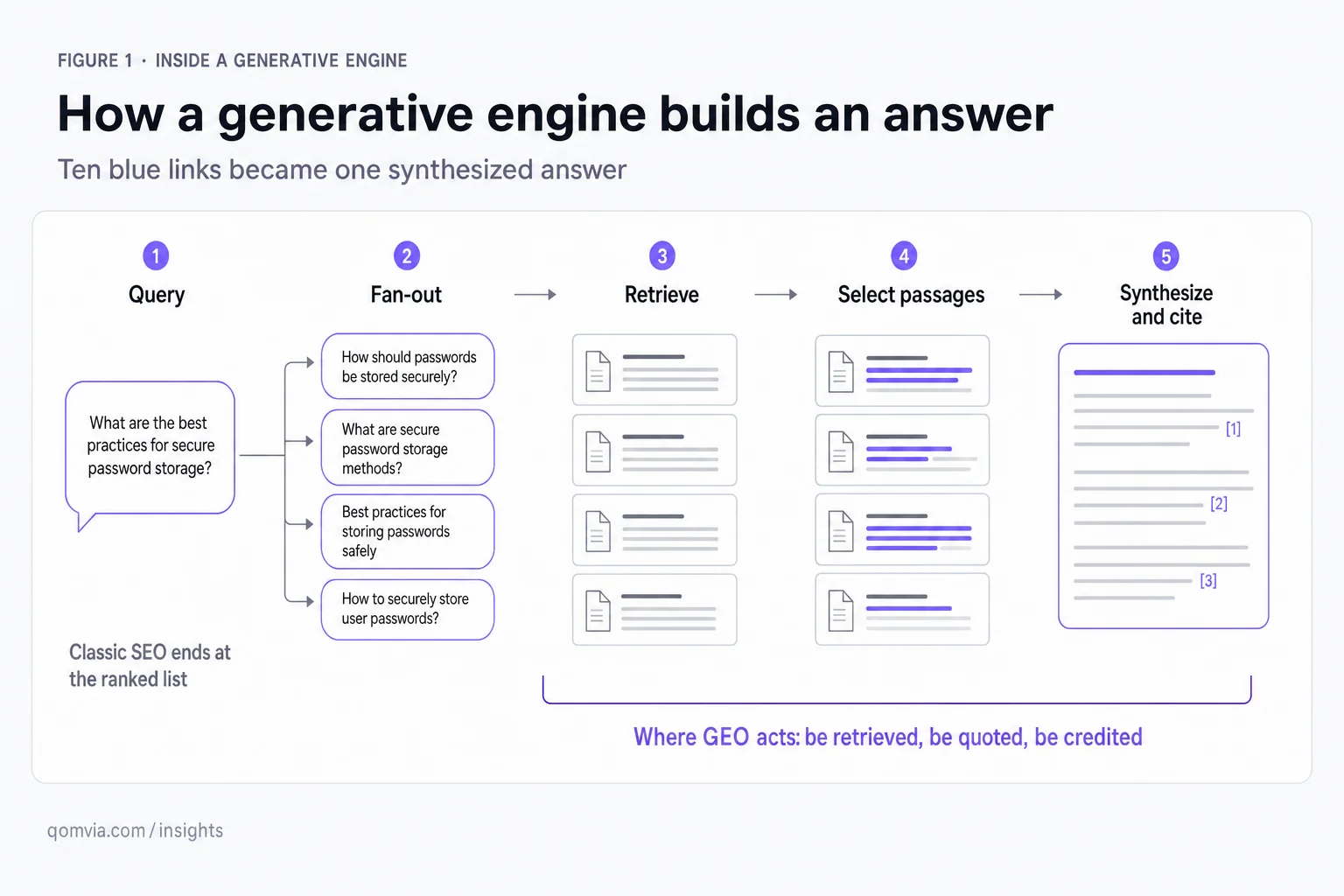
A grounded answer system may begin with a user question, form one or more searches, retrieve candidate pages, fetch or parse selected sources, and compose a response with citations. The exact pipeline varies across vendors and product modes. Some answers rely more heavily on model parameters; some trigger live search; some combine private indexes, first-party data, partner feeds or a tool call. “The model” is not a single stable channel, so a GEO plan should avoid writing as if every answer is produced by the same retrieval architecture.
A source can disappear from the answer before language quality matters. The URL may not be indexed, a crawler may receive a challenge, the page may return a blank shell, or the passage may be hard to extract. If retrieval succeeds, attribution still depends on the system finding the passage relevant and trustworthy enough for the answer. A citation means the source was selected for that response. A brand mention without a link may come from different evidence and has a different measurement meaning.
Google's published guidance is especially instructive about the boundary between optimization and eligibility. It says ordinary Search fundamentals remain relevant to AI Overviews and AI Mode and that a supporting page must be indexed and snippet-eligible. That is a statement about Google's products only. OpenAI likewise documents distinct bot functions for its own search, training and user-triggered visits. Read OpenAI's bot documentation and Google's AI feature guidance directly before making platform-specific claims.
Which GEO levers are on-site and off-site?
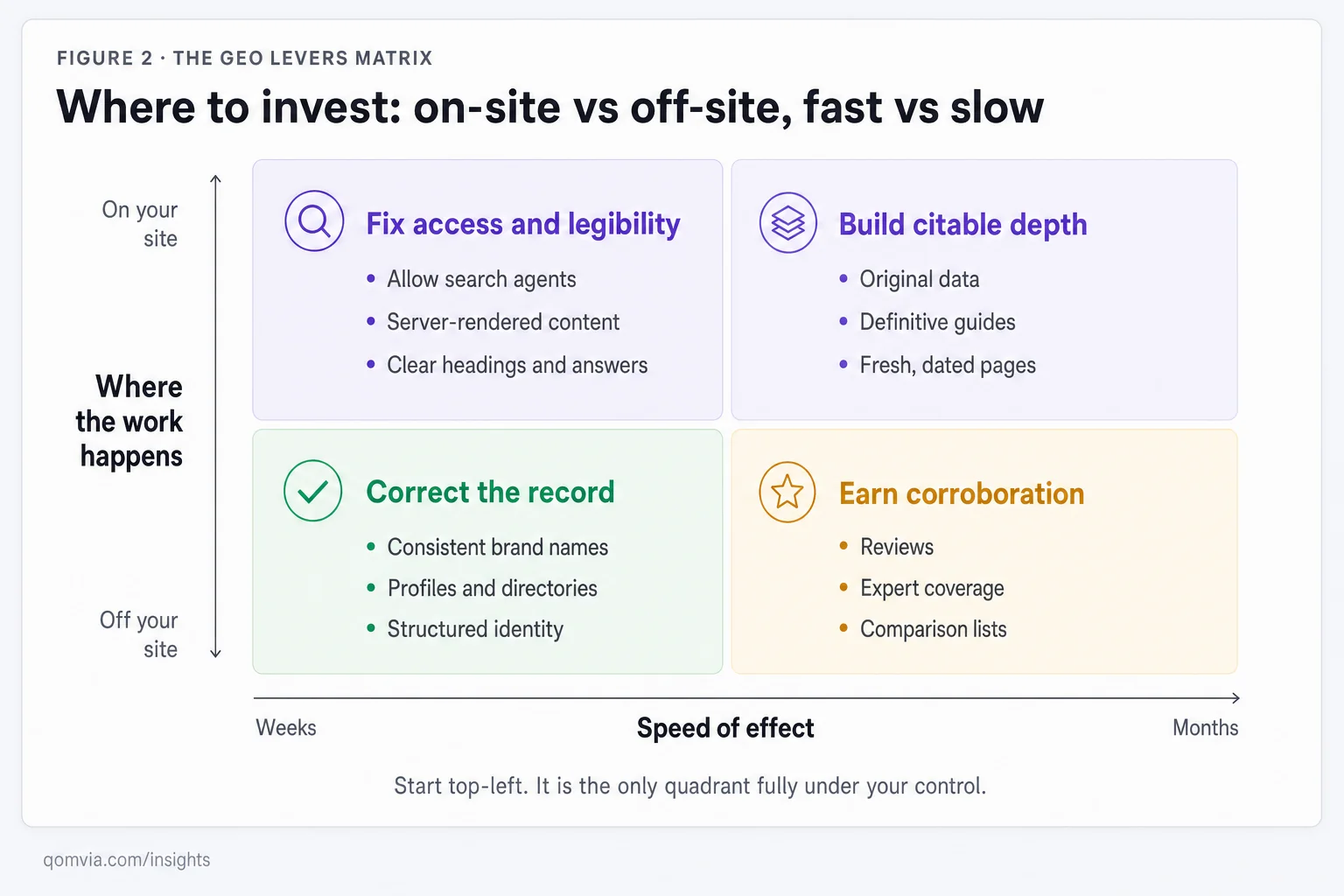
On-site work improves what an engine can retrieve from your own domain. It includes making important pages crawlable, returning useful server HTML, using descriptive titles and headings, writing passages that answer specific questions, keeping factual details current, connecting related pages and using structured data that matches what a person can see. A product page should not make the answer engine infer the price from a script; an expert article should not bury its conclusion beneath generic scene-setting.
Off-site work improves how your organization is corroborated elsewhere. That might involve accurate directory listings, independent reviews, expert references, public documentation, news coverage or a profile page with a consistent entity name. The task is not to manufacture mentions. It is to make the evidence coherent and verifiable. If an assistant repeatedly recommends a competitor, the diagnosis may be that a rival has clearer third-party proof or a better-known category association, not that your own site needs another round of meta tag changes.
| Lever | On-site | Off-site |
|---|---|---|
| Entity identity | Consistent name, About page, Organization data | Profiles, directories and independent references |
| Topic evidence | Original guidance, comparisons, methods and sources | Expert citations and useful coverage |
| Freshness | Accurate dates, prices, stock and revision notes | Current profiles and third-party records |
| Discovery | Links, sitemap, feeds, canonical URLs | Links and references that lead to the right page |
| Measurement | Server logs and page-level diagnostics | Referral analysis and sampled answer citations |
The boundary is not always tidy. A clear first-party comparison page can give a journalist or reviewer something precise to evaluate. A reliable external reference can help a model connect your organization to a topic, but it cannot repair a page that blocks retrieval. Keep separate owners for technical access, editorial quality and external reputation, then share one measurement brief so that teams do not optimize contradictory descriptions.
What does the GEO research show, and what does it not show?
Aggarwal and co-authors introduced GEO as a framework and reported that their methods could improve visibility by up to 40% in the generative engine responses they evaluated. The paper also reports that effectiveness varies across domains. The upper bound is often repeated without the benchmark context, which turns a bounded experiment into a misleading sales claim. In this guide, the figure is attributed to the paper and never treated as a likely result for an individual company.
A benchmark can establish that a tactic moved a defined metric in a defined test set. It cannot by itself tell a practitioner how much a live answer will change after a platform update, whether an intervention caused traffic, or whether a quoted passage will become a purchase. The measurement unit matters: word choice, citation position, answer inclusion, referral sessions and conversion are different outcomes. Preserve the paper's own metric when discussing its result; define a separate outcome when measuring your program.
The right use of the research is hypothesis generation. If a passage becomes clearer after adding definitions or evidence, test whether it appears more often in a fixed question set. If it does, repeat the sample, inspect citation URLs, and check the page has not simply moved because another source changed. A short experiment with a baseline and control page is more useful than claiming to have discovered an algorithm. The original GEO paper is the primary source for its terminology and benchmark result.
How do you build a GEO strategy?
Start with the questions, not the acronym. Interview sales, support and customer success. Collect the wording customers use when comparing providers, choosing a product, checking a risk or validating a claim. Group variants by intent and decision stage. Remove vague queries that no one would use to make a real decision. A useful set includes both high-level category questions and precise follow-ups where the answer depends on your evidence, geography, product or policy.
Map every question to a source page and a proof requirement. One topic hub may establish the terminology; a pricing page establishes terms; a technical page supports a capability; an independent case study supports a result. Where a page has no relevant evidence, do not optimize the wrong page just because it ranks. Create or improve the source that can answer the question honestly, then connect it to the rest of the site with clear internal links.
Choose a few changes with a plausible causal link to the failure. A missing page calls for a discovery fix. A blank initial response calls for rendering work. A confusing brand entity calls for identity cleanup. An answer with strong citations but weak recommendations may need better comparison evidence or a clearer category fit. Track each change in a log: hypothesis, owner, URL, date shipped, expected signal and the conditions that would falsify the idea.
Organize the work as a 90-day program with three distinct horizons. In the first month, establish the question set, baseline and crawlability of priority pages. In the second, ship focused improvements to the pages most often needed to answer those questions. In the third, repeat the same sampling protocol, inspect citations and decide which hypotheses survive. This is an operating cadence, not a promised time to rank. The AI search measurement framework details the sampling decisions that make comparisons defensible.
Make each GEO experiment falsifiable
Write the experiment as a statement that could be wrong: “For these five implementation questions, the updated guide will make the setup conditions easier to extract, and we will look for more accurate citations to this URL in the next sample.” Avoid a hypothesis like “This wording will rank in AI.” The first names a question set, a content change and an observable outcome. The second attributes a result to a hidden platform mechanism that the team may not be able to see.
Choose a comparison unit before shipping. It might be repeated runs of the same prompts, a matched group of pages with similar intent, or a small set of questions mapped to one page. Do not combine a refreshed model, a rewritten prompt and a redesigned page into one experiment if you want to understand which change mattered. Most real programs cannot isolate every factor, but careful sequencing can rule out some easy explanations.
Protect a record of the source, not just the answer. Save the exact cited URL and the passage that seems relevant. A page may appear in an answer while a different URL receives the citation. A provider may cite a directory listing rather than the official product page. These are different operational problems. For each one, ask whether the evidence is correct, current and appropriate for the question before deciding that a citation is a win.
Review risks before expanding content. A company may not have a defensible answer to every customer question, or one answer may depend on region, contract or product version. Editorial owners should be able to decline a page brief when the evidence is missing. A candid statement that a product does not support a certain integration is more valuable than generic copy suggesting compatibility and sending buyers to a dead end.
Use the first month to agree on definitions and collect a baseline, not to overreact to every fluctuation. During the second month, assign technical, editorial and off-site changes to separate owners when possible. In the third month, examine both the sampled response and the page itself. Did the answer become more accurate? Did the citation point to the right section? Did the page remain useful to a person? If the answer is no, revise the hypothesis before expanding the program.
A useful GEO roadmap stays resilient when the interface changes. Keep the underlying customer question, source page, proof requirement and technical status even if a particular chatbot renames a feature. Maintain separate notes for an answer seen from model memory and a response with visible web sources. The work remains valuable when a specific product surface changes because the content and evidence still serve searchers, sales conversations and customer support.
How should a team measure GEO?
For each tracked question, record whether the brand is mentioned, whether a page is cited, the cited URL, the brand's position in a recommendation list, the answer's sentiment and the competitors named. Keep model and mode distinct, since live search and non-search answers are not interchangeable. Define the market and language. Use the same prompt wording for a time-series comparison, but separately test paraphrases to understand whether the result depends on one exact string.
Report rates with denominators. “Mentioned in four answers” is incomplete without saying four of how many eligible samples. A share-of-voice comparison must use the same question universe and sample window for each brand. Do not infer a causal lift from a single before-and-after screenshot: answer generation varies, and external coverage, a product launch or a retrieval change may have happened at the same time. If results are too sparse, report the uncertainty instead of smoothing it into a story.
Qomvia's AI monitor asks tracked questions across ChatGPT, Gemini and Grok, with Claude and Perplexity as add-ons, and reports mentions, citations, position, sentiment and rivals. The methodology page describes the public readiness score separately. Readiness tells a team where a site may fail technically; sampled answers tell it what a configured model returned. The distinction keeps a score from being mistaken for a visibility outcome.
Tie each measure to the user question behind it. If buyers need a clear explanation of a category, inspect whether the answer is accurate and whether the cited definition is authoritative. If they are comparing vendors, capture which options are named, the criteria used and whether the source page supports those statements. If they need setup guidance, check whether the answer links to a current procedure rather than a broad marketing page.
Keep content quality and distribution distinct in the diagnosis. A page can answer well but remain hard to discover. A widely cited source can still contain outdated details. A visible brand name can be detached from the relevant first-party URL. Record the failure at the level where it occurs, then route the work to the owner who can address it.
Review the program for unintended incentives. A team rewarded only for mentions may chase broad exposure instead of useful citations. A team rewarded only for citation count may publish pages that answer no meaningful buyer question. Include a qualitative check for accuracy, relevance and audience value so a metric cannot improve while the experience deteriorates.
A useful GEO report shows the question universe and the answer-level evidence behind every aggregate. Include the sampling window, eligible platforms, modes, market, language, number of runs and exact rules for counting a mention or citation. If a platform changes its interface during the reporting period, note the date and consider splitting the comparison. This keeps the denominator visible and makes the limitations useful to the decision maker.
Report the content change alongside the measured result. Identify which page changed, what evidence was added or clarified, and whether the sample used the same question wording. A rise in citations may reflect a new source page, an external review or a change in retrieval, not only the edit under review. State the strongest interpretation the evidence supports and list plausible alternatives instead of hiding them in a footnote.
For a small program, a concise review can be more useful than a dashboard full of unstable metrics. Choose one or two outcomes tied to the business question, then add a few diagnostic fields to explain them. A team investigating citations may need the cited URL and passage; a team investigating product fit may need the alternatives and conditions named in the answer. Keep the full transcript available for review, while presenting only the summary that the reader needs.
Sources and further reading
Questions
- What is generative engine optimization?
- GEO is the practice of improving the chance that useful, attributable information appears in an AI-generated answer. The term was introduced in a research paper as a visibility optimization framework, not as a guaranteed ranking system.
- What does the GEO paper say about visibility uplift?
- Aggarwal and co-authors reported up to 40% visibility improvement in the responses they evaluated and said effectiveness varied by domain. The result is tied to their benchmark and should not be presented as a forecast for a particular website.
- Is GEO different from SEO?
- GEO emphasizes inclusion and attribution in generated answers, while SEO traditionally focuses on discovery and performance in search results. They share crawlability, useful content and information architecture, so GEO does not make SEO fundamentals obsolete.
- How long does a GEO strategy take?
- There is no universal time to an answer change. A 90-day program can establish a baseline, ship a focused set of improvements and repeat the measurement, but platforms, query sets and retrieval timing differ.
- Does adding statistics or quotations guarantee AI citations?
- No. The paper evaluated content strategies in a defined benchmark, but no individual edit guarantees citation by a live system. Use citations when they improve accuracy and attribution, then test the actual questions that matter.
- How can I measure GEO performance?
- Sample a stable set of customer questions across specified models, markets and modes. Record mentions, citations, cited URLs, position and sentiment with denominators, then compare repeated samples rather than isolated answers.
Score your own site against the rubric this is written from.
Is your site agent-ready?
Free score against the same rubric, in under a minute.
Sign up free to keep the fixes and track the score.
AI monitor
PreviewHow often each model names your site across 11 tracked questions.