Published by Qomvia, , 13 min read
Key takeaways
- SEO improves a site's eligibility and usefulness in search results. It remains the foundation for discovery, crawlability and organic demand.
- AEO focuses on concise, trustworthy answers in answer-oriented interfaces. The term is used inconsistently, so define the target surface.
- GEO focuses on visibility within generative responses, including when a system cites or names a source. It is an extension of discovery work, not a replacement for SEO.
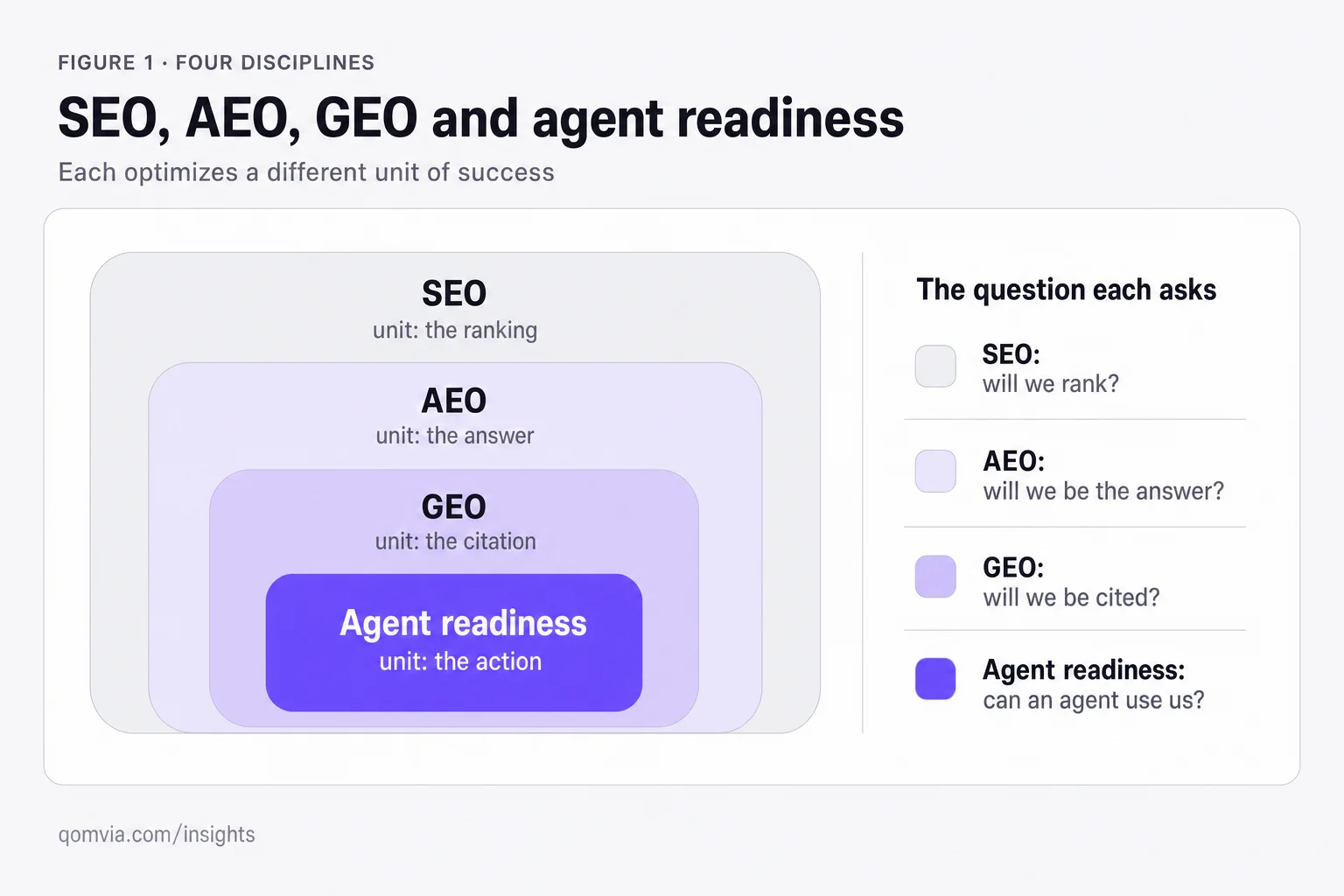
- Agent readiness adds the ability to interpret identity, data and permitted actions, not just retrieve a passage.
- Budget for shared foundations first, then assign specialist work to a measurable outcome and channel.
What is the difference between AEO, GEO and SEO?
SEO improves page discovery and usefulness in search. AEO organizes information for answer-focused systems to identify and present clearly. GEO improves the chance that a brand or source appears in generated responses. The labels overlap, so each needs a defined platform, outcome and measurement method.
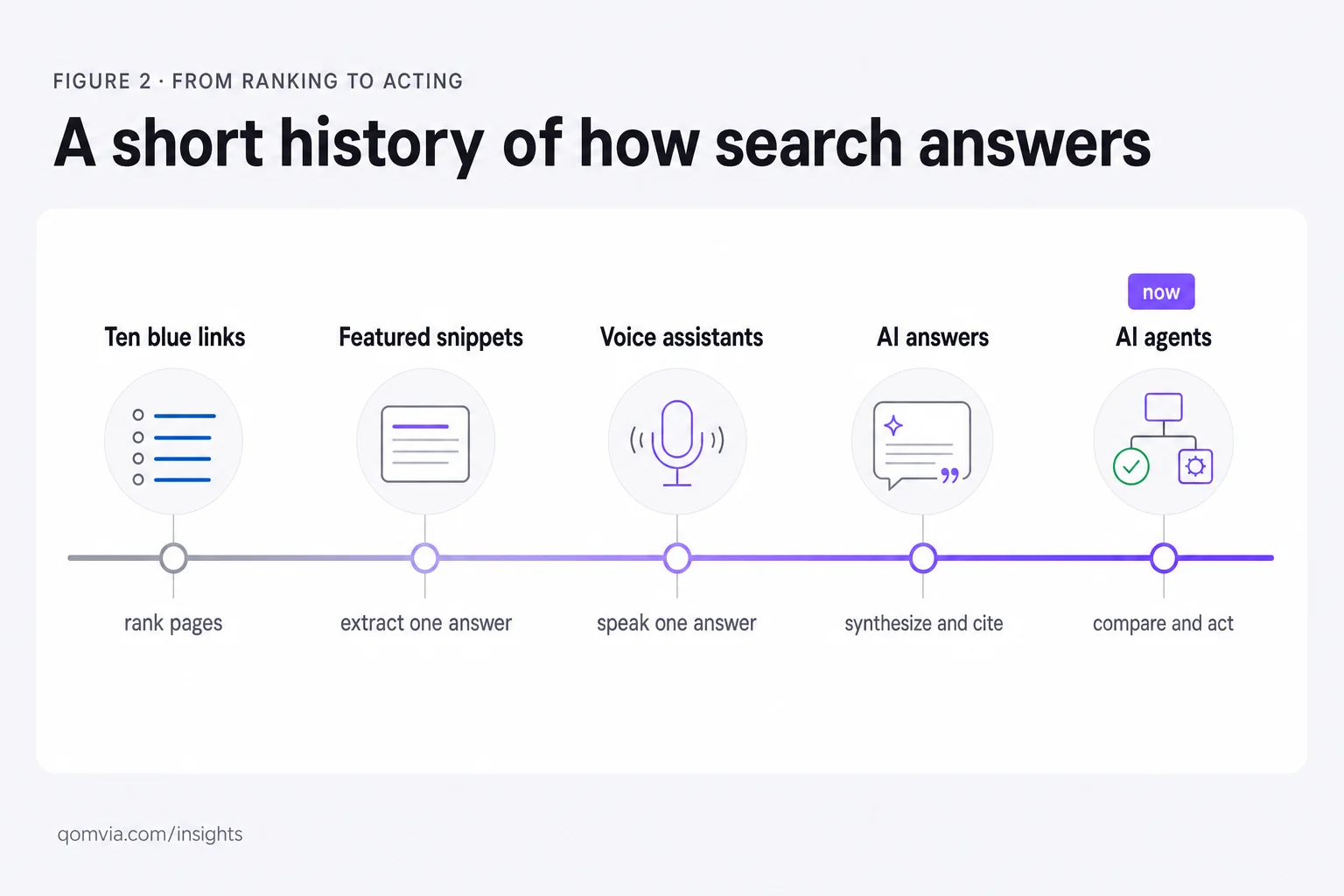
The terminology has multiplied faster than the systems it describes. A team can spend a quarter debating labels while the product pages remain uncrawlable, the company identity is inconsistent and the source material is thin. This guide uses the discovery-to-action ladder to align the work: discover the page, extract an answer, cite the source and, when relevant, complete a safe task. Search, answers and generative responses occupy overlapping rungs, not isolated disciplines.
A useful taxonomy begins with the user and interface. A person searching a category page, a person asking a direct factual question, a person asking a chatbot to compare options and an agent placing an order need different evidence. A strategy that says only “optimize for AI” has not identified the question, user, interface or success measure.
What does SEO optimize?
SEO is the practice of making pages eligible, understandable and worthwhile in search results. It combines technical access, information architecture, query-focused content, authority signals, useful page experience and ongoing measurement. The results page may contain traditional links, snippets, maps, products or AI features. SEO work still matters because search systems need to discover URLs, understand what they contain and choose whether to serve them.
The unit of work is often a query-page relationship: which page best serves a search intent, and can the system find it? Teams improve crawl paths, titles, headings, internal links, canonical choices, page speed and evidence. They also identify cannibalization and thin pages. Search Console impressions and clicks, rankings and conversions can answer different questions, so no one metric is the discipline itself.
Google's published AI-feature guidance is explicit that the same foundational SEO practices apply to AI Overviews and AI Mode, with no additional technical requirements. That is a useful counterweight to the idea that every platform needs a secret new markup. Read Google's AI features guidance alongside ordinary technical SEO documentation.
SEO is not just a ranking checklist
A rank without a useful landing page is a weak commercial result. A fast site with vague answers may attract a visit and still fail the person. A strong SEO program aligns page intent, content quality and business outcomes, then revisits the assumptions when the audience or product changes. The same standard applies to the newer acronyms.
What does AEO optimize?
AEO emphasizes the answer as the unit of usefulness: can a system recognize a direct response, retain its conditions and present it in an answer-oriented interface? In practice, this often means clear question-led headings, concise definitions, explicit steps, comparison structures and well-attributed facts. It may target voice assistants, featured answers, support search, knowledge panels or a chat interface, so a brief should name which.
The term has no single universally enforced platform definition. One consultancy may use AEO for featured snippets; another may mean answer engine results broadly. For a workable plan, write an operational definition such as: “We improve the extraction and citation of support answers in the named products for these customer questions.” A narrow definition makes ownership and measurement possible. A vague acronym gives a team little to test.
Answer clarity starts with editorial discipline. Put the answer close to the question, distinguish rules from examples, state units and dates, and explain exceptions. A FAQ is valuable when the questions reflect real uncertainty; it is not a container to repeat every keyword. Structured data can describe visible page content, but it cannot turn an unsupported claim into evidence or guarantee an answer feature.
What does GEO optimize?
GEO, or generative engine optimization, focuses on how a brand, source or passage appears in generated responses. That may mean being mentioned, cited, compared or represented accurately. The term entered academic discussion with the paper “GEO: Generative Engine Optimization,” which framed the problem as improving source visibility in generative engine responses and evaluated several content interventions in its experimental setting.
The paper should be read as research, not as an all-purpose field guarantee. Its experimental benchmark and platform setup do not prove that one writing trick increases citations everywhere. A GEO strategy therefore needs to pair on-site work, such as clear source pages and technical access, with third-party corroboration and repeated platform-specific observation. See the GEO guide for a closer reading of what that research does and does not establish.
A generated response may draw on live retrieval, previously learned information or a combination, depending on the product and question. Citation is not the same as a brand mention, and neither guarantees a visit. Define the outcome first: mention rate, citation rate, share of voice, qualified referrals or accurate product representation. Keep the exact question set and model configuration beside any reported number.
Where does agent readiness fit?
Agent readiness concerns whether a system can find, fetch, interpret, identify and safely use a site's information or capabilities. It overlaps with SEO at discovery and access, with AEO at extraction and with GEO at citation. It extends beyond all three when the system needs structured product data, authentication, consent or a supported protocol to take action.
This distinction matters for product teams. A page can rank and answer a question but expose no safe way to check availability. A protocol endpoint can be technically reachable but poorly documented or inconsistent with the visible product page. Agent readiness connects the page, the data and the allowed action while keeping human control and transaction safety in scope.
The AI agent readiness guide gives the technical model, and agentic commerce applies it to product discovery and shopping. Both rely on SEO fundamentals but require their own data and transaction checks.
How should teams compare the disciplines?
| Discipline | Primary unit | Typical outcome | Useful measure |
|---|---|---|---|
| SEO | Query and landing page | Eligible, useful search result | Impressions, clicks, conversions |
| AEO | Question and answer | Clear answer in a named interface | Answer accuracy, extraction, citation |
| GEO | Brand or source in generated response | Accurate mention or citation | Mention and citation rate by sample |
| Agent readiness | Information or action path | Reliable interpretation or permitted action | Access, data quality, protocol checks |
The unit column keeps budgets honest. SEO often requires content operations, technical fixes and search measurement. AEO benefits from subject matter expertise, answer design and knowledge management. GEO adds platform observation, entity consistency, source relationships and digital PR. Agent readiness draws on engineering, data, security, commerce and legal owners. Some tasks belong to more than one group; shared foundations should have one accountable owner.
Translate the outcome into a work request before assigning a discipline. “Increase ChatGPT visibility” is too broad. “For the ten category questions our sales team hears most, identify whether our product pages are accessible and whether the sampled answers cite relevant sources” can be split into technical review, content review and observation. That scope may involve SEO, AEO and GEO work at the same time, but each owner has a distinct deliverable.
One comparison can require all three perspectives. An SEO analyst can ensure the comparison page is indexable and connected from product navigation. An answer-focused editor can make the evaluation criteria clear. A GEO researcher can sample whether the named platforms use the page or a third-party source. These are complementary tasks, not three competing plans for the same paragraph.
Metrics should match the discipline without becoming silos. Search impressions can expose demand and eligibility. Answer accuracy can expose whether a system preserves the conditions in the source. Citation coverage can expose source selection under a stable sample. Referral sessions and conversions can expose some downstream behavior. A leadership report can connect these indicators while making it clear that they have different denominators and do not establish a single causal path.
Avoid double-counting the same foundation
A crawlability repair should have one implementation owner even if it supports SEO, AEO and GEO. A canonical fix should not appear as three separate completed projects just because three teams benefit from it. Shared work belongs in a common backlog, with channel teams contributing requirements and a central owner maintaining the evidence. This also prevents a department from claiming a visibility improvement that came from a change it did not own.
A useful quarterly review can start with one customer decision, list the pages and public evidence needed to answer it, then mark each item as accessible, current, attributable and useful. The review team can decide whether the next investment belongs in a content gap, platform engineering, external research or product data. This sequence reduces pressure to rename routine marketing activity as an AI strategy and keeps budgets tied to a failure the team can describe.
Do not buy an “AI visibility” dashboard before defining what it observes. Ask which models, regions, languages and modes are sampled, how repeated runs are handled, whether citations are verified and what denominator underlies the rate. Qomvia's AI monitor tracks ChatGPT, Gemini and Grok, with Claude and Perplexity as add-ons; it does not measure Google AI Overviews, Copilot or Bing. The AI visibility measurement framework provides a sample contract.
How should you staff and budget the work?
Start with a shared discovery foundation: clean architecture, accessible content, useful pages, consistent entities and reliable analytics. Then prioritize one audience question or task that matters commercially. If the failure is a blocked page, assign it to engineering. If the answer is missing or out of date, assign an editorial and product owner. If the answer is misattributed because external sources disagree, coordinate communications and off-site work.
A quarterly plan can reserve capacity for foundation work, one high-value answer cluster and one channel-specific experiment. For each initiative, write a hypothesis, baseline, owner, review date and stop condition. For example: “We will make the implementation requirements page explicit and measure whether it is cited for a stable set of setup questions.” This is testable. “We will do GEO” is not.
Use the 40-point checklist to triage technical and content risks. Consult Qomvia's methodology page for its readiness approach and assess product coverage before planning a monitor rollout. The right sequence is diagnosis, scoped work, repeated observation and learning, not a switch from SEO to a new label.
Review staffing with the same discipline. A small team might have one technical owner, one editor with access to product expertise and one person responsible for measurement. Larger organizations can add communications, commerce operations, legal review and regional owners. The titles matter less than the ability to approve a change, verify the result and maintain the evidence after a launch.
Do not assign an outcome to a team that cannot control the relevant input. Content editors cannot unblock a CDN. Public relations cannot promise that a model will cite a press release. Engineering cannot make an inaccurate product claim defensible. When the observed failure crosses boundaries, write down the handoff and agree on the evidence that indicates the fix worked.
A disciplined plan also sets a stopping rule. If a channel does not serve the audience, if the product is not a fit, or if an experiment produces no reliable signal after a reasonable sample, the team can stop investing there. Strategy is not a mandate to be present in every interface. It is a process for putting the right evidence where a customer can find it.
Sources and further reading
Questions
- What is the difference between AEO, GEO and SEO?
- SEO improves search discovery and usefulness, AEO focuses on clear answers in answer-oriented interfaces, and GEO focuses on brand or source visibility in generated responses. Their foundations overlap, so define each by its target and outcome.
- Is GEO replacing SEO?
- No. Generative systems still need useful, discoverable sources, and Google's published AI search guidance points site owners to the same foundational SEO practices. GEO adds measurement and source-level questions rather than removing SEO.
- What does AEO stand for in marketing?
- AEO usually means answer engine optimization, but practitioners use the term for different answer-oriented products. A useful plan names the platform, question set and outcome instead of relying on the acronym alone.
- Does structured data improve AI citations?
- Structured data can clarify what visible page content describes, but it is not a guarantee of inclusion or citation. Keep it accurate and consistent with the page, then measure citations separately.
- How should a company budget for GEO?
- Begin with crawlability, source quality and a defined set of customer questions. Fund specialized monitoring or off-site work only when a baseline and an accountable decision owner exist.
- Where does AI agent readiness fit with SEO?
- Readiness shares SEO's discovery and access foundations, then extends to identity, structured data and safe action paths. It addresses what happens after an agent has found a page.
Score your own site against the rubric this is written from.
Is your site agent-ready?
Free score against the same rubric, in under a minute.
Sign up free to keep the fixes and track the score.
AI monitor
PreviewHow often each model names your site across 11 tracked questions.