Published by Qomvia, , 13 min read
Key takeaways
- One answer is a clue, not a verdict. Retest the same question and note whether live search and citations appear.
- A rival may have clearer entity signals, stronger third-party corroboration, better-fit evidence or more accessible product information.
- A mention is not a citation, and neither guarantees that a recommendation is accurate or commercially useful.
- Repair the evidence gap that the answer exposes. Do not manufacture reviews, listings or comparison claims.
- Use a 60-day plan to diagnose, clarify first-party evidence, improve legitimate corroboration and retest a stable question set.
Why does ChatGPT recommend my competitor?
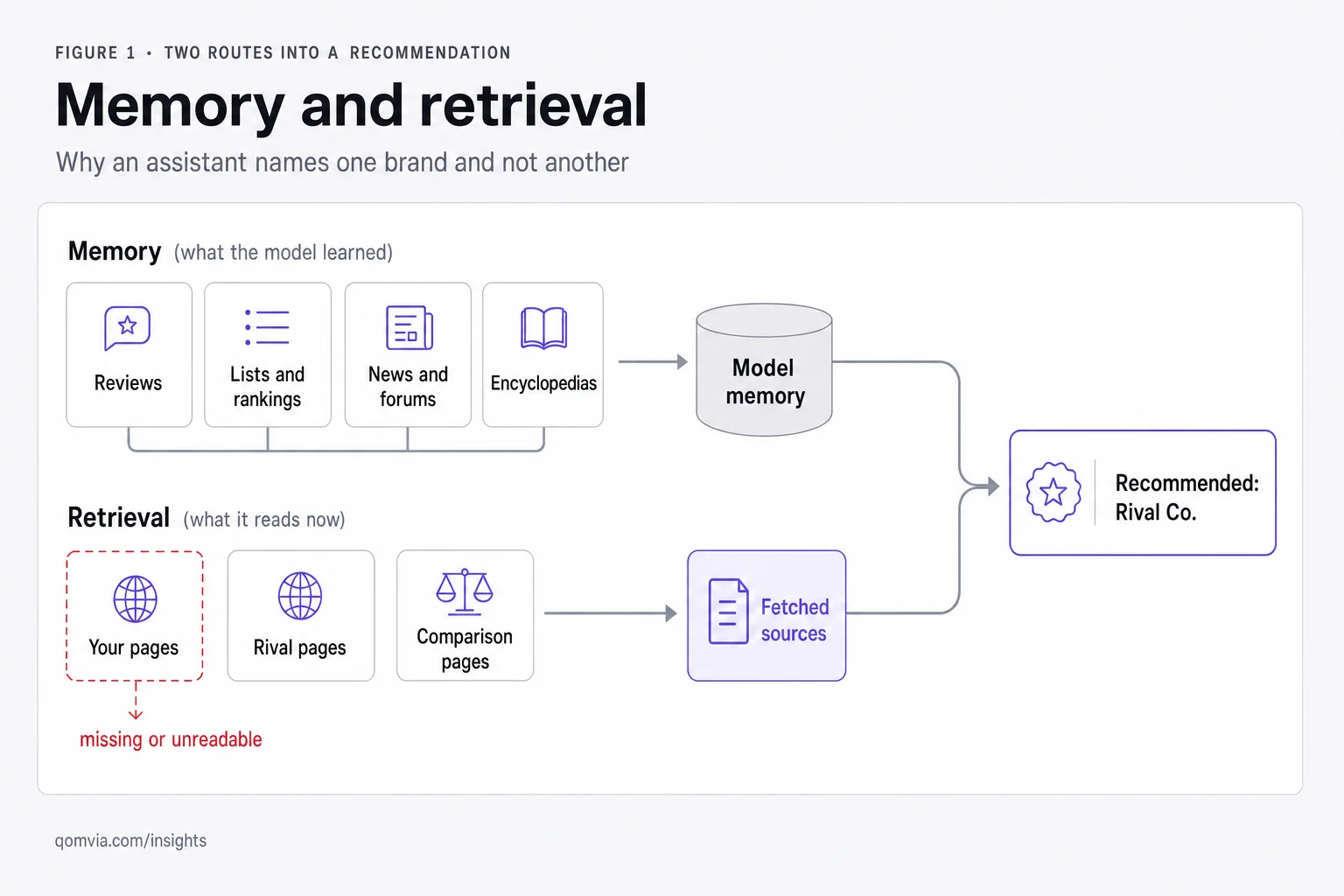
ChatGPT may recommend a competitor when available evidence makes that brand easier to identify, compare or support for the question. The answer may draw on learned associations, live search or both. Without seeing its retrieval path and sources, one response cannot reveal the exact cause; diagnose evidence, not a supposed model preference.
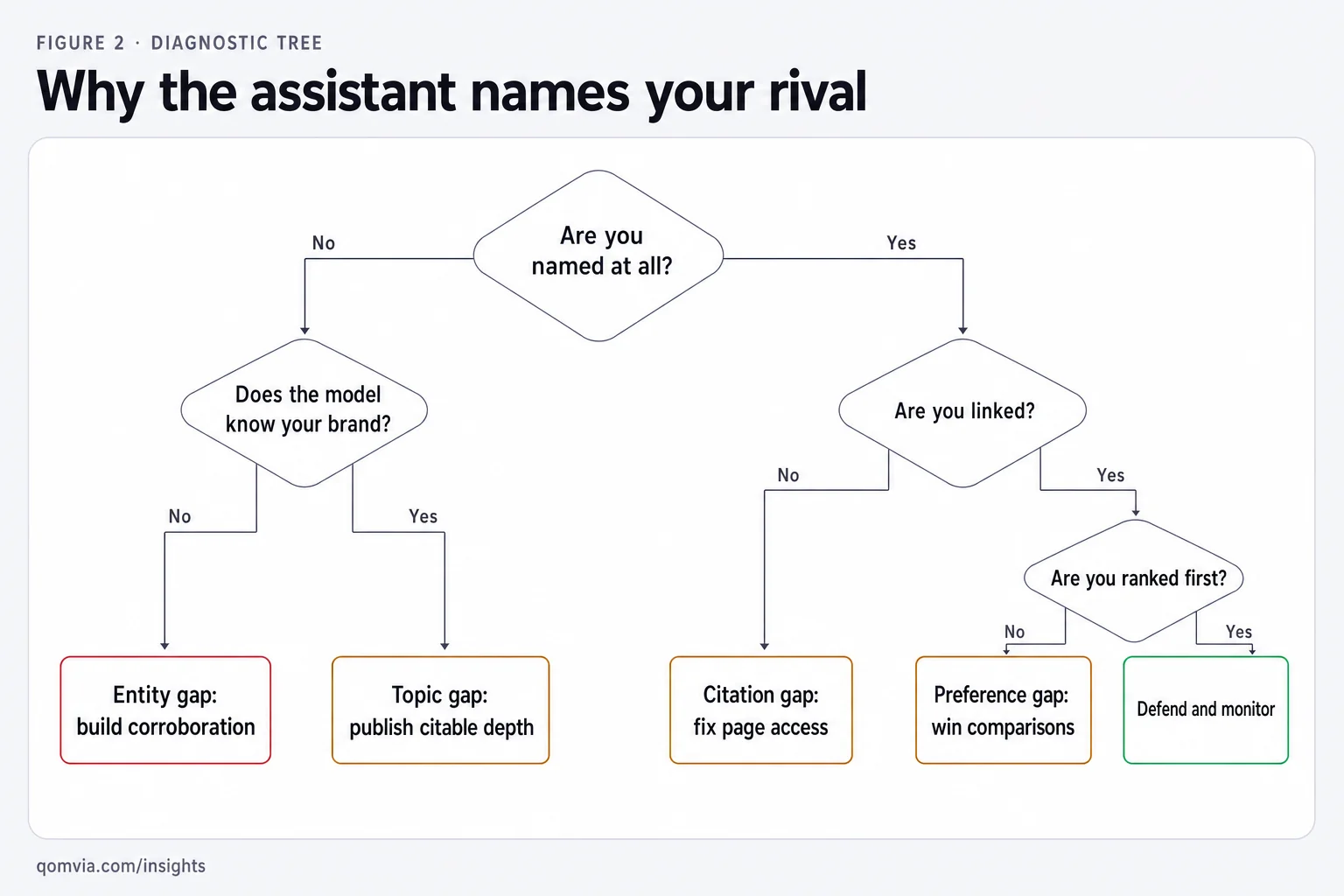
That answer can feel like a judgment on the business, but it is better treated as a test result. Did the prompt include a category, region, use case or budget? Did ChatGPT search the web? Which citations appeared? Was your site missing, or was the company named without a citation? Were the compared offers actually equivalent? The competitor diagnosis tree separates retrieval, identity, evidence and fit so the team can choose an intervention rather than reacting with a burst of generic content.
First-party OpenAI guidance distinguishes OAI-SearchBot, used to surface websites in ChatGPT search, from GPTBot, which may be used to crawl content for model training. ChatGPT-User is documented for certain user-initiated visits. Those roles matter when investigating access, but they do not reveal the exact internal reasoning behind one recommendation. Read the official OpenAI bot documentation and the guide to getting cited by ChatGPT.
Is the answer using live search or learned associations?
Some ChatGPT responses show search activity and linked citations; others answer without visible web sources. The interface and product mode can change, so record what the response actually shows instead of assuming every answer is live retrieval. Ask the same neutral question several times, with a consistent account and context. Note citations, the wording of the answer and any mention of search. Preserve the result even if it is unfavorable.
A response without citations may reflect general learned associations, conversation context or information not visibly attributed in that answer. It is not safe to conclude that a crawler recently visited a specific URL. A response with citations gives more concrete evidence to inspect, but the linked pages may not be the only inputs that influenced it. Treat visible source links as a starting point for investigation, not a full provenance record.
Compare the question forms. A prompt like “best accounting platform” is underspecified; a prompt that names company size, integration needs and region asks for different evidence. If the rival wins only a particular use case, that may point to a real product fit rather than a visibility problem. If the answer repeatedly claims your product lacks a feature you offer, improve the evidence and verify whether the claim comes from an outdated page or an ambiguous product description.
| Observed pattern | First question to ask | Evidence to inspect |
|---|---|---|
| No brands named consistently | Is the question too broad or category unfamiliar? | Question design and answer variation |
| Competitor cited, your brand absent | Can a source establish your relevant use case? | Search access, category pages, external corroboration |
| Your brand named without a link | Is a clear first-party source available? | Citation path and authoritative landing page |
| Wrong product facts | Where does the outdated statement originate? | Visible product pages, feeds and third-party listings |
Is the competitor easier to identify?
Entity clarity starts with consistent names and relationships. The brand, legal organization, product names, parent company, locations and official profiles should be connected in visible, verifiable places. If your site calls the product one thing, directories use another name and social profiles link to an old domain, an assistant may have less confidence about which records refer to the same company. A rival with a long-standing, consistent footprint can be easier to describe.
Organization structured data can help Google understand administrative details and disambiguate an organization in Search. Google's documentation gives sameAs as an example property for other pages that identify the organization. That does not mean a sameAs array directly controls ChatGPT recommendations. Use it to describe official relationships accurately, and align it with visible links and public profiles rather than treating schema as a shortcut.
Audit the basics: exact organization name, canonical domain, headquarters or service area where relevant, a concise company description, product taxonomy and official profile links. Publish an About page that states what the business does and who it serves. Remove broken or obsolete identity links. See Organization JSON-LD and sameAs for the implementation details.
Does the competitor have stronger third-party evidence?
Recommendations in crowded categories rarely depend on one page. Review sites, trade publications, comparison articles, professional associations, partner pages and customer stories can reinforce a company's category and use cases. When those sources consistently describe your rival as a fit for the question, the generated response may have more evidence available about that competitor. The same pattern can happen when your public sources are sparse, outdated or inconsistent.
Earn evidence by doing work worth documenting. Help a customer solve a real problem, publish a transparent case study with permission, contribute expertise to a trade publication, maintain accurate partner listings and ask customers for honest reviews without scripting their language. Correct directory facts through legitimate owner channels. Never buy fake reviews, create fabricated comparison pages or ask employees to impersonate customers. Manipulated evidence damages trust and may breach a platform's policies.
Wikipedia and Wikidata are not marketing listing services. Do not create or edit entries to advertise a company or force a recommendation. If an organization is independently notable and a neutral editor can establish that from reliable published sources, the relevant community's inclusion standards apply. The ethical lesson is broader: create public evidence that would remain credible even if the reader knew exactly how it was obtained.
Map the sources that appear in actual answers. Are they current? Do they describe the right product? Do they include a comparison that omits your category? Ask the owner of a page to correct demonstrably false information, but do not demand a favorable conclusion. A well-supported correction is more durable than a campaign to seed a preferred phrase.
Build a source map with separate fields for first-party pages, customer evidence, independent reviews, partner records and editorial coverage. Record the publisher, exact URL, date reviewed, product or claim supported and whether the page is current. This simple inventory shows where an answer may have found its description of the rival and where your own public evidence is incomplete. It also helps a communications team choose a legitimate relationship to develop.
Evaluate the quality of a source before trying to reproduce its presence. A neutral technical review may answer a buyer's question better than a high-authority but unrelated directory. A customer quote can establish that one customer had an experience, not that every buyer will get the same outcome. A competitor's official documentation can be the best source for its own feature. Good analysis follows the evidence rather than treating every citation as an endorsement.
Also look for negative evidence. If a third-party comparison names your business but says it does not serve a particular market, check whether the statement is dated or still true. If your product pages omit the market, an assistant may have no basis to correct that impression. Update the source you own and contact an independent publisher only with a factual correction supported by current documentation.
The external footprint is not a popularity contest. A company with fewer but clearer, independent references may be easier to verify than one with many duplicate listings. Focus on the quality and consistency of the sources that matter to the buyer's decision. Do not solicit identical wording from partners or ask customers to repeat an SEO phrase. Authentic specificity is more useful than coordinated sameness.
Is your offer easier to compare?
A model cannot make a meaningful recommendation when the source pages hide the comparison variables. State who the product is for, the job it performs, integrations, requirements, limits, price structure and what it is not designed to do. Keep the answer near the claim. A generic “best-in-class” statement is less useful than an explicit distinction a buyer can verify.
Comparison pages should be fair and specific. Explain the dimensions, update date and evidence behind a claim. Distinguish your own product facts from competitor facts, and link to primary documentation where possible. Avoid absolute superiority claims unless there is a testable standard and current support. The goal is not to create an AI bait page; it is to help a human choose with fewer unknowns.
A controlled answer review can identify missing variables. Ask neutral prompts about the category, then ask follow-up questions about use case, cost, risk and deployment. Check whether the assistant represents your product accurately. If your information is technically present but buried in a PDF or an inaccessible interactive tool, improve the source path. If the product is genuinely not a fit, do not try to persuade an answer engine otherwise.
What is the 60-day recovery plan?
Days 1 to 10: establish the baseline. Select a small set of high-value category and comparison questions, record exact prompts, market, model and mode, and save full responses and citations. Repeat a subset to see how much answers vary. Classify each problem as access, identity, corroboration, product clarity or actual fit. Do not start by rewriting every page.
Days 11 to 30: repair first-party evidence. Make the key product and category pages crawlable, align names and descriptions, clarify the audience and offer, add current supporting documentation, and check that internal links point to the canonical page. Correct stale facts in your control. Record what changed and why. The agent readiness guide and technical checklist help identify access and extraction issues.
Days 31 to 50: strengthen legitimate corroboration. Ask customer success for publishable proof, refresh partner listings and offer subject matter expertise to relevant publications. Ensure every claim in a comparison has a source and a review date. Avoid mass outreach that asks for a scripted keyword. Strong evidence is a result of real business activity; a campaign cannot manufacture a track record honestly.
Days 51 to 60: retest the original question set under the same conditions. Compare mentions, citations, factual accuracy and source quality, not just whether your brand moved up in one list. If results changed, look for the evidence that may explain the shift and note other changes in the platform. If they did not, revisit the diagnosis. A clear result can be “no measurable change in this sample.” That is more useful than a victory claim without a baseline.
For the baseline, write down the prompt exactly and keep both the answer and any citations. Mark whether the product is a plausible fit, whether the answer is materially wrong, and whether the visible source supports the statement. If the interface offers a search mode, note it. If it does not disclose a mode, record that as unknown rather than assuming the model used a particular index.
During the repair phase, preserve the original source snapshot and make a short changelog. A page can improve while the answer remains stable, or an answer can change after a provider update without a site edit. The changelog helps the team avoid attributing every difference to its own work. It also makes it possible to reverse a content change that introduced a new ambiguity.
Invite product, customer support and legal reviewers when the recommendation involves capabilities, regulated claims or transaction terms. They can catch cases where marketing copy overstates a feature or fails to explain an eligibility condition. A model answer that repeats an unsupported claim is not a successful outcome. Accuracy and qualified fit matter more than winning a mention.
Report the result without overclaiming
At the end of the plan, report the sample size, questions, settings, date range and changes shipped. Include one representative answer only if it is labeled as an example. Summarize whether the evidence improved, whether the response changed and what the team cannot attribute. A modest result can still justify better product documentation or reveal that the original issue was a genuine mismatch.
Use a separate dashboard for sampled answer visibility and technical site readiness. A crawl score can identify a blocked source, but it cannot establish recommendation quality. A citation report can show a source URL, but it cannot confirm the site is ready to accept a purchase. The measurement framework and agent readiness guide give each question its own evidence.
Keep the plan focused on the audience and category where the mismatch matters. One team may discover that the competitor is named because its offer genuinely fits the prompt better. Another may find that an outdated directory lists a discontinued feature. Those outcomes call for different responses. Improve your product or correct the record when appropriate, but do not assume every unfavorable recommendation is a content problem.
Be selective about what you publish. A public comparison creates obligations to keep criteria, prices, compatibility and competitor descriptions current. A case study needs customer consent and enough context to understand the result. An unsupported superlative may create more risk than visibility. Build the evidence first, then choose the format that serves a real buyer question.
If answers rely on a third-party page you cannot edit, document its claim and contact the publisher with a specific correction and a source. Ask for accuracy, not a preferred ranking. If the statement is an opinion, offer additional evidence rather than demanding removal. Respectful, verifiable corrections preserve editorial independence and make a request easier to evaluate.
The plan should leave room for no change. A stable competitor recommendation may be accurate, or the sample may be too small to detect a difference. Record the result and decide whether the business has a product, positioning or audience question to solve. Visibility work is not a substitute for establishing a genuine reason customers should choose the offer.
If the answer uses live search, inspect the sources before editing your own site. A marketplace, review publication, official profile or the competitor's documentation may supply the decisive fact. If the answer appears to rely on a learned association, treat that as a hypothesis because the underlying evidence may not be visible. Compare repeated answers and search-enabled runs where available, and label what the interface does not reveal.
Do not conflate the competitor's name with a citation. An answer can recommend a company without linking its site, or cite a third-party review without quoting the company's own claims. Track mention, recommendation, first-party citation and external citation as separate observations. Each points to a different question about identity, evidence and fit.
When the recommendation is factually sound but unfavorable, test whether the product strategy should change. The page may accurately describe a rival as a better fit for a particular budget, geography or requirement. In that case, clearer disqualification criteria can improve customer trust. Trying to force a different recommendation would make the content less useful and may create additional support or refund costs.
Sources and further reading
Questions
- Why does ChatGPT recommend my competitor instead of my company?
- The competitor may be easier to identify, better supported by available sources or a better fit for the question. Repeat the prompt, inspect citations and separate product fit from visibility before making changes.
- How do I get ChatGPT to recommend my business?
- Make the business and offer easy to verify: maintain accessible, specific product pages and consistent identity information, then earn credible third-party evidence. No page change can guarantee a recommendation.
- Does ChatGPT use live search for recommendations?
- Some ChatGPT experiences display live search and citations; other answers may not. Record the mode and visible evidence rather than assuming the retrieval path from a single response.
- Will sameAs schema make ChatGPT recommend my brand?
- No. Google's Organization documentation says structured data can help Google understand and disambiguate an organization in Search. It does not promise recommendations by ChatGPT or other assistants.
- Should I create a Wikipedia page to improve AI recommendations?
- No, not as a marketing tactic. Wikipedia and Wikidata have their own notability and neutrality standards; contribute only when an independent, policy-compliant basis exists.
- How long does it take to change AI brand recommendations?
- There is no guaranteed timeline. Improve verifiable evidence, record a baseline and retest the same questions over time, while recognizing that answer systems and retrieval sources can change independently.
Score your own site against the rubric this is written from.
Is your site agent-ready?
Free score against the same rubric, in under a minute.
Sign up free to keep the fixes and track the score.
AI monitor
PreviewHow often each model names your site across 11 tracked questions.