Published by Qomvia, , 13 min read
Key takeaways
- A ChatGPT mention and a ChatGPT citation are different observations. One names a brand; the other links a source page.
- OpenAI publishes separate bot controls. OAI-SearchBot is for search, GPTBot concerns potential training use, and ChatGPT-User can visit a page in response to a user action.
- Eligibility is not selection. Allowing a crawler removes one barrier, but does not make a page relevant to every question.
- Write source pages so a passage can stand alone: define the claim, state its scope, show evidence and identify the publisher.
- Check the cited URL, not just the answer text. A result can cite a useful page while recommending another company.
What does it mean to be cited by ChatGPT?
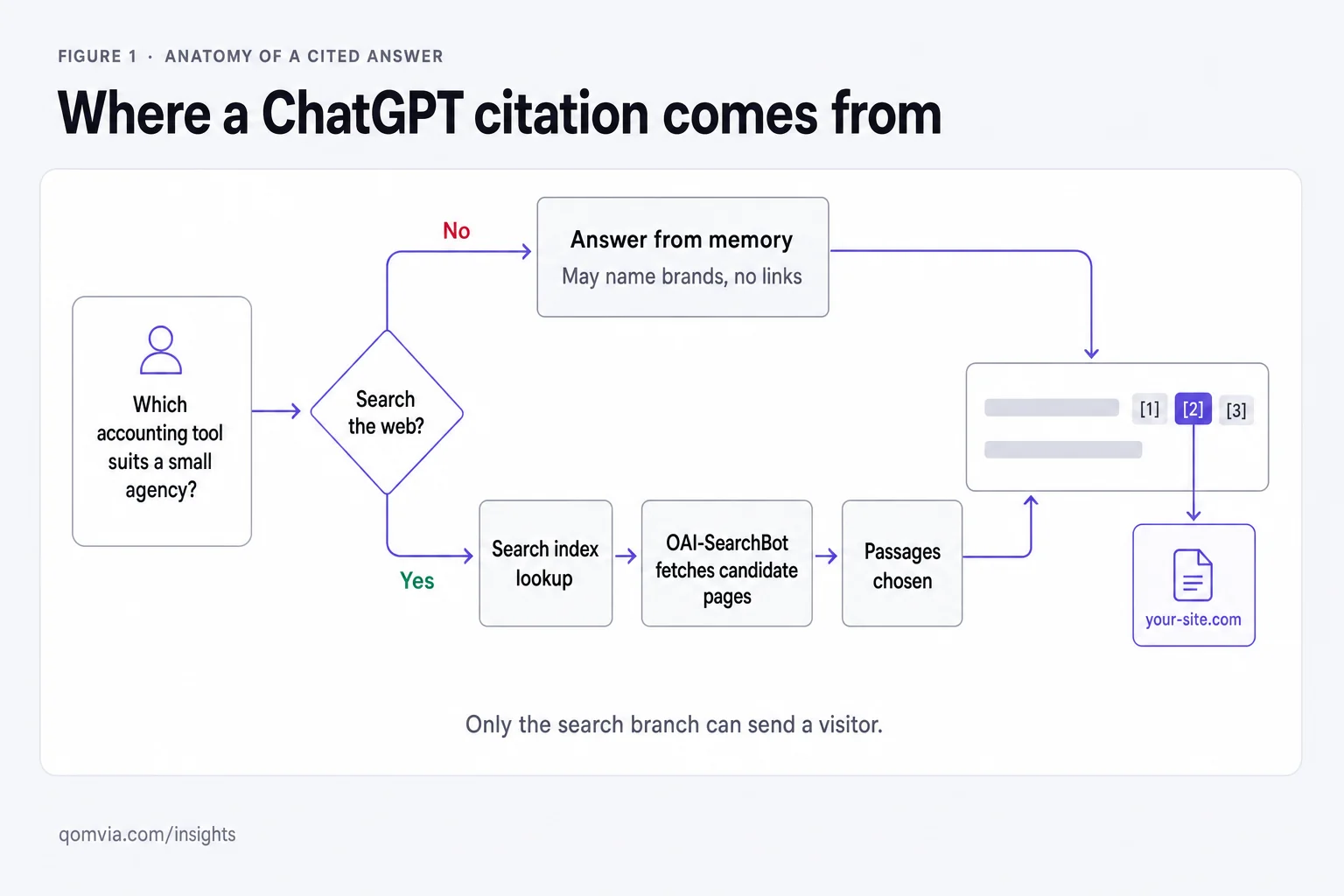
Getting cited by ChatGPT means an answer includes a link to your website as evidence. A mention is only the appearance of your brand name. They can happen together, but neither implies the other: an answer can name a company without linking it or cite an article without recommending its publisher.
The distinction begins with the mode. Some ChatGPT answers draw on the model's existing learned associations; search-enabled answers can retrieve current pages and show citations. A specific product may use tools in ways that are not exposed in every answer, and a user can directly request a page visit. Avoid guessing which internal source supplied a particular phrase. Record what is observable: the prompt, whether search was invoked, the answer, the citation target and the date.
A citation is not a certificate that every claim on the page is endorsed. It is a clue about one source selected for one answer. Inspect the passage, surrounding context and destination URL. A product page may support price and availability; an editorial guide may support method; a third-party report may support an independent comparison. The source-level goal is to make the right evidence easy to retrieve and hard to misattribute.
What is the difference between OAI-SearchBot, GPTBot and ChatGPT-User?
OpenAI's crawler documentation assigns different jobs to its public user agents. OAI-SearchBot is used to surface websites in ChatGPT search. GPTBot can crawl content for potential training use. ChatGPT-User is used for some requests initiated by a ChatGPT user or Custom GPT, and OpenAI says it is not the automatic web crawler used to determine Search inclusion. Do not collapse these into one switch called “ChatGPT bot access.”
That distinction changes the practical robots.txt decision. A publisher can choose whether to allow search discovery separately from whether to allow a training crawler. If the aim is to be discoverable in search answers, disallowing OAI-SearchBot is the relevant risk. A user-requested fetch is not the same mechanism and may follow different rules. A firewall that blocks an IP range can override the intent in robots.txt, so test both the declared policy and the actual response.
| Agent | Documented role | Editorial decision |
|---|---|---|
| OAI-SearchBot | Surfaces websites in ChatGPT search | Allow if search discovery is wanted |
| GPTBot | May crawl content for model training | Set policy based on training preference |
| ChatGPT-User | Can fetch after a user action | Assess separately from automatic Search |
Use OpenAI's bot documentation as the source of truth for current user-agent names and roles. Our guide to robots.txt for AI crawlers covers grouping and policy examples. If your CDN challenges these requests, review bot protection and AI agents before copying IP rules from a forum.
What are the citation gates?
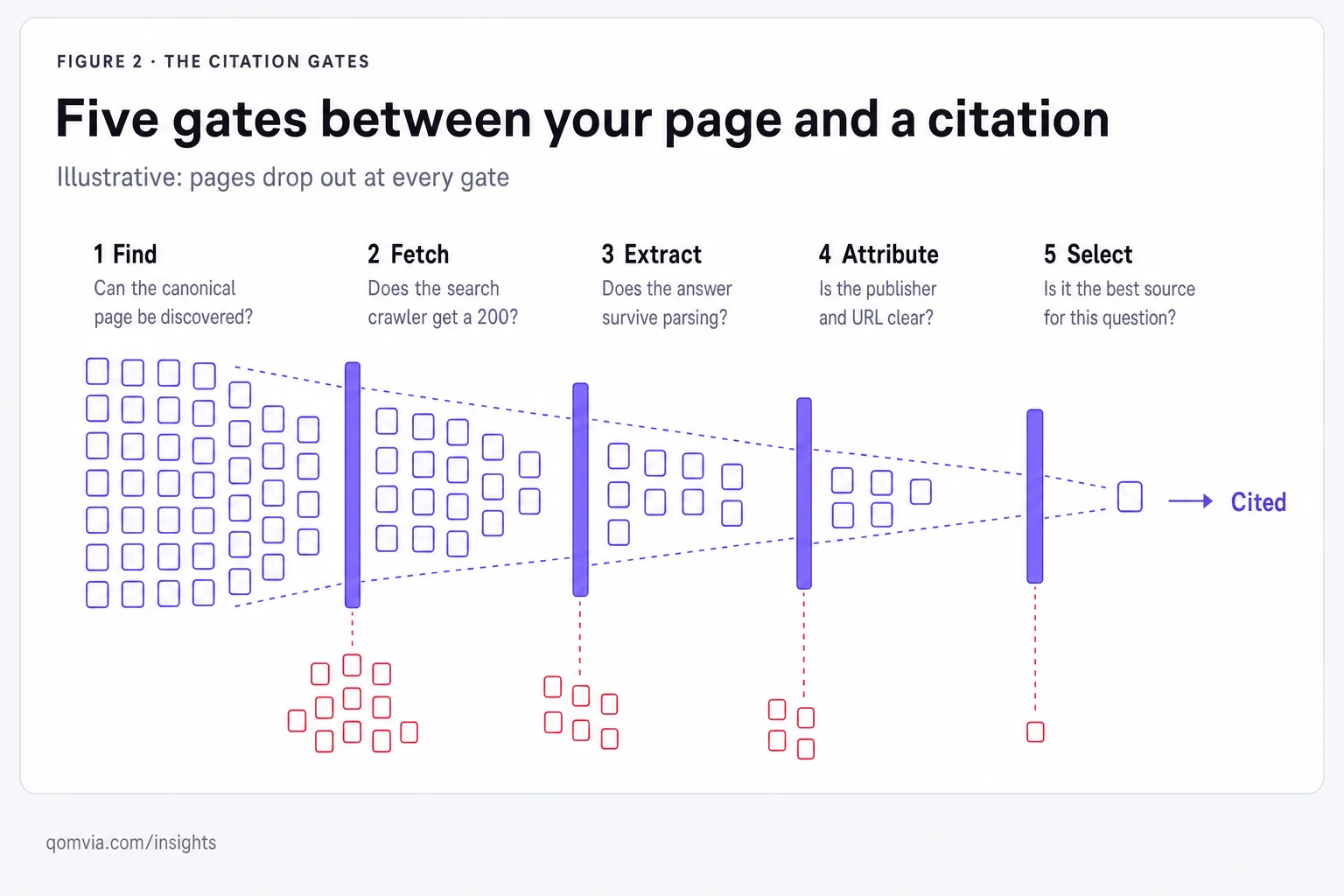
The five citation gates are find, fetch, extract, attribute and select. They are an operating framework, not OpenAI's published ranking formula. Find means the right canonical page can be discovered. Fetch means the relevant search process receives a successful response. Extract means the answer-bearing passage survives rendering and parsing. Attribute means the system can connect the passage to the right publisher and URL. Select means the source is relevant enough to cite for this particular question.
These gates make troubleshooting more useful than a generic citation checklist. If a URL never appears in search results, examine discovery and access first. If it is indexed but the first response contains a cookie notice or empty application shell, examine extraction. If the citation uses the wrong brand name, examine canonical and identity signals. If the page is technically clean but still absent for a comparison query, inspect whether it contains direct evidence that answers the query at all.
Use Search Console, server logs, page inspection and answer sampling for different questions. Search Console can show Google indexing and search performance; it does not expose every ChatGPT retrieval event. A successful request from your own browser does not prove that OpenAI fetched the same URL. State what each tool observes, and do not label a proxy metric as a citation measurement.
What page patterns make a source quotable?
A quotable passage starts with a direct statement whose subject is explicit. Follow it with the conditions that make it true, the evidence that supports it and the point at which it stops applying. Readers and extractors should not need to combine a hero tagline, a chart, a footnote and a pricing tab to reconstruct the claim. Use headings that identify the question, then paragraphs that explain the answer in context rather than repeating a keyword phrase.
Evidence is more useful when the reader can audit it. Link the underlying policy, standard, dataset or announcement. Name the method and date for research. Distinguish what your company observed from what an independent study found. If a statistic only applies to one sample or market, say so next to the number. Do not add made-up precision to appear authoritative. The source itself earns trust by showing what it knows and what it cannot establish.
Keep claims near their context. Put limitations near outcomes, prices near the product they describe, and author or organization information where a visitor can find it. Add structured data only when it accurately represents visible content. Make sure the page has one canonical URL and that its internal links use a stable name. These decisions reduce ambiguity for humans first. Any benefit to a machine follows from the page being clearer, not from writing an incantation for a model.
How can I check whether ChatGPT cited my site?
Build a test set from questions a buyer or researcher would actually ask. Include category, comparison, branded and support intents. For every run, preserve the exact wording, model or mode, region, language, date and any setting that indicates search. Capture the full answer and every citation. Mark whether the answer mentions the organization, cites its own domain, cites an external page about it, names a competitor or gives no recommendation.
Repeat the test. A single answer may differ after a refresh, prompt rephrase or search result change. Track the denominator and separate “brand named” from “first-party URL cited.” A citation to your own About page is not the same as a citation to the product page relevant to the purchase. Likewise, a citation to a review page may show external corroboration, but it does not prove the publisher controls the claim.
Qomvia's AI monitor records answer-level mention and citation observations for tracked questions across ChatGPT, Gemini and Grok, with Claude and Perplexity available as add-ons. Its Site monitor is a separate public-readiness measurement. The two views help distinguish a fetchability issue from an answer-selection issue without claiming access to OpenAI's private retrieval logs.
Keep an answer archive that makes a later review possible. Save the prompt, the full response, citation URLs, collection date and any visible search setting. If a source link redirects or disappears, note what the page showed at collection time. Avoid copying a large volume of material into a public report; preserve only the details needed to substantiate the analysis and respect the provider's terms.
A citation review should classify what the linked page contributed. It may provide a definition, a product specification, an independent comparison or a policy statement. If the page is only tangentially relevant, count it according to the declared rule but do not treat it as evidence that the answer used your preferred fact. A strong source is both visible in the response and relevant to the question being answered.
Compare the citation with the passage on the live page. Did the answer preserve the date, condition, exception and named entity? If it did not, decide whether the page itself is ambiguous, the answer compressed too aggressively or the source is no longer current. A correction to your own page can reduce one kind of ambiguity, but it cannot control how a third party summarizes it.
When comparing changes, hold the question set and collection method steady as much as practical. If prompts, mode or geography change, label the new sample and resist blending it into the old rate. Mention rate may rise while first-party citations fall, or the reverse. Show these outcomes separately rather than collapsing them into one number that conceals the tradeoff.
What should I fix first?
Fix a broken gate before polishing one that already works. If OAI-SearchBot is disallowed, clarify the policy with the site owner and check the edge response. If the page is not indexed, repair its canonical, navigation or technical status. If the initial response lacks the answer, improve server-rendered content. If it is clear but hard to attribute, align organization and product names across visible text and structured data.
If the first four gates look sound, move from engineering to evidence. Does the page answer the exact question? Are comparisons explicit, current and fair? Does it show why a product is appropriate for one use case and not another? Are important claims corroborated by reliable third parties? See why ChatGPT recommends your competitor for an entity and evidence diagnosis, and the AI search optimization checklist for a broader technical review.
Change one meaningful thing at a time where practical. Keep a record of the page and date, then rerun the same questions and inspect actual source URLs. Avoid publishing a mass of nearly identical “best” pages to manufacture coverage. Thin comparison pages create more claims to maintain without improving the underlying proof. A trusted source is a useful answer first, and a search asset second.
How should you earn reliable citations?
Start by matching the page to the source role. A product page should establish what is sold and how it works. A policy page should state the conditions and date. A research article should expose its methods and limitations. A company profile should identify the organization and connect to official resources. When a page tries to perform every role at once, the specific evidence can become hard to locate. Split material only when the reader has a real reason to move between pages.
Make important claims independently understandable. “Available in 12 countries” needs the countries, a current date and a definition of availability. “Reduces costs” needs a scope and evidence. “Supports an API” should link to documentation that explains authentication and limits. If the claim depends on a plan, region, account type or partner, state that next to the answer. A citation is most valuable when the cited page can substantiate the sentence the assistant presents.
Give a reader a reason to trust the material beyond polish. Name the responsible organization, author or subject matter expert where appropriate. Link primary documentation. Separate a direct quotation from an editorial summary. Keep dated guidance from implying that a new capability existed earlier than it did. If a customer example is illustrative, label it; if it is a real case study, obtain permission and describe the conditions that shaped the result.
Let the structure show what supports what. A definition can establish a term, a procedure can show how to use it, and a limitation can explain where it does not apply. Put a claim's source close enough that the reader can verify it without hunting through a bibliography. Where a statement comes from your own product, link the relevant product or technical documentation rather than relying on a general homepage.
Avoid formatting superstition. There is no universal word count, number of headings or FAQ length that ensures citation. A compact paragraph can be easy to quote if it answers a narrow question accurately. A longer technical guide can be better when the reader needs assumptions, procedures and exceptions. Use structure to reveal the logic of the material, not to imitate an imagined prompt format.
Update source pages when the underlying product or policy changes. Do not change only the visible date while leaving an outdated example, screenshot or downloadable file intact. A content review should include linked pages, structured data and the canonical URL. If the page summarizes a third-party standard, link the current primary text and avoid paraphrases that turn an optional practice into a requirement.
Do not strip away context to create a short excerpt. A page may need a caveat in the answer sentence itself so it remains true when quoted alone. If a procedure is safe only for a test environment, say that in the step. If a recommendation is valid only for a particular version, put the version in the heading or paragraph. These details make a passage less likely to mislead when reused outside the original page.
Make comparison pages explicit about criteria and tradeoffs. Identify who evaluated the options, when, and what evidence informed each conclusion. If a feature is not offered by your product, say so rather than burying the limitation. A fair comparison can still explain where your product is a strong fit, but the page should distinguish a documented capability from an editorial judgment.
Build an editorial maintenance loop for high-value source pages. Assign an owner, record the last evidence review and flag dependencies such as a product feed, policy document or third-party specification. When one dependency changes, update the pages that repeat it. A scheduled review is useful, but a material product or legal change should trigger an earlier check rather than waiting for the calendar.
When the answer is wrong, compare its wording with your page and the cited sources. Is a qualifier missing from the page, or did the response omit a qualifier that is visible? Preserve the exact example and route it to the relevant owner. Do not rewrite a source to anticipate every possible paraphrase; clarify the underlying fact and make its limits easy to verify.
Build a passage that can survive extraction
A good passage names its subject rather than leaning on “it” or “they” from the previous paragraph. It uses a precise verb, a bounded claim and the context required to interpret it. A list can show steps, but the introduction should clarify whether they are required or optional. A table can compare two plans, but the column labels should make clear whether values are monthly, annual, per user or per site. Read the passage in isolation and ask whether a careful person would understand its limits.
The citation surface also includes the surrounding publisher signals. Keep contact and organization information accessible, link relevant policy pages and ensure that article metadata identifies the canonical URL. Those signals can help people judge a page, but they cannot replace the factual quality of its content. The guide to being named versus being cited explains why brand visibility and source attribution are separate outcomes.
Sources and further reading
Questions
- How do I get my website cited by ChatGPT?
- Make the relevant page discoverable, allow the search crawler you intend to support, return useful content in a readable response, identify the source clearly and answer the query with verifiable evidence. These steps improve eligibility but cannot guarantee selection.
- Does allowing GPTBot get my website into ChatGPT search?
- GPTBot is documented for potential training use. OpenAI identifies OAI-SearchBot as the crawler used to surface websites in ChatGPT search. Set each policy according to its stated purpose.
- What is the difference between OAI-SearchBot and ChatGPT-User?
- OAI-SearchBot is for automatic search discovery. ChatGPT-User can visit a page in response to an action initiated by a user and is not used to determine Search inclusion, according to OpenAI's documentation.
- Can I appear in ChatGPT answers without a citation?
- Yes. A response can mention a brand without linking its domain, and it can cite a source without recommending that brand. Track mention and citation rates separately.
- How long does it take for a page to get cited by ChatGPT?
- There is no dependable universal interval. Crawling, index updates, query relevance and answer sampling all affect when a page may appear. Monitor the actual page and repeated answers rather than promising a fixed number of days.
- Does structured data guarantee ChatGPT citations?
- No. Structured data can clarify an entity or product when it matches the visible page, but it does not force a search result or citation. It is one part of attribution, not a ranking guarantee.
Score your own site against the rubric this is written from.
Is your site agent-ready?
Free score against the same rubric, in under a minute.
Sign up free to keep the fixes and track the score.
AI monitor
PreviewHow often each model names your site across 11 tracked questions.