By Qomvia, 14 min read
Key takeaways
Share of voice in AI answers is easy to report and easy to get wrong. AI assistants now answer the question before anyone clicks a result, so a clear, repeatable denominator is the only way to know whether you are gaining on rivals.
- Define the denominator first: a per-question rate and a per-answer share describe different things.
- Keep mentions, citations and recommendations separate: they are distinct outcomes, not interchangeable inputs.
- Preserve the question set: prompt changes can alter the population being measured.
- Show sampling uncertainty: a small or variable sample should not be presented as a precise market fact.
- Set a cadence that fits the decision: collect often enough to act, but do not hide changed conditions inside a continuous chart.
What denominator should a team use?
Define what counts as an opportunity
Define the eligible sample before collecting results. Decide whether the denominator contains all tested questions, only questions where a provider returned an answer or only cases where a source could be inspected. The choice changes the meaning of the metric. Keep excluded cases in a separate record so the reporting team can explain its rules and revisit them consistently.
A question set should represent the decisions an audience actually makes. Mix appropriate intents such as learning a category, comparing options and checking a brand fact, but preserve the intent labels. Do not add a question solely because it produces a favorable mention. A stable, documented set is more useful for directional comparison than a growing collection selected after answers are observed.
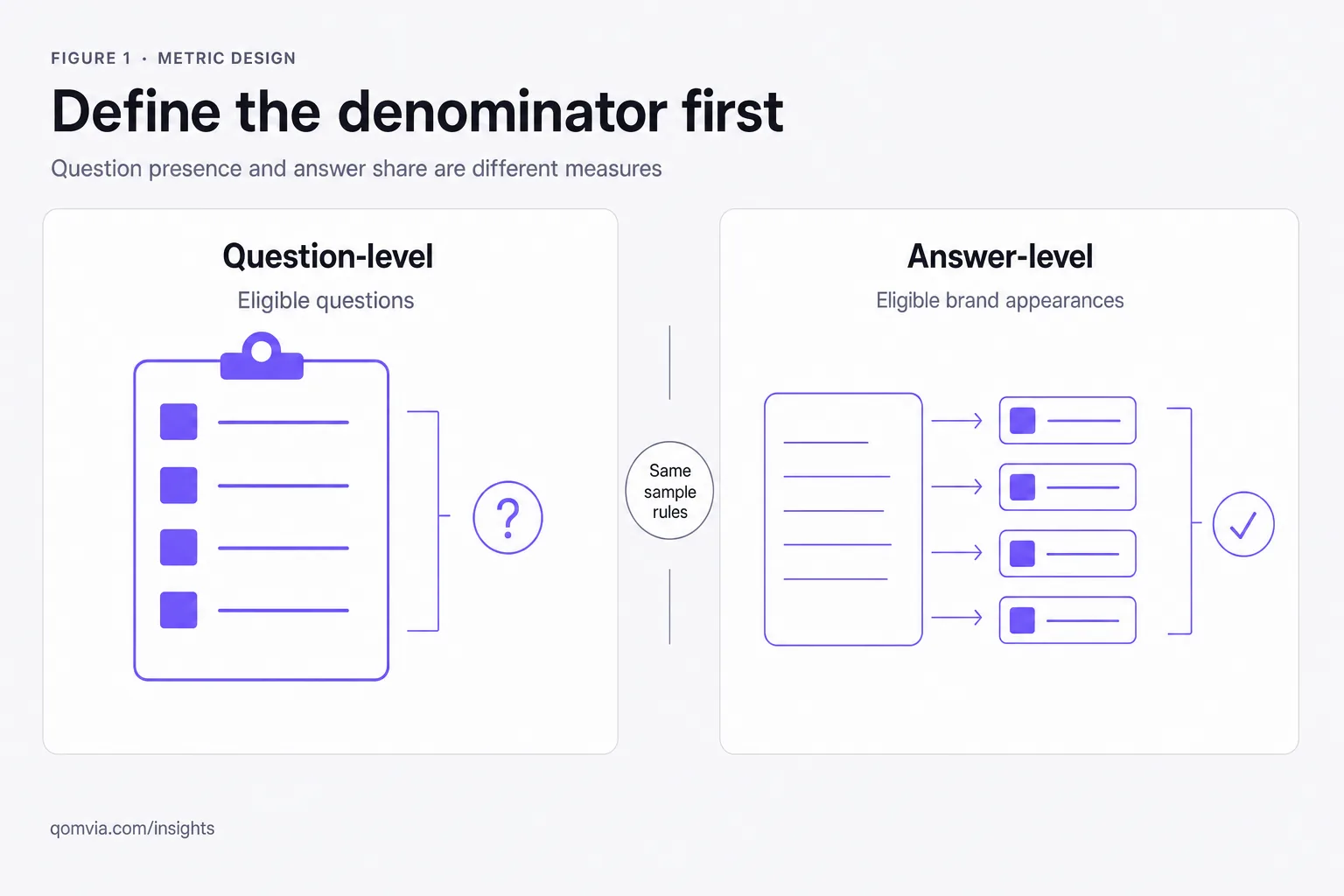
Report the unit beside the denominator. If each question is counted once, say so. If a question is sampled more than once, specify whether the unit is a response or a distinct question. Without that definition, readers cannot tell whether the share describes breadth of coverage or frequency in a chosen collection.
A per-question presence rate uses eligible questions as its denominator: the numerator is the number of sampled questions where the brand appears under a defined rule. This answers whether the brand shows up across the tested tasks. A per-answer share of voice can instead compare the brand's appearances with all eligible brand appearances within collected answers. It asks how the set of named options is distributed.
The denominators differ when an answer includes several brands, no brands or multiple references to the same brand. Decide whether repeated mentions count once per answer or once per appearance. Decide whether aliases and product names roll up to the company. Decide whether a citation to a company page counts as a brand appearance if the prose never names the organization.
Write the formula in the metric documentation. For question-level presence, define the number of questions with a qualifying brand appearance divided by all eligible questions. For answer-level share, define eligible brand appearances for the focal entity divided by eligible appearances across the comparison set. State how answers with no eligible brand are handled rather than dropping them silently.
Make eligibility rules part of the denominator definition. Decide whether a failed collection, an answer with no brands or a response outside the intended product mode remains in the sample. Do not remove inconvenient observations after seeing the results. If a prompt no longer fits the question set, mark its retirement and report the change rather than quietly changing the denominator for one period.
Define the comparison set before computing a share. A brand's proportion among two named competitors answers a different question from its proportion among every eligible entity in the response. Explain whether the set is fixed, selected by a customer task or inferred from the observed answer. This keeps a change in competitor mix from being misread as a change in the focal brand's own presence.
| Metric | Numerator | Denominator | Question answered |
|---|---|---|---|
| Question presence | Questions with a qualifying brand appearance | Eligible questions sampled | How often did the brand appear across tasks? |
| Answer share | Eligible appearances for the brand | Eligible appearances for all compared brands | How are named brands distributed in answers? |
| Citation presence | Answers with a first-party source link | Eligible answers sampled | How often was the brand's own site linked? |
| Recommendation rate | Answers that meet a recommendation rule | Eligible recommendation questions | How often did the answer prefer the brand? |
Why separate mentions, citations and recommendations?
A mention is a textual appearance under the team's alias rules. A citation is a source link displayed or associated with an answer. A recommendation is a preference or selection claim. A brand may be mentioned without a link, cited as evidence without being recommended or recommended with a source that does not support the claim.
The same answer can also mention several products in different roles. One may be the example, another a warning and another the recommended fit. A raw count that treats all appearances equally can make a brand look visible while hiding that it was described negatively or only as an alternative. Preserve enough answer context to classify the role.
Define ambiguity handling. Does an alias count? Does a retailer page count as a citation for the manufacturer? Does a citation to an external review count as a brand citation? When a reviewer cannot determine the role, keep an uncertain state. Forcing uncertain cases into a favorable category can create a tidy but misleading trend.
Write coding examples for common edge cases. A product nickname may refer to one brand in one market and another in a different context. A response may cite a retailer that sells the product without naming its manufacturer. A brand may appear only in a warning or correction. Reviewers should be able to see how each case is handled and request a rule change when the definition does not match the decision.
How should a team handle question-level and answer-level reporting?
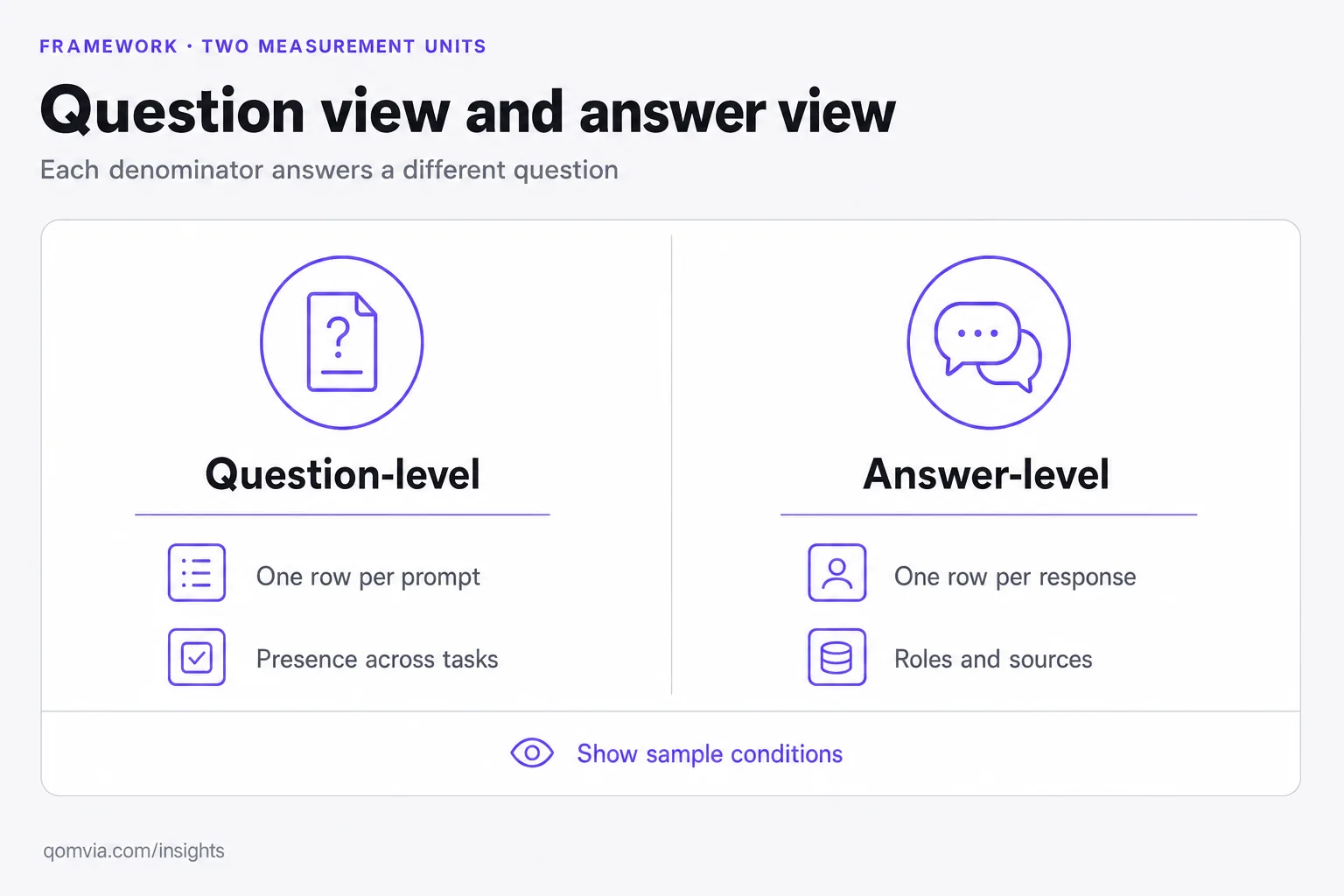
Preserve a question-level record for diagnosis and an aggregate view for reporting. The record should include the tested wording, intent, product surface, collection context, answer and visible citations. The aggregate can then show what was included without losing the evidence needed to review an individual result.
Keep brand identity rules explicit. Decide whether a product name, parent company, local branch or common abbreviation counts as a mention, and document the edge cases so reviewers can separate real references from coincidental name matches.
For each citation, record the destination and the claim it appears to support. A page from the company's domain is not automatically an endorsement, and a citation near a sentence does not necessarily validate every phrase in that sentence. Separate presence, placement and evidentiary support in the reporting model.
Question-level reporting gives each prompt an explicit role. A category question, a comparison, a branded request and a support task do not have the same opportunity to produce a brand mention. Report by task family or intent so that a shift in the mix does not masquerade as a change in visibility.
Answer-level reporting examines the content of each response. It can capture which brands were named, their roles, the source links and the accuracy of the relevant passages. Preserve the full answer and its collection context. If a summary metric cannot be traced to the underlying response, a reviewer cannot check whether the classification still makes sense.
A combined dashboard can show both views, but its labels should make the unit unmistakable. Question incidence counts queried items; appearance share counts individual brand mentions. First-party citation rate and overall share of voice use different denominators. Avoid a single color or score that hides those differences from a decision-maker.
Keep the relationship between prompt and answer explicit in storage. One question may produce a different response across product modes or collection dates, and each response may contain several eligible brands. Store one row per observation with an identifier that links it to the stable prompt definition. This makes it possible to inspect both the question-level outcome and the answer-level coding without losing the unit.
How should teams represent sample uncertainty?
Show sample conditions alongside the result
Separate uncertainty in collection from uncertainty in classification. A response that could not be retrieved is a missing observation; a response whose brand reference is ambiguous needs human review. Combining both into a single negative result hides two different problems. Report the applicable category and preserve the rule used to resolve it.
A sampled answer set is not a census of every user interaction. Results can vary with prompt wording, product mode, locale, collection time and the sources available. Preserve those conditions and avoid reporting a precise-sounding share without the sample size and sampling design needed to interpret it.
Repeat observations when the decision requires a stable pattern. Keep the prompt and product mode fixed where possible, record every run and show the spread rather than only the most convenient result. If the sample is small, describe the finding as directional. Do not infer a broad market position from a limited set of internal questions.
When comparing periods, check whether the question set, model coverage and coding rules stayed the same. If any changed, annotate the break or report the segments separately. A methodology change can move a metric even when the underlying answers did not. The record should let a future analyst distinguish change in the world from change in how the team measured it.
Uncertainty can be communicated without pretending to calculate a formal confidence interval from an unsuitable design. Show the number of eligible observations, collection failures and how results varied across repeated samples. Explain which dimensions were held constant and which could not be controlled. If a team needs statistical inference, it should define a sampling design suited to that inference rather than borrow precision from a simple dashboard.
Use cautious language for small or shifting samples. “Appeared in these sampled answers” is more accurate than “owns the category.” If the set is exploratory, label it exploratory. If a repeated test produces different outcomes, show that spread instead of selecting the most favorable response. The report's wording should not claim broader coverage than the collection method can support.
How can a team make the metric decision-ready?
Connect the observation to a decision the organization can make. A low citation share on a comparison question may prompt a review of the comparison page; an incorrect product fact may need catalog correction. A number without a defined action can create recurring reporting work without helping the underlying customer experience.
Show the evidence alongside any change in the aggregate. Include representative questions, the relevant response passages and the source links where available. If the reporting period or sample changed, label the break instead of presenting the series as directly comparable. The reader should be able to understand both what moved and how the team knows.
Use cautious language when a sample is small or inconsistent. Describe a pattern as observed in the tested set, name the conditions and avoid extrapolating to every customer or answer. If a decision depends on more confidence, collect a broader and more representative sample under a documented method rather than decorating the existing number with extra decimal places.
Pair the score with examples that explain it. Show a response where the brand was named, one where it was cited and one where the coding was uncertain. Explain which source supported each statement. This makes the metric actionable: the team can see whether the issue is identity, evidence, selection or a denominator that needs refinement.
Keep the question set tied to customer tasks and review it when those tasks change. Remove prompts that no longer represent a real need, but document their retirement. Add a new prompt as a new segment before blending it into a historical trend. Preserve a stable core sample for comparison and use exploratory questions separately.
Make the report useful to the owner who can act. An editorial team may need the exact source passage and a content gap; a product team may need an inaccurate specification; an analytics team may need a revised denominator. Pair the aggregate measure with representative examples and a clear next step. Do not ask one metric to diagnose access, factual accuracy, source selection and business impact at once.
A durable metric dictionary should state the formula, eligible units, alias rules, citation definition, recommendation coding, sample conditions, failure handling and owner. Include a version history when the definition changes. That record lets a new analyst reproduce the result and prevents a familiar label from masking a new calculation.
A good report can withstand the question “what exactly is this share of?” It should show the formula, the sample, the definitions, the date and the limitations. If a reader cannot reconstruct that statement from the report, the metric is not yet ready to guide investment.
Sources and further reading
Questions
- What is AI share of voice?
- It is a proportion of defined answers in which a brand appears relative to a stated denominator. The question set and inclusion rules determine what the result means.
- How do you calculate share of voice in ChatGPT?
- Define whether the denominator is eligible questions or all eligible brand appearances in collected answers, then apply consistent mention and alias rules to a documented sample.
- What is the difference between per-question and per-answer share?
- A per-question measure asks how often a brand appears across prompts. A per-answer measure compares eligible brand appearances within the responses collected.
- Do citations count as mentions?
- Not automatically. A citation is a source link, while a mention is a brand appearance in answer text. Define and report them separately.
- How do I report AI share-of-voice uncertainty?
- Show the sample scope and conditions, repeat observations where the decision requires it and label small or changing samples as directional.
- How often should I measure AI share of voice?
- Choose a cadence that fits the decision and sample stability. Explain collection timing separately from how often results are reviewed.
Score your own site against the rubric this is written from.
Is your site agent-ready?
Free score against the same rubric, in under a minute.
Sign up free to keep the fixes and track the score.
AI monitor
PreviewHow often each model names your site across 11 tracked questions.