By Qomvia, 14 min read
Key takeaways
Models lean on the sources they trust, and many of those sources are other sites writing about you. AI assistants now answer the question before anyone clicks a result, so earning the right citation elsewhere decides whether the answer names you.
- Earn references through usefulness: offer evidence, expertise or a resource that genuinely helps another publisher's audience.
- Earn useful references: give journalists and subject communities evidence they can verify and cite in context.
- Give reporters something verifiable: make the underlying method, data and limitations inspectable.
- Reject disguised incentives: fake reviews and paid links presented as independent coverage undermine trust.
- Measure the reference and the result separately: coverage, answer citations, referrals and business outcomes are different observations.
What is digital PR for AI search?
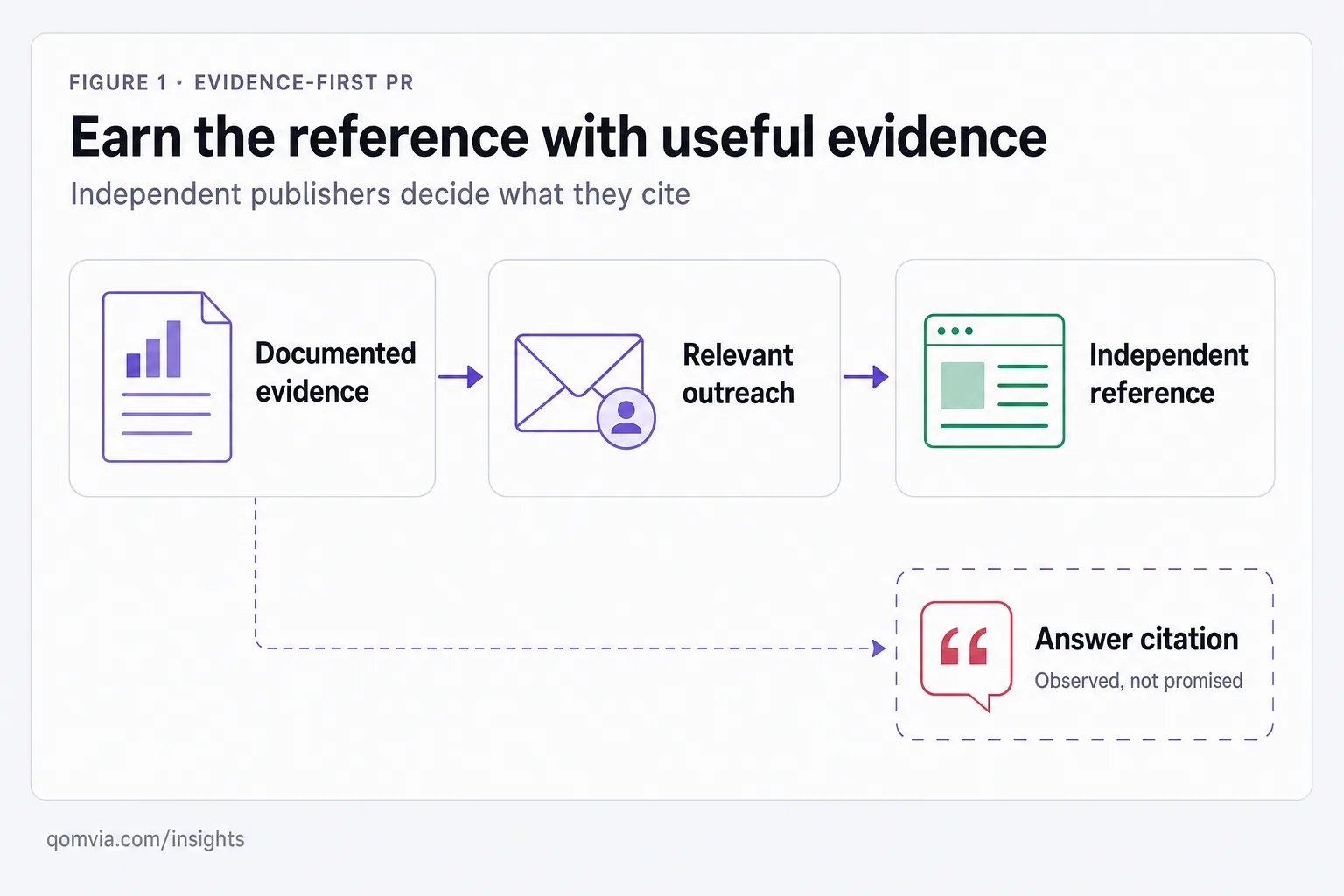
Digital PR for AI search is the work of earning accurate, useful third-party references that people and answer products can inspect. It combines newsworthy evidence, relevant expertise and transparent outreach, making credible source material available to the audiences that consult those references.
The goal is not to seed the web with repeated brand phrases. It is to create something worth referencing and make the source easy to verify. That might be a carefully documented analysis, a practical expert explanation, a public record or a resource that answers a real reporting question. A reference has value when it helps its own audience, even before an AI citation is considered.
OpenAI's ChatGPT search documentation describes source citations in search responses but does not document every selection step. Use visible answer links to assess which sources support a claim. For the difference between a mention and a linked source, read why ChatGPT recommends your competitor and entity SEO.
What makes a story reference-worthy?
Bring evidence before outreach
A strong pitch can be declined even when its evidence is sound. The editor decides whether the material serves the publication's readers, and the organization should respect that choice. Continue making the resource useful on its own site rather than treating a refusal as a reason to broaden claims or increase outreach volume.
Start with a question that matters to an audience beyond the company. A useful story may explain a change in a process, a hard-to-see customer problem, a new public dataset or an expert's interpretation of a policy. The company should have direct access to the evidence or expertise needed to contribute something specific, not just a desire to appear in a roundup.
A strong asset makes its claims inspectable. Publish the method, define the terms, show what was excluded and identify the limits. If the analysis uses internal records, obtain the necessary permission and remove information that should not be public. If it uses an illustrative example, label it as hypothetical. Do not disguise a sales sample as independent research.
The material should serve a writer's workflow. Provide a concise summary, a clean link to the full source, a responsible contact and a clear answer to likely follow-up questions. Do not bury the caveat in a separate page or offer a chart with no underlying definition. A publisher should be able to check the claim without relying on a promotional statement.
Before pitching an asset, ask what an independent writer can learn from it that is not already in the company's marketing copy. If the answer is only that the business wants more awareness, return to the research question. A meaningful contribution might clarify a confusing process, expose a documented constraint or explain how a change affects a particular audience. The company should be able to show why it has access to the evidence and what the evidence cannot say.
Prepare the source for scrutiny. State the definitions, collection method, inclusion criteria, limitations and the person responsible for the analysis. Keep a versioned copy of the underlying material where permitted. If the work includes customer stories, obtain consent and remove details that could identify someone without a legitimate reason. The ability to answer hard questions is a better test of readiness than the polish of a launch page.
How should expert outreach work?
Confirm that the spokesperson can speak for the organization on the subject and can distinguish evidence from opinion. Share the source material before the conversation, disclose relevant organizational interests and correct any factual mistake promptly. Do not offer a quote that implies an independent endorsement or ask an expert to make a claim outside their area of knowledge.
Make every pitch specific to the recipient's work. Explain the information gap, the source material available and why it is relevant to that audience. Offer an expert who can answer questions on the record and distinguish known facts from interpretation. If the material is not a fit, accept the decision without repeated pressure.
A useful expert response is direct and bounded. State what the evidence supports, what it does not prove and which assumptions could change the conclusion. Avoid scripts that require an exact brand phrase or a link to a chosen landing page. A journalist should be free to paraphrase, challenge or decline the proposed framing.
Give attribution information accurately. Identify the person's role, the organization's interest and any relevant commercial relationship. Disclose where the analysis came from. If a company commissioned or funded work, do not invite a publisher to present it as independent. A transparent relationship protects the credibility of both the source and the coverage.
Make the expert available to explain method and uncertainty, not merely repeat the approved headline. Agree on who can speak for the organization, how conflicts of interest are disclosed and which technical details require a separate owner. If an expert cannot answer a question from the available evidence, say so and offer to follow up rather than improvising a stronger claim.
Keep the outreach useful even when the recipient does not cover the story. A short answer to the specific question, a link to a source and a clear contact can save time. Do not send repeated follow-ups that pressure a journalist to use a quote or insert a link. A recipient's editorial choice is independent of the company's measurement goals.
How do teams avoid manipulative citation tactics?
Keep publisher independence intact
Do not buy a link and present it as an independent editorial judgment. Do not fabricate reviews, create a fake customer persona or ask employees to pose as unaffiliated advocates. Do not pay for a positive recommendation while hiding the relationship. These shortcuts create a false record of independent support and can mislead customers even if no search system notices them.
Avoid mass-produced guest articles that repeat the same promotional paragraph across unrelated sites. A real contribution should fit the publication and add expertise or evidence. If a partnership involves sponsorship or compensation, disclose it in a way the audience can understand. Do not make payment conditional on a specific factual claim or a concealed link.
A correction request should be factual and proportionate. Point to the exact statement, show the supporting record and ask for a correction without demanding praise or a particular recommendation. If the publisher declines, preserve the response and focus on improving the company's own source material rather than generating a competing stream of artificial endorsements.
Do not seed employee accounts with coordinated praise or ask partners to repeat a prewritten endorsement without disclosure. Do not create a fake comparison site that appears independent, and do not trade a hidden payment for favorable coverage. These practices mislead people about who is speaking. A transparent expert contribution or sponsored placement must make the relationship clear to its audience.
| Practice | Audience value | Integrity check |
|---|---|---|
| Publish a documented analysis | A source another writer can inspect | Method and limits are visible |
| Offer a subject expert | Specific, attributable explanation | Role and interest are disclosed |
| Request a factual correction | A more accurate public record | The request names evidence, not preferred praise |
| Buy concealed endorsements | No reliable independent value | Reject the tactic |
How can a team create an evidence-first PR program?
Start with a subject the organization can substantiate. Identify the question the work answers, the underlying evidence, the person qualified to explain it and the limits of what the organization knows. A specific operational finding or useful public resource gives an editor something to assess; a generic announcement about wanting more AI citations does not.
Prepare a source packet that makes independent review possible. Include the original records or method description, definitions, relevant time period, known gaps and a contact who can answer technical questions. Do not remove qualifications to make a headline simpler. A journalist or analyst needs to understand what the evidence supports before deciding whether the idea merits coverage.
Choose outreach targets by subject fit and audience. A publication that covers a related discipline may be more relevant than a larger outlet with no reason to examine the material. Read the outlet's current guidance, tailor the pitch to its work and make clear which details are public. A short, accurate explanation is more respectful of an editor's time than a mass message built from the same claim.
Give the expert a disciplined role. Prepare them to explain the method, separate observation from interpretation and acknowledge uncertainty. Do not script an endorsement or ask someone to repeat language they cannot defend. Follow up with factual corrections when a published detail is wrong, while recognizing that an independent editor controls the final framing.
Keep outreach records focused on the relationship and the material shared. Record the target, date, subject, evidence supplied and next step. Respect declines and stop contacting people who request no further outreach. This turns public relations into a professional process rather than a volume exercise.
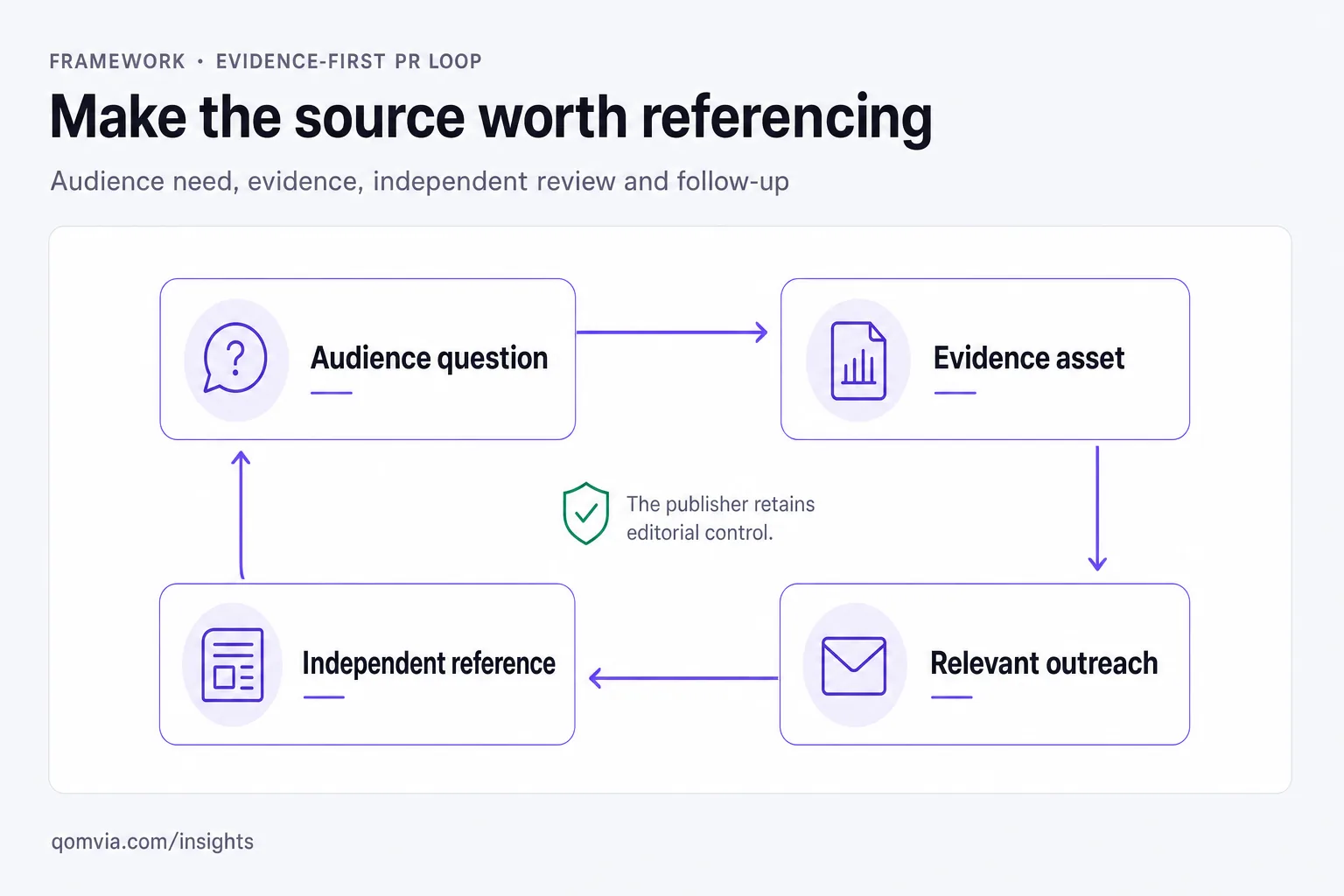
Use the evidence-first PR loop. Identify an audience question, create a source that adds information, test whether an independent editor can verify it, offer the material to relevant publishers and improve the source based on genuine questions. The loop is about earned usefulness, not the quantity of links or the frequency of brand mentions.
Build a small claim file for every campaign. Record each factual statement, its primary source, the scope and any unresolved limitations. Keep the original data or record where permission allows. Prepare a concise explainer that helps a reporter find the evidence without forcing them through a sales funnel. Before the pitch, invite a colleague to challenge the analysis.
Choose outreach based on relevance, not a list-size target. A local policy story may suit a regional editor; a technical specification may suit a trade publication; a consumer issue may need a service journalist. The same asset can be adapted to a different question, but the evidence and disclosure should not change to fit a preferred headline.
Plan the lifecycle of the asset. Decide who answers questions after publication, how a correction is made, where a retired dataset or policy is labeled and how an editor can reach the responsible person. Keep the canonical page available and avoid changing its URL without a redirect. If a claim becomes outdated, update it transparently so later citations do not point to a page whose meaning has silently changed.
A campaign brief can name its audience question, evidence owner, source page, likely caveats, outreach list criteria and prohibited tactics. Review the brief with legal, privacy and subject-matter owners before publication when the material involves sensitive data or regulated claims. This creates a practical guardrail without dictating what an independent publisher must conclude.
How should teams evaluate earned references?
Review the reference for accuracy, relevance and independence before assigning it value. A mention can repeat an outdated claim, sit in an unrelated context or come from a source the audience does not use. Keep the original destination and surrounding passage so the team can assess what the reference actually contributes.
Review the reference itself. Is the organization named accurately? Does the passage describe the work fairly? Is the source linked to the specific evidence? Does the publisher disclose the relationship? An unlinked mention can still inform a reader; a citation leads to the underlying page.
Keep the measures separate. Count relevant placements as a communications output only under a clear inclusion rule. Record answer citations in a separate sample with the question and product mode. Measure tagged referrals in analytics and business outcomes using their own definitions. Do not sum coverage, mentions and sessions into a single “AI PR impact” score.
Use a qualitative review alongside any count. A small number of accurate, relevant references can be more useful to customers than a broad but shallow set. Ask whether a source added genuinely new evidence, whether the article preserved a caveat and whether the reference reached the audience the campaign intended to serve. These are strategic judgments, not hidden engine metrics.
Separate the communication outputs from downstream outcomes. A published story is a placement under a defined inclusion rule; a linked page is a citation; an analytics session is a visit; a customer action is a business outcome. They may be related, but one does not automatically prove the next. Report the evidence for each stage with its own scope and avoid claiming that one placement caused an answer citation without a method that can support that conclusion.
What should a team do when coverage is wrong?
Identify the exact published statement and distinguish factual error from disagreement about framing. If a number, date, attribution or description is wrong, send a concise correction with the supporting record and the precise change requested. Do not ask a publication to remove a fair critical opinion merely because it is unfavorable to the organization.
Keep a correction log that records the source, disputed passage, evidence shared, response and outcome. This helps the company identify recurring misunderstandings in its own materials and maintain an accurate public record. Use the log to document the process and preserve publishers' editorial independence.
Separate a factual error from an editorial disagreement. If a page misstates a verifiable fact, provide the exact correction and a source that supports it. If the writer made a judgment the company dislikes, do not call it inaccurate merely because it is unfavorable. Respect editorial independence and make the case with evidence.
If an answer cites an inaccurate article, inspect both the cited passage and the company's own source page. Correct the first-party record if it is incomplete, then request a correction from the publisher when the outside page contains a demonstrable error. Preserve the answer and citation as an observation, not as proof that the PR campaign caused the summary.
For a recurring mismatch, update the canonical explanation, public identity details and supporting evidence. Then watch whether the issue remains in the sources or appears only in a generated response. The competitor recommendation diagnostic and AI search visibility measurement guide offer complementary frameworks.
If a publisher corrects the article, verify the updated text and record the change without asking for a favorable rewrite. If the publisher declines, decide whether the original page remains materially inaccurate and whether a public response is warranted. Make any response specific to the evidence and avoid amplifying a minor disagreement into a broader accusation.
When the answer misstates otherwise accurate coverage, preserve the source passage and the response as separate records. Correct the company's own pages if they leave room for a misunderstanding, then use the product's available feedback path where appropriate. Do not pressure an independent writer to alter a sound article because a generated answer summarized it poorly.
How Qomvia shows which sources win
Qomvia's AI monitor shows the sources each model cited and the rival it named, so PR effort goes where the answers come from.
The free scan runs all 26 checks of the agent-readiness score in about a minute and lists every failing check with a copy-paste fix; the free Site monitor re-scans weekly, no signup for the score. The AI monitor then asks your buyers' questions to ChatGPT, Gemini and Grok every day and shows whether you are named, which rival is named instead and which sources the models used. Qomvia Market and the MCP server take it one step further, letting agents act on the recommendation. Sign up free or see plans and pricing.
Sources and further reading
Questions
- What is digital PR for AI search?
- It is the work of earning accurate, useful third-party references that readers and answer products can inspect. Build evidence that serves the audience and gives publishers a clear source to evaluate.
- How can digital PR earn AI citations?
- Create a source that contributes verifiable evidence, offer relevant expertise to independent publishers and make the material easy to inspect. Citation selection remains outside the publisher's control.
- Should I pay for links to improve AI visibility?
- Do not present paid links as independent editorial references. Focus on useful evidence and transparent relationships rather than disguised endorsements.
- Do AI citations count as digital PR coverage?
- They are a separate observation. Record the answer, citation and product surface independently from editorial placements and referral sessions.
- How do I pitch an expert for AI search coverage?
- Offer a relevant expert who can explain evidence, scope and limitations. Tailor the pitch to the publisher's audience and disclose the person's relationship to the organization.
- Can digital PR guarantee brand recommendations?
- No. Earned references make accurate source material available; each answer product selects and describes sources through its own process.
Score your own site against the rubric this is written from.
Is your site agent-ready?
Free score against the same rubric, in under a minute.
Sign up free to keep the fixes and track the score.
AI monitor
PreviewHow often each model names your site across 11 tracked questions.