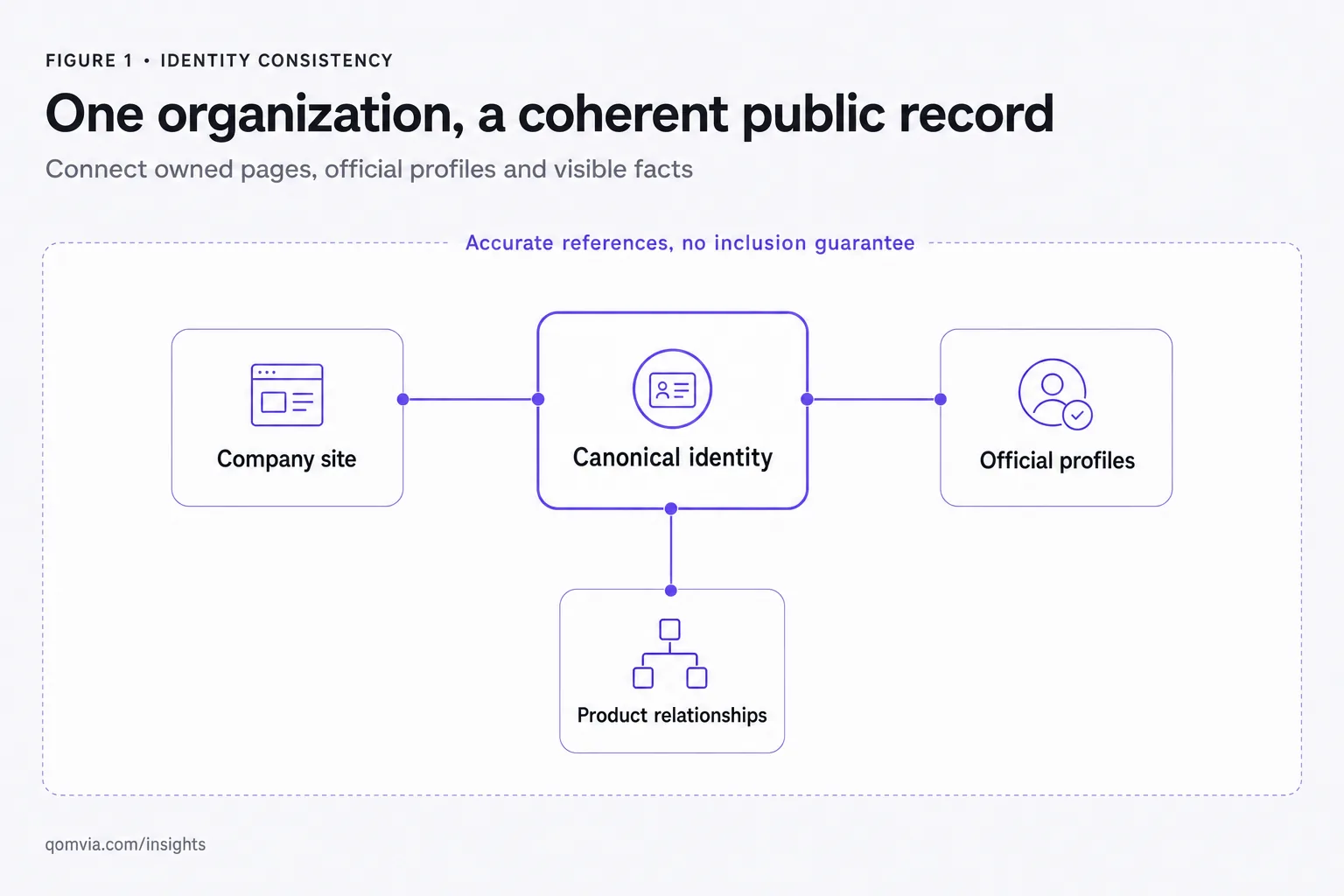
By Qomvia, 14 min read
Key takeaways
A model that is unsure which company you are will describe someone else or nobody. AI assistants now answer the question before anyone clicks a result, so clear entity facts decide whether the answer names you correctly.
- Start with the identity you control: keep the organization's name, description, location and product relationships consistent on owned pages.
- Connect profiles carefully: a link should represent the same organization, not merely a page that mentions it.
- Structured data reflects visible facts: Organization markup cannot replace a clear About page or credible source.
- Third-party references need stewardship: correct genuine errors, but do not manufacture profiles, reviews or mentions.
- Make identity easy to verify: align names, facts and relationships across the website and legitimate public references.
What is entity SEO?
Entity SEO is the work of making an organization, person, product or other subject easier to distinguish and describe across a website and its public references. It focuses on stable names, accurate facts and clear relationships so readers and systems can interpret the subject consistently.
A company is more than a string in a title tag. It may have a legal name, a public brand, products, leadership and a history of changes. If the site uses those labels inconsistently, a reader has to infer whether two pages refer to the same organization. The first goal is to remove avoidable ambiguity in the information the company publishes and controls.
This guide treats entity SEO as identity stewardship, not a technique for entering a hidden graph. For the implementation of Organization JSON-LD and sameAs, read the Organization markup guide. For broad answer readiness, see AI SEO and E-E-A-T for AI search.
How do searchers and answer systems recognize an organization?
Start with one canonical description
A reader usually identifies an organization through a cluster of signals: its name, description, site, products, people, contact details and references. A well-maintained site can explain these relationships directly. A company can distinguish itself from a similarly named brand, state which products it owns and clarify when it changed names or ownership. Those are visible facts that human reviewers can verify.
Do not claim that a particular model uses a specific hidden entity graph unless the provider has documented that behavior. An answer may name a business based on a first-party page, an external directory, a cited article or other information. The answer alone does not reveal the complete source path. Treat entity consistency as a way to make the organization's public facts coherent across those references.
The first diagnostic is a name audit. Compare the homepage, About page, footer, product catalog, legal terms and public profiles. Record official and former names, common abbreviations and product relationships. If a brand name is also a category word, provide enough context to distinguish the company. If a public reference is wrong, preserve the correction request and its evidence rather than silently changing the site to match an error.
Make the audit operational by listing each name variant beside the page where it appears and the role it plays. A legal entity, a consumer brand and a product line may all be accurate labels, but they should not be used interchangeably. Add a short explanation where the relationship is not obvious. The aim is not to force every page into one phrase; it is to help a reader understand when the labels refer to the same organization and when they do not.
Review the identity from the perspective of someone who has never visited the site. Could they tell who sells the product, who provides support and which company is responsible for the statement? If the answer depends on internal acronyms or an old acquisition history, explain the relationship on an owned page. Clear context is more useful than publishing the same tagline in every location.
Which organization facts should stay consistent?
Connect names to real relationships
Keep the organization name stable, with a clear explanation of aliases where they matter. Use the same description of the business across owned pages, but tailor the level of detail to the context. An About page can describe the company and its history; a product page can explain the product relationship; a support page can identify who provides the service.
Clarify relationships instead of assuming they are obvious. State whether a product is made by the company, sold by it, licensed to it or offered by a partner. Identify the publisher of editorial material separately from the organization being discussed. When names change after an acquisition or rebrand, give the effective context so readers can connect old references to current facts.
Use a source-of-truth table for information that appears in multiple places. Assign an owner to the legal name, public description, leadership, product family, address and support channel. Define which pages are authoritative and how updates propagate. This prevents one public page from describing a product as current while another calls it discontinued or attributes it to a different company.
Separate stable identity facts from facts that change often. The canonical business name may be stable while a support address, executive role or service area changes. Record a review trigger for volatile fields and a process for correcting downstream pages. Do not let a sitewide footer become the only source of truth if no owner is assigned to maintain it.
Preserve historical context when it affects interpretation. If a company changed its name or a product moved between organizations, state the timing and relationship in language that avoids implying that the current entity always owned the older record. A clear chronology can reconcile legitimate differences across archived reports and current product pages without erasing useful history.
| Identity attribute | Authoritative source to maintain | Consistency check |
|---|---|---|
| Organization name | About page and legal identity | Aliases and former names are explained |
| Product relationship | Product page and catalog | Maker, seller and partner are distinct |
| Leadership or author | Current profile and byline | Role and name match public page |
| Location or contact | Contact and policy pages | Address and service area remain current |
| External profile | Official profile URL | It represents the same organization |
How should a business use external profiles and directories?
Treat each profile as a reference that has its own owner, editing policy and evidence threshold. Claim or maintain a profile only when the organization is entitled to represent it. Keep descriptions accurate, link to the official site and correct obsolete information through the profile's documented process. Do not create duplicate listings to occupy more names or categories.
A directory listing can help a person confirm practical details such as name, location and service. It can also become stale. Build a review process for the references that matter to customers and partners, then correct errors with verifiable documentation. Do not treat the number of profiles as an entity strength score or imply that every assistant uses the same directory sources.
Pursue a Wikipedia or Wikidata entry only when independent coverage and community policies support one. Do not create an article or data item just to force a brand into a knowledge system. If an organization already has a valid independent reference, follow the community's rules and make neutral, verifiable corrections when appropriate. The company website should stand on its own as a reliable source for first-party facts.
Review directory quality by relevance and authority to its own audience, not by how many entries can be created. A listing may be useful because customers use it to confirm a location, professional role or product relationship. Another profile may be abandoned or duplicative. Keep a short register of the references worth maintaining and the evidence required to claim or correct each one.
Third-party references should be earned through useful work: publish documentation, answer legitimate customer questions, provide accurate records to partners and make original information available to reporters. Avoid fake reviews, paid links disguised as independent endorsements or repeated boilerplate profiles. These tactics can create contradictions and undermine the credibility the identity program is meant to protect.
Prioritize profiles by the people who rely on them. A local service provider may care about accurate location and hours; a software company may need its product documentation and support record to be easy to identify. Review whether the profile is official, current and editable by an authorized representative. If the platform does not permit a correction, document the limitation and keep the canonical fact clear on your own site.
What role does structured data play in entity SEO?
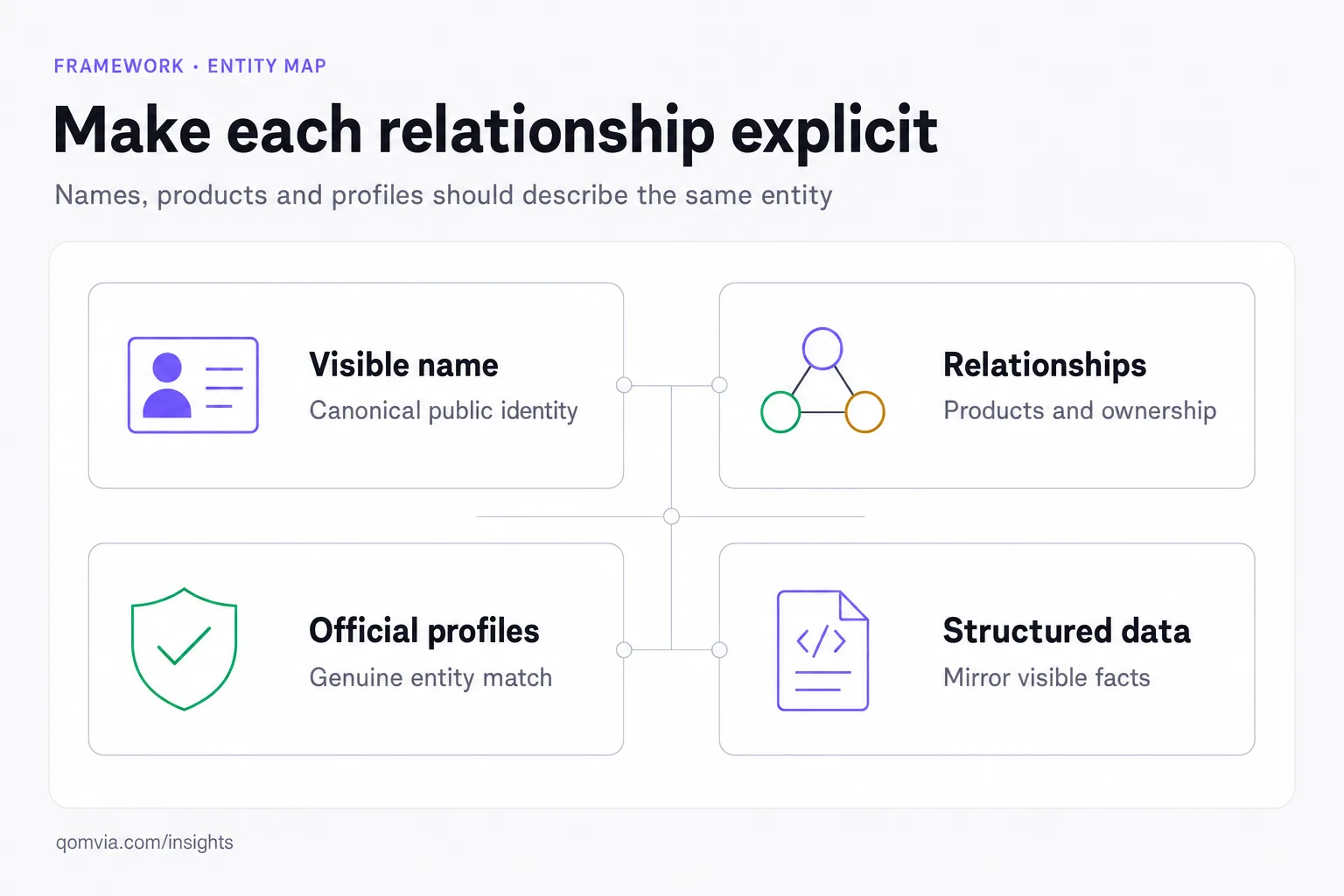
Organization structured data can express the organization described on a page. Google says markup should accurately represent visible content; that means the page still needs to identify the organization in reader-facing text. Structured data should reuse the canonical name and correct official URLs rather than introduce an alternate story that visitors cannot see.
The sameAs property is best used for pages that genuinely identify the same entity. A profile that merely mentions a company is not necessarily an equivalent identity page. Review each linked profile and remove broken or misleading references. A long list is not inherently stronger than a short list of accurate relationships.
Structured data is one part of the identity consistency map. Align it with page titles, visible names and actual profile URLs. If an organization changes its public name, update the relevant source pages and explain the transition where the history matters. The technical markup guide Organization JSON-LD and sameAs covers the schema-specific implementation.
Use markup to state a relationship that already makes sense in the visible page. If the business operates a product brand, the site should explain that connection before the structured object links the two. If a page discusses a third party, do not mark that subject as the publisher. Accurate visible language gives a human reviewer the context needed to evaluate the machine-readable relationship.
Structured data cannot resolve a contradictory public record by itself. If the visible About page calls the business one thing, a product page names another seller and a profile points to an obsolete site, adding a JSON-LD object can create a fourth version. Correct the reader-facing source and establish the relationships first, then represent those facts in markup that follows the visible page.
How can a team diagnose an entity mismatch?
Capture the exact statement and the page or profile where it appeared before making a correction. Compare it with the organization's authoritative record and ask whether the disagreement is a true factual error, a naming variation or a relationship the company has not explained. This classification helps the team send a precise correction and avoid treating every difference as evidence of a broken entity system.
Capture the exact wording in the answer or profile, then compare it with the company's canonical source pages. Classify the mismatch: wrong name, outdated description, mistaken product relationship, incorrect location, unsupported claim or confusion with another organization. This classification prevents a team from rewriting the entire site when one field or reference is responsible.
Next, find where the conflicting statement appears. If the first-party page is wrong, correct it. If a public profile is stale, use its established correction channel. If the source is accurate but an answer still misstates the fact, preserve the response and use the product's available feedback route. Do not claim that a correction request will immediately alter a model's learned information.
Monitor changes with a stable set of identity questions and recorded conditions. Save the full response, source links and date; compare whether the name, category and ownership are correct. Log the observation and compare the next sample under the same conditions. For broader answer sampling, see AI search visibility measurement.
A good correction ticket includes the exact incorrect statement, where it appeared, the authoritative fact and the evidence supporting it. Assign the correction to the owner of that source. If the mistake exists only in an answer, attach the response and use the available product feedback process; do not edit unrelated pages to mimic a false answer. Recheck the same wording after the source correction and label any remaining uncertainty.
Avoid measuring identity quality by counting profile links or schema properties. Those counts can reward redundant or low-quality records. Instead, test whether a person can answer practical questions about the organization from the public information: what it is called, what it provides, which products it owns and where to find an authoritative description. A written identity brief can support that review.
What should a brand do first?
Use a short maintenance checklist after each material identity change: update the canonical About page, affected product pages, structured data, contact information and official profiles. Assign an owner and verify the live destinations. If a third-party reference cannot be corrected, record that constraint and preserve the organization's current facts on pages it controls.
Choose the facts that would cause the most confusion if they differed: the public name, what the company does, who owns a product, where support is provided and which profile is official. Verify each against the responsible owner and the page where a customer should find it. Then prioritize corrections by their impact on a real reader.
Make a review schedule that follows the organization's change process. A product launch, leadership change, office move or rebrand may trigger several updates. Include the public page, structured data and external profile in the checklist, then record any platform that does not permit an immediate correction. This keeps the identity map useful without promising control over third-party systems.
Ask a colleague outside the identity project to explain the business from its public pages. If they confuse the parent company, product, seller and support provider, improve those descriptions before adding more profiles. This exercise exposes internal shorthand and provides a reader-centered check of whether the organization's relationships are clear.
Keep an identity change log for rebrands, acquisitions, product transfers and important profile corrections. Record the date, old and new wording, the evidence behind the change, the pages updated and any external reference still awaiting correction. A small log helps teams explain legitimate variation without copying an obsolete name across every current page.
Write a one-page identity record with the canonical organization name, public description, product relationships, official profile links and owner for each fact. Compare the record with the site and the references customers actually use. Fix contradictions on owned pages before asking an external platform to infer which statement is correct.
Ask a colleague outside the identity project to use the record to explain the business. If they confuse the manufacturer, retailer, product and parent organization, improve the relationship descriptions before adding more profiles. This exercise exposes hidden assumptions in internal language and gives the team a reader-centered test for whether the identity information is clear.
Then review the public citations and profiles relevant to the business. Correct facts with evidence, avoid manufacturing references and preserve the status of unresolved requests. The aim is not to enter every directory or knowledge base. It is to make the organization's identity understandable wherever a person encounters it.
Revisit the identity record after meaningful business changes, such as a rename, product divestiture or new support relationship. Assign an owner to check the pages and profiles affected by the change. Keep a short history of what was updated and when. This gives employees a consistent reference and helps prevent old names from resurfacing in new content without explanation.
How Qomvia checks your entity signals
Qomvia's score checks the identity signals that make your organization easy to identify, from Organization JSON-LD to sameAs links.
The free scan runs all 26 checks of the agent-readiness score in about a minute and lists every failing check with a copy-paste fix; the free Site monitor re-scans weekly, no signup for the score. The AI monitor then asks your buyers' questions to ChatGPT, Gemini and Grok every day and shows whether you are named, which rival is named instead and which sources the models used. Qomvia Market and the MCP server take it one step further, letting agents act on the recommendation. Sign up free or see plans and pricing.
Sources and further reading
Questions
- What is entity SEO?
- It is the work of making an organization or other subject easy to distinguish through consistent names, accurate facts and clear relationships across public sources.
- How do AI systems know who my company is?
- A response may draw on different information sources, and the answer alone does not reveal the full path. Keep first-party identity facts clear and inspect citations where available.
- Does entity SEO mean getting into Wikipedia?
- No. A Wikipedia or Wikidata entry depends on the relevant community's policies and independent coverage. Maintain accurate first-party information and follow the policies of any third-party reference you legitimately manage.
- How should I use sameAs in Organization schema?
- Link to profiles that genuinely represent the same organization. Do not use a page that only mentions the business as an identity match.
- How can I fix an incorrect AI answer about my brand?
- Identify the exact wrong fact, correct the authoritative source if needed, use available feedback controls and preserve later answer samples to see what remains.
- Can consistent entity information guarantee brand mentions?
- No. Consistency makes public facts easier to interpret; brand mentions and recommendations remain answer-level observations to measure.
Score your own site against the rubric this is written from.
Is your site agent-ready?
Free score against the same rubric, in under a minute.
Sign up free to keep the fixes and track the score.
AI monitor
PreviewHow often each model names your site across 11 tracked questions.