By Qomvia, 14 min read
Key takeaways
E-E-A-T is often treated as a ranking hack, and AI answers raise the stakes on trust. AI assistants now answer the question before anyone clicks a result, so models repeat sources that look reliable and skip those that do not.
- E-E-A-T means experience, expertise, authoritativeness and trustworthiness: use the framework to guide editorial review.
- Biographies need substance: show the author's relevant experience and contribution to the page.
- Google gives greater attention to E-E-A-T for YMYL topics: the stakes of the topic shape how carefully content should be evaluated.
- Use Who, How and Why as editorial questions: identify responsibility, production method and the reason the page exists.
- Make evidence inspectable: accurate bylines, clear methods and supported claims help readers judge the work.
What is E-E-A-T for AI search?
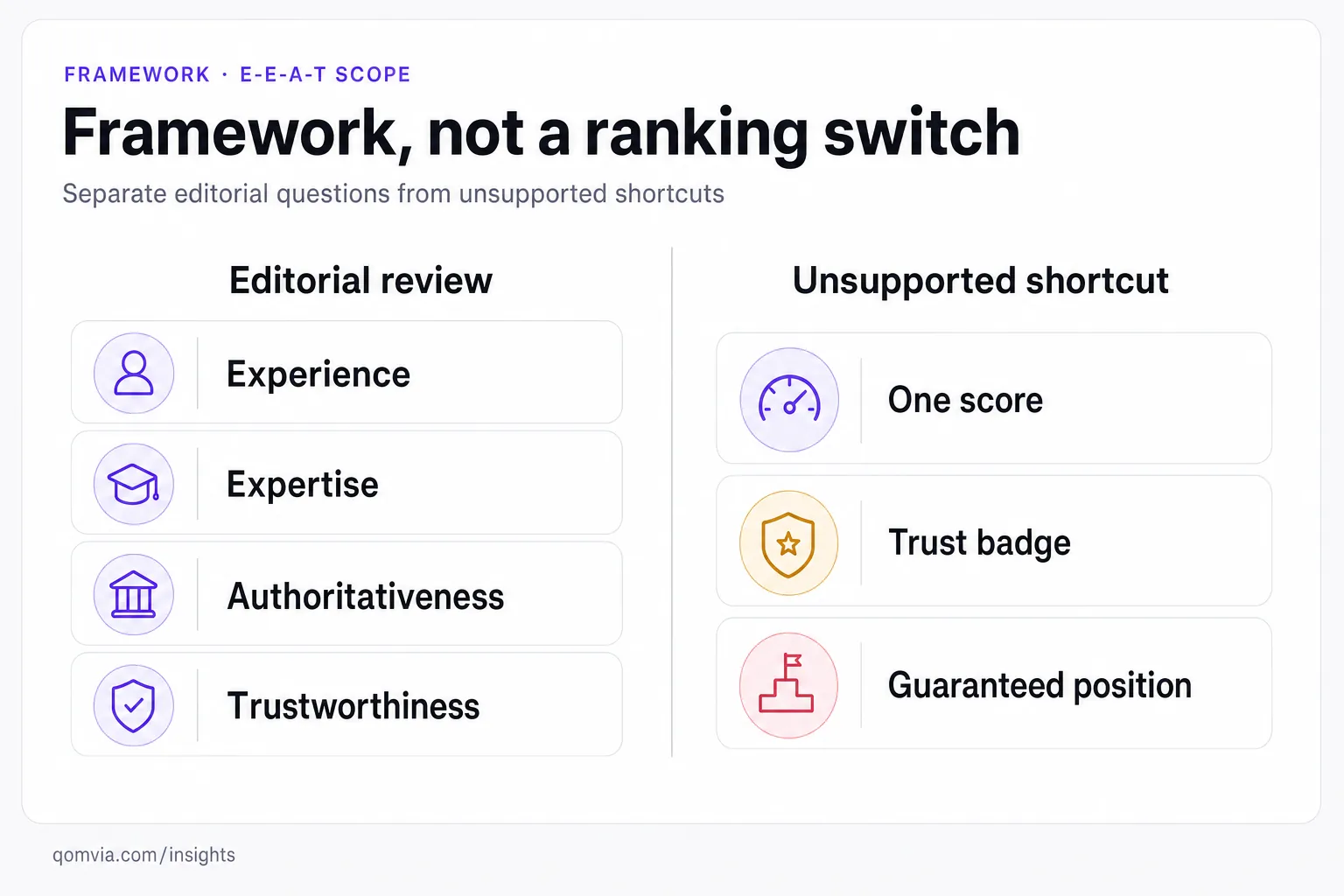
E-E-A-T stands for experience, expertise, authoritativeness and trustworthiness, Google's framework for evaluating qualities of helpful content. For AI search, it is a way to make responsibility and evidence visible to readers, not a separate set of technical ranking switches. A publisher can improve its editorial process without claiming control over a generated answer's source selection.
The framework is often turned into a checklist of superficial signals: add an author box, use a credential, publish a date or repeat a trust phrase. Those elements may help a reader when they are accurate and relevant, but they do not substitute for a page that supports its claims. A biography cannot prove a statistic; a recent timestamp cannot make an obsolete policy current.
Google's Search guidance asks publishers to consider who created content, how it was produced and why it exists. This guide uses those questions as an editorial review method. For page structure, see writing content for AI search; for source eligibility and selection claims, read AI search ranking factors.
Is E-E-A-T a Google ranking factor?
A quality framework is not a switch
Keep the terminology precise when discussing this question. A quality concept can guide editorial decisions without being a single measurable switch that a publisher can activate. Explain what the official guidance says, distinguish it from the team's recommendations and avoid assigning causal ranking effects to individual page elements without supporting evidence.
Google states that E-E-A-T itself is not a specific ranking factor. That is the clearest answer to the long-tail question. It does not mean that content quality is irrelevant or that Google ignores the qualities described by the framework. It means that publishers should not describe the acronym as one measurable signal that can be added to a page to secure a ranking.
Google says its systems give more weight to content that aligns with strong E-E-A-T for topics that can significantly affect health, financial stability, safety or the welfare of society. Apply deeper review to these topics by checking accuracy, sourcing and accountability rather than counting credentials or paragraphs.
Google also says quality raters do not directly rank pages. Their assessments help evaluate whether changes to Search systems are producing results that align with its guidance. A rater score should not be described as a direct mechanism that moves one page up or down. This distinction helps teams discuss quality without turning a review framework into an invented score.
Keep the distinction visible in planning documents. A page review can use E-E-A-T questions to identify missing evidence, unclear authorship or a weak purpose. That is different from assigning the page an “E-E-A-T score” and claiming that a particular score will move it in Search. A checklist can support internal consistency, but its result remains an editorial diagnosis unless the method and meaning are defined.
Do not confuse the framework with the credentials of the writer. Expertise may matter for a topic, but the page still needs accurate reasoning and sources. A credential can help explain why a person is qualified to contribute; it cannot validate every sentence automatically. Review each claim for its evidence and its consequences, then use authorship details to make responsibility clearer.
How do Who, How and Why guide an editorial review?
Make authorship, method and purpose visible
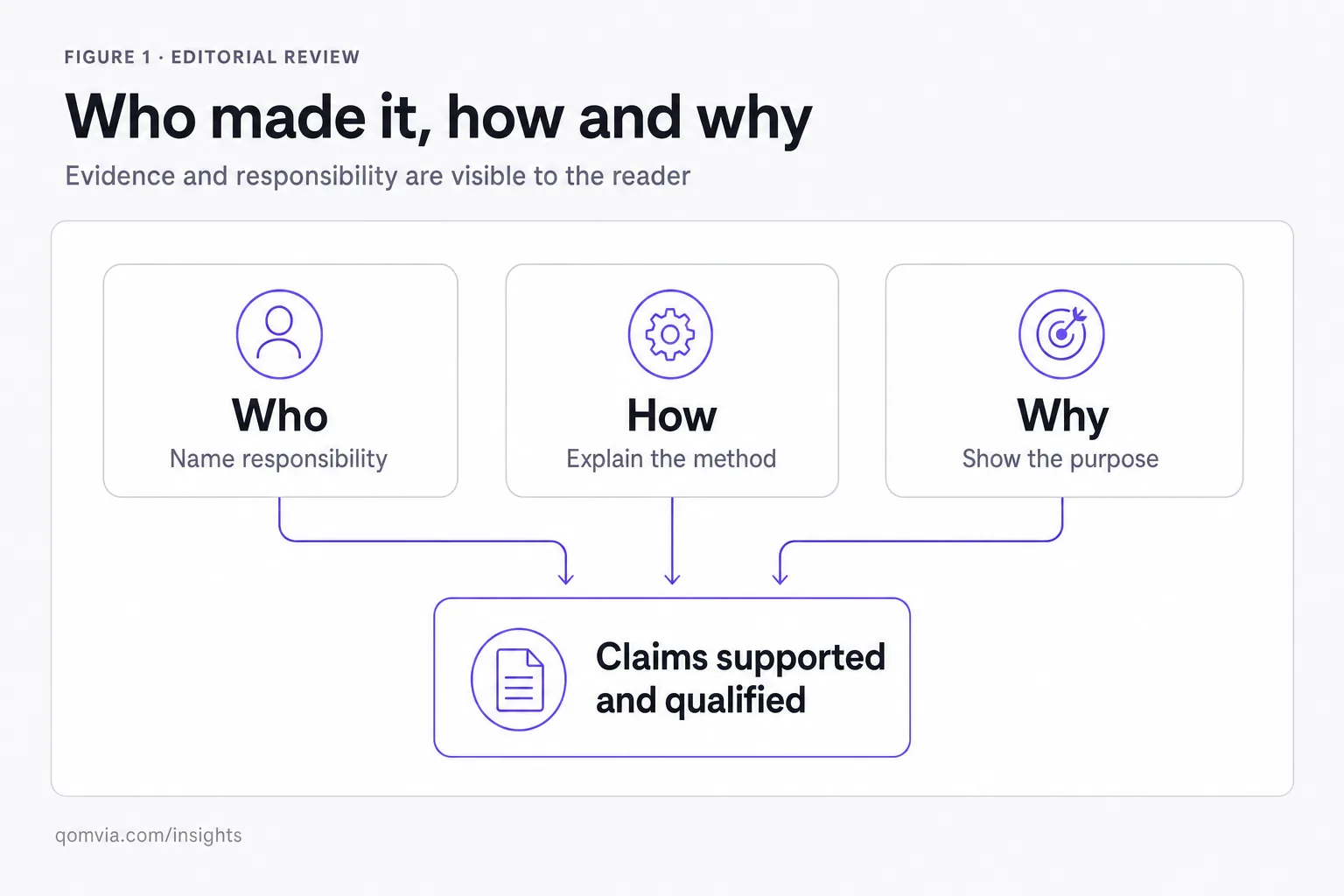
Who asks who created the material and who is accountable for its claims. An article can identify its author, editor or responsible organization, with an accurate description of the role. A business page can explain which legal entity provides the service. If several people contributed, be precise about authorship and review instead of assigning a credential to a team that does not hold it.
How asks how the content was produced. A first-hand review might describe the test conditions and what was not tested. A research summary can explain how sources were selected and when they were checked. Google says the How may include a description of automated or AI assistance where relevant. The point is not to disclose irrelevant production details; it is to let the reader understand the method behind a claim.
Why asks why the page exists. Is it intended to help someone make a decision, understand a topic or complete a task? Or does the page exist mainly to capture search visits without contributing distinct value? A clear purpose should be visible in the depth, evidence and next steps. A page that answers a real question can still have a business goal; the goal should not replace the reader's need.
Turn the three questions into a review conversation. Ask the author or owner to explain who is accountable, what sources or experience informed the page and which reader task the material resolves. Then compare the answers with the page itself. If the method exists only in an internal brief, expose the relevant details to the reader. If the stated purpose does not match the content, revise the page rather than adding a decorative disclosure.
Make disclosure proportional. A first-person product test may need to explain which item was tested and under what conditions. A factual help page may need a responsible publisher and a link to the policy. A short glossary may not need a long account of the writing process. The test is whether a reader could reasonably ask how the material was created and whether the answer affects trust in its claims.
| Editorial question | Evidence a reader can inspect | Common overreach |
|---|---|---|
| Who made this? | Accurate byline and accountable publisher | A credential unrelated to the subject |
| How was it produced? | Method, sources and relevant assistance | A label that replaces evidence |
| Why does it exist? | A useful task and a clear contribution | A page created only to capture a query |
| What can I trust? | Supported claims and visible limitations | A generic trust badge or unsupported claim |
How should E-E-A-T affect high-stakes content?
Use a more demanding review for advice that could materially affect a person's health, finances, legal position or safety. State the limits of the guidance, link to authoritative information and route case-specific questions to a qualified professional. If the organization lacks the necessary expertise, narrow the topic instead of presenting a confident general answer.
Start by identifying what could go wrong if a reader relies on an incorrect statement. Health, finance, safety and major life decisions deserve particular care in source selection, review and limitations. Assign a qualified reviewer where the subject requires specialist judgment, and make the responsibility accurate. Do not use a credential as a proxy for proof of every claim on the page.
Build the review around the claims that affect a decision. Check whether a recommendation has a primary source, whether a policy is current and whether exceptions are stated near the guidance. If evidence is uncertain, say so. A clear limit is more trustworthy than a confident answer that ignores conditions the reader needs to know.
Keep the method proportional to the risk. A personal anecdote may illustrate an experience but cannot establish a general medical or financial conclusion. A technical benchmark should state what was measured and how. A product comparison should name the criteria and relevant exclusions. In each case, the page should make it possible for a reader to distinguish evidence from interpretation.
Use a two-stage review for consequential material. First verify the source record and whether the claim is current. Then ask a qualified reviewer to assess the reasoning and any limits a general reader might miss. Assign responsibility for approving changes and keep a record of unresolved questions. A review process should be clear enough that a later editor can tell what was checked and what remains uncertain.
Do not conceal uncertainty behind polished presentation. If evidence is mixed, describe the disagreement and explain why the page reaches its conclusion. If a recommendation depends on personal circumstances, state those conditions and invite the reader to consult the appropriate professional where needed. The goal is not to eliminate judgment; it is to make the basis and limits of judgment inspectable.
Can AI-assisted content meet Google's guidance?
Google's guidance says the How question can include information about automation or AI assistance where a reader might reasonably wonder how content was produced. It does not say that the mere use of a tool proves content is unhelpful, or that disclosure alone makes an inaccurate article useful. The publisher remains responsible for facts, sources, judgment and the final work.
A useful disclosure describes the role of automation when it matters to the reader. It should not be used as a substitute for an author, reviewer or method. If a writer used assistance to summarize primary material, the article still needs a human to check that the summary is faithful and that the source supports it. Avoid overstating the degree of original research or first-hand experience.
The deeper question is whether the content offers value that follows from its purpose. Does it answer the query accurately? Does it add evidence, analysis or practical clarity? Can a reader tell who stands behind it and how to verify important claims? These questions are more useful than trying to optimize an acronym as though it were a metadata field.
A disclosure should not be used to excuse a weak process. If automation helped draft or summarize the material, the publisher still needs to check facts, citations, reasoning and any claim of first-hand experience. If an automated workflow introduced an error, correct it at the source and review whether the process needs a stronger check. The reader's interest is in the reliability of the finished page, not a label alone.
Avoid inventing experience to satisfy a perceived preference. A writer should not imply that they tested a product, visited a location or interviewed a source if they did not. Explain the actual basis of the work and supplement it with evidence that can be inspected. Honest limits help a reader decide how much weight to give an explanation.
How can a team make E-E-A-T operational?
Keep the review record proportionate. A stable, low-risk definition may need a straightforward source check, while a consequential recommendation may require multiple reviewers. Document who examined the material and what question they answered, so the process provides accountability without becoming a decorative approval step.
Prioritize review effort by the likely consequence of being wrong and the rate at which the underlying facts change. A stable conceptual explainer may need a different cadence from a current service policy. State the rationale in the editorial record so the review schedule is not mistaken for a ranking tactic.
Give reviewers a clear scope. They may verify the source, test a product procedure, check terminology or approve a high-stakes qualification. Do not assume that an expert in one topic can validate every claim in a long article. Where expertise is missing, narrow the article or seek an appropriately qualified reviewer.
Make the correction path visible and practical. Readers need a way to flag an error, and the publisher needs an owner who can assess evidence and update the relevant page. Record the date, change and source of a substantive correction. A public correction process is meaningful only when it leads to a real review.
Create an evidence record for important claims. Store the wording, author or accountable expert, supporting source, review date, scope and next review trigger. The record should distinguish direct organizational experience from a summary of public information. If a claim has no accountable owner, qualify it or remove it until the team can substantiate it.
Use an editorial review that matches the consequence of an error. A product comparison may need a current specification check; advice with material health, legal or financial implications needs an appropriately qualified reviewer and clear boundaries. Do not use one generic approval checkbox for every topic. The review record should show what was actually examined.
Make first-hand experience concrete without turning it into an unsupported credential. Explain what was observed, how the observation was made and which circumstances limit its use. A practitioner can describe a workflow they handled; a company should not imply independent endorsement merely because an employee wrote about its own service.
Keep ownership visible to readers. A byline should identify the person responsible for the article, and a useful author page should explain relevant experience in specific terms. Where a team or organization produced the material, name the editorial responsibility instead of inventing a personal expert identity.
Review trust signals as a connected system. Contact information, correction routes, product terms, privacy disclosures and editorial sourcing should not contradict one another. If an article recommends an action, make the relevant qualification easy to find. A professional-looking page cannot substitute for accurate terms and a responsive correction process.
Schedule review when the underlying facts can change, not only when a page reaches an arbitrary age. A pricing update, policy revision, product version or new source may trigger a review. Record the reason for a substantive update, then retest links and examples. If no evidence changed, do not imply that merely refreshing the date has improved the article.
Assign an owner to each high-impact page and define what triggers a review. A policy change, new evidence, a product revision or a discovered error can be a meaningful trigger. The owner should verify the substance, not simply change a visible date. For evergreen guidance, schedule a source check that confirms links and claims still hold.
Create a compact record of claims, sources, reviewer and last substantive change. Preserve unresolved questions so the next writer does not convert an assumption into a fact. When a claim is based on professional judgment, label the interpretation and explain the evidence that supports it. The record helps editors maintain consistency across a series of pages.
Review the rendered page as a reader. Can you identify the author, publisher, purpose and relevant method? Are important limits visible? Does the title describe what the page actually delivers? A structured data implementation can represent some of these facts, but it cannot repair missing or misleading visible content. See schema markup for AI search for the relationship between page copy and structured description.
Create an issue record for each review finding. Name the claim or section, the evidence needed, the owner and the next review trigger. Separate a factual correction from an editorial disagreement and a design improvement. This turns broad language about “trust” into work a writer, subject expert or product owner can complete and verify.
Retire claims that no longer have a responsible source. If the evidence has changed, update the explanation and show what is current. If no reliable basis can be found, remove the statement or label the uncertainty instead of preserving it because it performed well in search. A trustworthy process includes a route for withdrawing a claim as well as publishing one.
How Qomvia checks your trust signals
Qomvia's score checks the identity signals agents use to trust a site, such as Organization data, sameAs links and policy pages.
The free scan runs all 26 checks of the agent-readiness score in about a minute and lists every failing check with a copy-paste fix; the free Site monitor re-scans weekly, no signup for the score. The AI monitor then asks your buyers' questions to ChatGPT, Gemini and Grok every day and shows whether you are named, which rival is named instead and which sources the models used. Qomvia Market and the MCP server take it one step further, letting agents act on the recommendation. Sign up free or see plans and pricing.
Sources and further reading
Questions
- What does E-E-A-T mean?
- It means experience, expertise, authoritativeness and trustworthiness. Google uses it as a framework for content quality, not as one standalone ranking factor.
- Is E-E-A-T a ranking factor?
- Google says E-E-A-T itself is not a specific ranking factor. Do not promise that adding a biography or trust badge will improve a page's position.
- Does E-E-A-T matter for AI Overviews?
- Use Google's quality guidance to improve accurate, accountable content, but do not claim that E-E-A-T is a separate AI Overview ranking switch.
- What are Google's Who, How and Why questions?
- They prompt publishers to explain who created content, how it was produced and why it exists. Use them to make responsibility, method and purpose clear.
- Can AI-written content have E-E-A-T?
- Google says the How may include how automation or AI was used where relevant. The publisher remains responsible for accuracy, evidence and usefulness.
- Does E-E-A-T matter more for YMYL topics?
- Google says its systems give more weight to content aligning with strong E-E-A-T for topics that can significantly affect health, financial stability, safety or societal welfare.
Score your own site against the rubric this is written from.
Is your site agent-ready?
Free score against the same rubric, in under a minute.
Sign up free to keep the fixes and track the score.
AI monitor
PreviewHow often each model names your site across 11 tracked questions.