By Qomvia, 14 min read
Key takeaways
Schema markup is sold as a shortcut into AI answers, and the truth is more modest and more useful. AI assistants now answer the question before anyone clicks a result, so correct structured data makes your facts easy to extract and attribute.
- Markup describes a page: Organization, Article, Product and Offer data should match facts a reader can see.
- Accuracy is the constraint: Google says structured data must be a true representation of visible content.
- Use FAQPage for visible content: mark up the questions and answers readers can see, then assess citations from the answer itself.
- Use each type for its subject: organization identity, article authorship, product facts and breadcrumb paths solve different clarity problems.
- Validate meaning, not only syntax: a technically valid object can still be misleading, stale or inconsistent with the page.
What is schema markup for AI search?
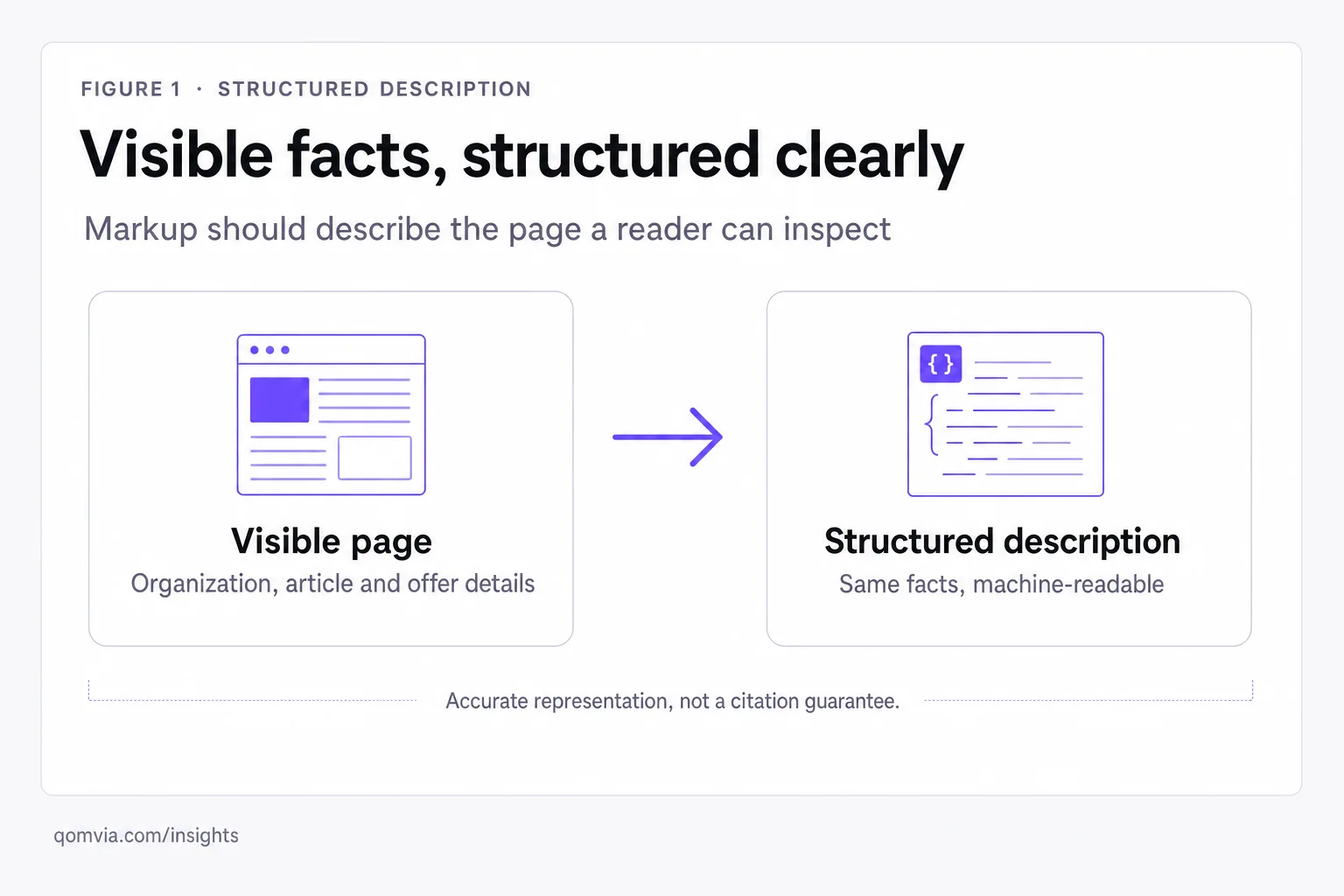
Schema markup for AI search is structured description that helps software interpret the people, organizations, products and content represented on a page. It can clarify relationships, but it does not replace visible evidence or compel an answer engine to cite the page. Use markup to accurately express what the page already says.
The phrase often attracts claims that a particular field will unlock a citation or a model-specific result. Google's structured data guidelines require markup to be a true representation of visible page content and prohibit marking up content that readers cannot see. That is the right starting boundary for any schema project.
Structured data is only one layer of a source page. The page still needs a clear answer, correct facts, accessible text and a useful relationship to the rest of the site. For Organization identity and sameAs details, see Organization JSON-LD and sameAs. For a wider evidence framework, read AI search ranking factors and writing content for AI search.
Start an implementation from the page's visible subject rather than a list of available properties. Ask what a reader would say the page is about, which organization or product it describes and which facts appear in the rendered experience. Then select only the type that fits. This prevents a template from accumulating fields no editor can explain or keep current.
Keep a field-to-source map. For each structured value, record whether it comes from the CMS, catalog, organization record or page copy. Assign the source owner and identify what should trigger an update. An audit is easier when reviewers can trace a price or byline back to the system responsible for it rather than inspect an object with no provenance.
Which schema types should a publisher consider?
Select types from page purpose
Choose types according to the actual subject of the page. Organization markup can state the name, public identity and relationships of a business. Article markup can describe an editorial work and its responsible author or publisher. Product and Offer descriptions can represent an item and a commercial offer. BreadcrumbList can express the site's navigational hierarchy. Each type answers a different classification question, so avoid adding every available vocabulary to every page.
Organization data is most useful when the business identity is already clear in visible copy. Use one consistent organization name, link the organization's canonical profile and distinguish the company from similarly named products or divisions. The sameAs property should point to profiles that genuinely represent the same organization, not pages that merely mention it. For entity consistency beyond markup, the entity SEO guide covers public identity signals.
Treat organization identity as a relationship, not just a name string. A parent company, product brand, retailer and service provider may all appear on one page but play different roles. Mark the organization that actually owns or publishes the content, and make the relationship to a product clear. If two public names refer to different legal entities, do not combine them into one object for convenience.
Article data should reflect the visible article: headline, author, publisher and dates where those facts are presented. Do not populate an author field with a department name if the page says an individual wrote it, or invent a review date because a template needs a value. A structured date is not a substitute for a meaningful revision. Keep the visible byline and the machine-readable statement aligned.
Make the author, editor and publisher roles legible to a reader before encoding them. An expert who reviewed one section should not be represented as the author of the whole article unless that accurately describes the work. A company can publish material without claiming a named individual wrote every line. Structured authorship should clarify responsibility rather than lend an unrelated credential to a claim.
Product and Offer markup needs especially careful maintenance. If the visible page shows a selected variant, a price condition or availability, the structured representation should describe the same offer. Do not use an aggregate or generic value that a shopper could mistake for the specific item. When the offer changes, update the underlying source and all rendered representations rather than adding a patch that leaves contradictory values.
For selectable variants, decide which item the page describes before choosing fields. A color, size, bundle or plan may have different details and terms. The visible selection and structured values should identify the same item. If the page does not show a price or availability, do not invent a value merely because an example object contains one. The point is correspondence, not completeness at any cost.
Is FAQPage markup useful for AI answers?
FAQPage markup can represent a visible question-and-answer section, but it does not promise that a search or assistant interface will quote those answers. Treat the markup as a description of the page, not an instruction to a model. The questions should be useful to people, and each answer should make sense with its surrounding context rather than existing only in structured data.
Google's structured data policies require a true representation of visible content. If an FAQ answer is hidden from readers, differs from the page text or describes a claim the organization cannot support, the markup is misleading even if it parses. Keep the rendered answer and structured answer aligned, including limits, conditions and the current state of the policy.
Avoid duplicating a block of questions across unrelated URLs solely to create more markup. A product page should answer questions about that product; a policy page should explain the policy. A repeated answer can become stale in one location while another is corrected. If a topic needs a dedicated answer page, link to the canonical source and make the relationship explicit.
Review the rendered question-and-answer experience as well as the structured object. Each marked answer should be available to the reader in its relevant context and retain its qualifications. A collapsed interface may still be visible when a person can open it; a data-only answer that readers cannot find creates a mismatch. The editorial owner should be able to explain why each question belongs on that page.
After a FAQ block validates, review whether each question reflects a real customer need and whether the answer is clear and current. If a policy changes, revise or remove both representations. Reusing an outdated answer across many pages can make a correction harder, not easier.
| Page content | Potential type | Editorial check |
|---|---|---|
| Public company identity | Organization | Name and profiles identify the same entity |
| Editorial article | Article | Author and dates match the visible article |
| Sellable item and offer | Product and Offer | Price and availability match the selected offer |
| Visible question and answer | FAQPage | Every marked answer can be read on the page |
| Navigational hierarchy | BreadcrumbList | The path matches the site's actual structure |
How should a team implement JSON-LD safely?
Validate against visible content
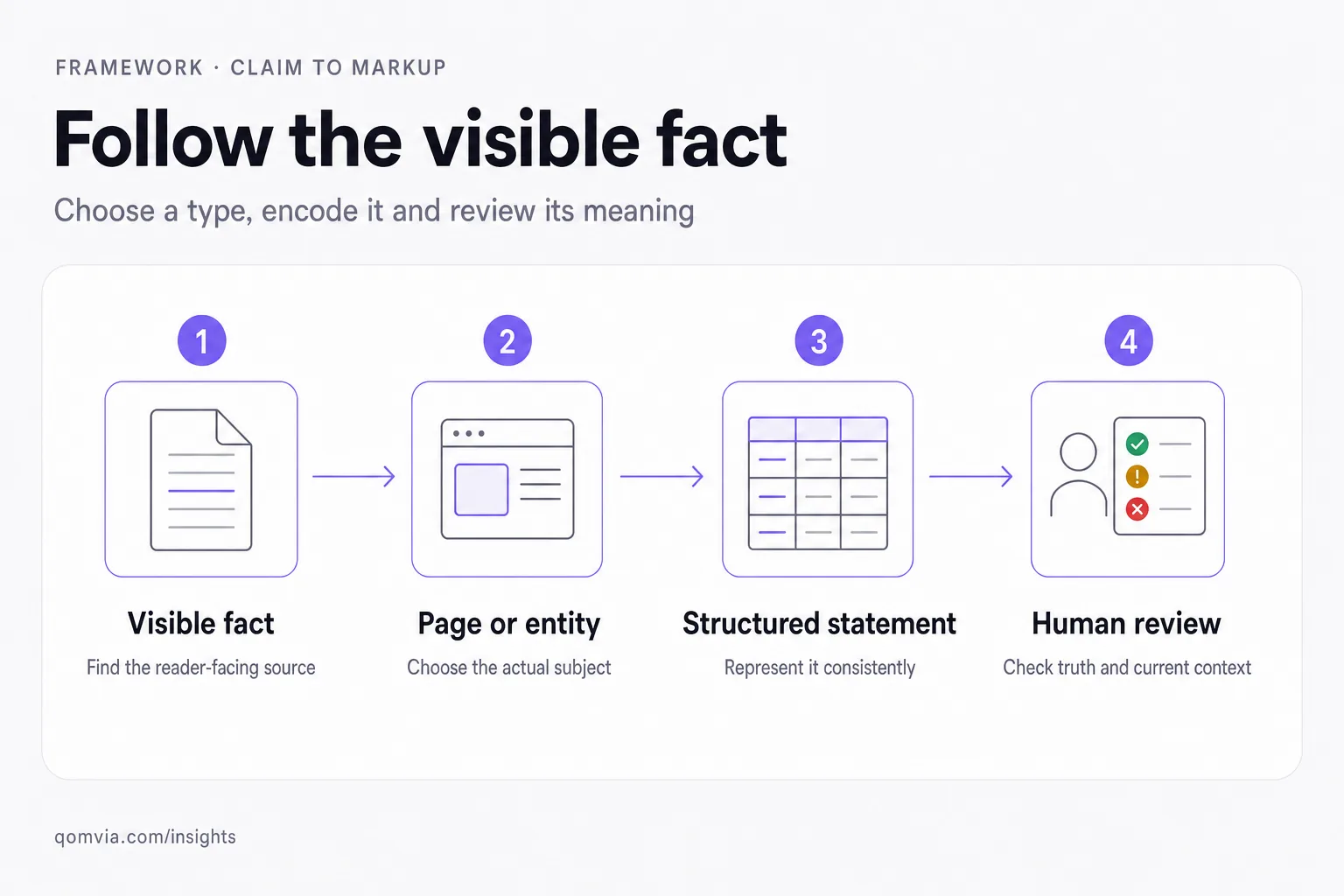
Start with a claim-to-markup chain: identify the visible statement, determine which entity or page it describes, encode that fact in the appropriate type, validate the generated object and compare it with what a reader sees. The chain keeps schema work connected to editorial ownership. If no one can identify the source of a value, do not encode it as though it were settled.
Generate JSON-LD from the same source of truth as the visible page where possible. That reduces the chance that a price, author, organization name or canonical URL drifts between templates. If the page has variants, define how the selected offer is represented. If the schema is shared across many routes, test a representative page from each template rather than assuming that one valid example proves the whole implementation.
A shared renderer can still emit different data for different page states. A product selector may update visible details after load while the initial structured object continues to describe the default offer. A reusable article template may render an editor and writer as duplicate authors. Test the important states and inspect the output users and crawlers receive, not only the source component.
Validation should include both structure and meaning. A syntax validator can detect malformed JSON, but a reviewer must still ask whether every field is accurate, current and visible. Compare title and byline, verify destination URLs, check for duplicate entities and inspect whether hidden blocks are marked up. A technically valid object can still make a false claim.
Keep canonical URLs and entity identifiers stable where they represent the same page or organization. Avoid emitting a temporary or parameterized destination when the visible page identifies a canonical address. If two objects represent different entities, give reviewers enough context to distinguish them. A syntactically correct link can still point to the wrong identity.
Does schema markup improve AI search ranking?
A responsible audit should keep markup validity, accurate representation and search outcome as separate questions. A clean parse addresses syntax; a visible-to-structured comparison addresses consistency; a controlled observation addresses a specific outcome. None of those answers can substitute for the others, and a successful validation should not be presented as proof of ranking impact.
The cited sources describe markup accuracy and Search eligibility rather than an AI citation or ranking effect tied to one property. Google's policy guidance addresses accuracy and visibility of marked-up content; its AI Search documentation says AI Overviews and AI Mode do not require special optimization beyond existing Search eligibility. Assess citations from the answer surface separately from the schema validation.
Structured data can still be useful when it accurately clarifies identity or page meaning for software. That is a technical reason to implement it, not proof of a visibility outcome. Keep the distinction in tickets and reports: “schema now matches the visible offer” is verifiable; “schema caused a citation” requires evidence that isolates that effect.
If a page is not cited, investigate the entire source path. Check access, relevance, the strength of the visible answer, entity consistency and the exact question. Do not add more properties before establishing which defect exists. For the distinction between disclosed eligibility and unproven selection, revisit AI search ranking factors.
A structured value can reduce ambiguity about what a page describes, but the sources here do not establish that adding more markup improves selection for a generated response. A page can have valid JSON-LD and still be irrelevant to the task, inaccessible or missing the evidence behind an answer. Treat those as separate investigations and correct the layer that has a demonstrated problem.
Do not let a markup validator define the editorial roadmap. A warning may concern an optional property, while an inaccurate visible offer can be more consequential even if the object passes validation. Prioritize discrepancies by their effect on a person's understanding and the truth of the page. Use the validator to find structural issues, then apply human review to the facts and relationships.
Use verifiable acceptance criteria for implementation work: the organization name matches the visible page, an offer reflects the selected variant or an FAQ answer is available to readers. These criteria let teams close a schema ticket on implementation evidence while tracking citation and ranking outcomes separately.
How can teams audit structured data?
Assign each finding to an owner and distinguish code defects from source-data and editorial defects. A template developer can repair how a value is emitted, but the merchandising owner may need to correct the value itself. Record both the change and a live-page check so a syntactically correct output is not mistaken for an accurate one.
Begin with a template inventory. Identify the page types that publish structured data, the components that create each object and the systems supplying the values. Select representative pages, including variants and exceptions, rather than checking only the homepage. A shared template may produce the same defect across hundreds of URLs, while a single page may have a one-off content mismatch.
Compare the rendered object with the visible page and the authoritative record. Check that names, prices, dates, authors and relationships agree where those properties apply. Confirm that the URL represents the page a reader can reach and that the object is not copied onto an unrelated template. Keep a record of the precise discrepancy so an owner can reproduce it.
After repair, verify both the page and the generated output in the deployed environment. A local fixture can pass while production data remains stale, or a cache can serve an earlier version. Recheck a representative page after deployment and note which templates were covered. Validation tools help identify syntax and vocabulary issues, but human review is still needed for truth and usefulness.
Create an inventory by page template and owner. List which types are rendered, where the values originate and who approves changes. Compare a sample of production pages with the source record and visible content. Include pages with multiple offers, changed authorship, archived products and localized routes, because those templates can expose different consistency problems.
For each finding, record the field, visible source, rendered value and correction owner. Classify it as missing, malformed, inaccurate, stale or not applicable. A missing field may be harmless if no reliable value exists; an inaccurate price or identity claim needs prompt correction. Avoid filling a field merely to make a validator display more green checks.
Choose audit samples that represent states with a higher chance of mismatch: products with variants, articles with several contributors, organizations with alternate public names and FAQs that have recently changed. Compare the rendered page with its structured object. A small deliberate sample can reveal a template bug more clearly than a long list of URLs with no state coverage.
After a fix ships, verify the deployed page and object together, save an example and assign the next review trigger. When the catalog, organization record or authorship changes, update the shared source so every representation follows. A schema program stays reliable only when it remains connected to the systems that own the facts.
Make the audit reusable by storing the route, template, field, visible text, structured value, source owner and disposition. When the same issue appears on another page, the team can determine whether the cause is a shared component or a local record. Close findings with evidence from the deployed page, not only a code review or a green validation result.
Recheck after deployment and when the underlying source changes. Preserve a rendered example with the audit record so another reviewer can see exactly what the markup represented. Keep schema validation and answer-level citation evidence separate: Qomvia's Site monitor reviews public site readiness, while citation outcomes should be checked on the answer surface. Use the Organization JSON-LD guide for the identity-specific implementation.
How Qomvia checks your structured data
Qomvia's score checks the structured data agents rely on and lists missing or broken types.
The free scan runs all 26 checks of the agent-readiness score in about a minute and lists every failing check with a copy-paste fix; the free Site monitor re-scans weekly, no signup for the score. The AI monitor then asks your buyers' questions to ChatGPT, Gemini and Grok every day and shows whether you are named, which rival is named instead and which sources the models used. Qomvia Market and the MCP server take it one step further, letting agents act on the recommendation. Sign up free or see plans and pricing.
Sources and further reading
Questions
- Does schema markup help AI search?
- Structured data can accurately describe visible entities and page content. The sources here do not establish that a property guarantees an AI citation or ranking.
- What schema should I use for AI Overviews?
- Use types that match the visible page, such as Organization, Article, Product and Offer, FAQPage or BreadcrumbList where appropriate. Google says AI Overviews have no special technical requirements beyond existing Search eligibility.
- Does FAQPage schema make an AI answer use my FAQ?
- No. It can describe visible question-and-answer content, but it does not compel a product to quote or cite that answer.
- Can I mark up content that is hidden from readers?
- Google's structured data guidance says markup must represent content visible to users. Do not add hidden claims as structured data.
- Should Product schema include current price and availability?
- If those facts are represented, keep the structured value aligned with the visible offer and selected variant. Stale or generic values can mislead readers.
- Is valid JSON-LD enough?
- No. Syntax validation does not prove that values are accurate, current or consistent with the visible page. Review both structure and meaning.
Score your own site against the rubric this is written from.
Is your site agent-ready?
Free score against the same rubric, in under a minute.
Sign up free to keep the fixes and track the score.
AI monitor
PreviewHow often each model names your site across 11 tracked questions.