By Qomvia, 14 min read
Key takeaways
There are now dozens of AI visibility tools, and their dashboards look alike while their methods do not. AI assistants now answer the question before anyone clicks a result, so the wrong tool leaves you with a number and no way to change it.
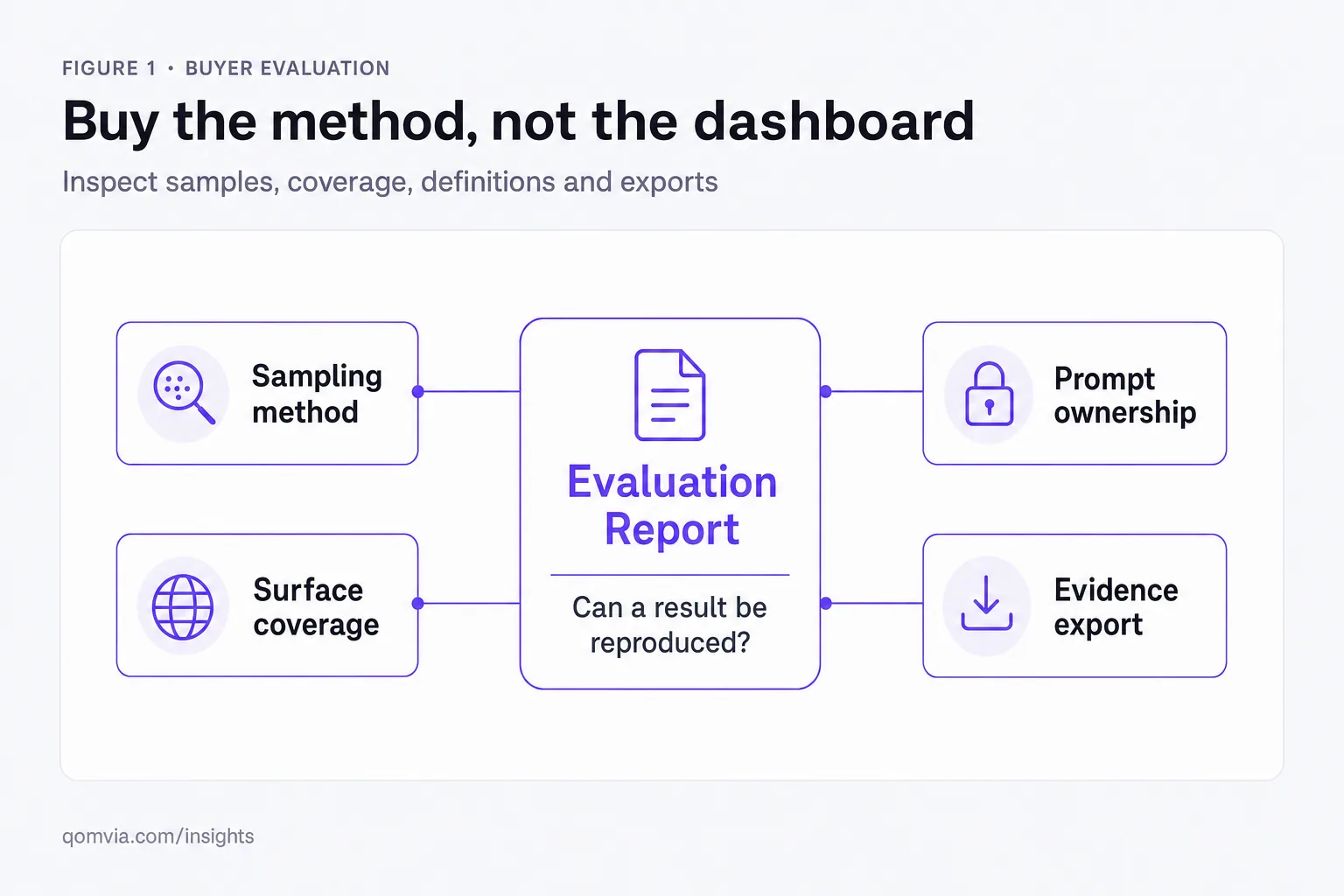
- Buy the method, not the dashboard: understand how questions, products, markets and samples are defined.
- Own the question set: teams need to inspect, edit and export the prompts that drive reported results.
- Separate mentions from citations: they describe different answer outcomes and require distinct coding rules.
- Read model coverage literally: a tool's supported surfaces are not the same as every AI product a customer may use.
- Require an audit trail: saved answers, sources, dates and exports make a visibility claim reviewable.
What are AI visibility tools?
AI visibility tools are products that help teams observe how organizations, products or sources appear in sampled answers from AI-enabled search and assistant surfaces. They may organize prompts, capture outputs, classify citations or report patterns. They do not automatically reveal every answer a real user sees, and their results depend on the sampling and definitions behind the dashboard.
A buyer should evaluate the evidence pipeline from question to report. Which product mode was queried? How were prompts selected? How often are results refreshed? Does the system preserve full answer text and source links? Can a reviewer distinguish a first-party citation from a third-party mention? If those details are hidden, a polished chart may be difficult to interpret or reproduce.
This is a procurement framework, not a ranking of third-party products. For metric definitions and sampling design, read how to measure AI search visibility. For the difference between answer observations and public site checks, see the AI SEO guide.
How transparent is the measurement method?
Ask how a result was collected
Ask the provider to describe the unit behind each chart. Is the row one answer, one prompt, one source URL, one model response or a group of repeated samples? What is the denominator for a mention rate or citation rate? How are aliases, products, links and ambiguous mentions classified? A buyer should be able to explain a metric without relying on a vendor's undefined label.
Inspect the sampling procedure. Does the system run a prompt once or collect repeat observations? Are product mode, locale, date and search state recorded? Can the buyer see when a question changed or a collection failed? If the tool supplies a score, ask what inputs it combines, how the score is normalized and which outcomes it intentionally excludes.
A transparent method does not eliminate variation. It makes variation interpretable. A small question set can be useful for monitoring a defined task, but it should not be presented as a census of every user prompt. Require the sample scope and known blind spots to appear near the result, not only in a sales presentation or separate help document.
Ask how the tool handles repeated questions and changed answers. Does it retain the full response, note that the wording or product mode changed and show when a collection failed? A historical chart is meaningful only if an analyst can tell whether the underlying task and collection conditions stayed comparable. If those details are absent, treat the trend as directional and do not use it to explain a specific content change.
Review the distinction between observed evidence and the provider's interpretation. The answer text, source URL and collection timestamp are observations. A label such as “visibility,” “authority” or “share” may combine additional choices. Ask for the calculation and coding rules, then decide whether those definitions fit the business question. A buyer should be able to reproduce a simple example from the evidence provided.
Which models and surfaces are included?
Ask how the provider defines a surface when the interface contains several modes. A product may offer search, a conversational answer and an action flow with different source behavior. A tool that groups those modes under one label should show how the observations were collected and whether the customer can separate them in an export.
Ask for an exact list of supported products and modes, not a broad claim of “AI coverage.” A product may sample a search-enabled mode but not a general assistant, or one language but not another. Record how the vendor identifies the surface, whether the experience can be selected consistently and which interfaces are outside the scope.
Model names and availability can change. The report should preserve the label used at collection time and avoid silently merging observations from different modes. A buyer should be able to filter or annotate coverage changes rather than interpreting a new sample as a continuous historical series. Ask how the tool handles unavailable responses and whether those attempts remain visible.
Qomvia's feature inventory describes AI monitor coverage for ChatGPT, Gemini and Grok, with Claude and Perplexity available as add-ons. It separately describes Site monitor as a public-readiness assessment. The inventory does not list Copilot, Bing AI Performance or Google AI Overviews as AI monitor models. Keep that product scope explicit when comparing what any monitoring setup can observe.
Ask whether the product distinguishes an assistant app from a search-enabled mode within the same brand. The product name alone may not identify the experience that produced an answer. Request the mode label, locale and any available context fields on the saved observation. If two surfaces cannot be separated, do not assume that their results are interchangeable in a trend report.
Coverage decisions should follow the audience's real tasks. A team may care most about branded support answers, product comparisons or recommendations in a specific market. Define those use cases first, then check whether the tool can observe the relevant surface and language. Broad product coverage is not valuable if it misses the actual customer decision or labels a different interface as equivalent.
| Coverage question | Evidence to request | Warning sign |
|---|---|---|
| Which products are queried? | Named surface and mode per result | A single “AI” label for unlike outputs |
| How are conditions captured? | Date, locale and query context | No record of collection setup |
| What happens when a run fails? | Visible failed or unavailable status | Missing results disappear silently |
| How does coverage change? | Versioned history and scope notes | Old data is relabeled as current |
Can the team own its prompts and questions?
Prompt ownership changes the evaluation
The question set is part of the measurement design. Ask whether the team can create, edit, group, pause and export its own prompts. Confirm how branded, category, comparison and support questions are represented. If the tool supplies prompts, inspect how they were generated and whether the buyer can reject questions that do not reflect real customer needs.
Keep a change history. When someone revises a prompt, record the previous text, the reason for the change and the date the new version entered collection. Otherwise a chart can combine different tasks under one label. A buyer should be able to return to the exact question that produced a response and tell whether a later sample is comparable.
Prompt ownership also has a governance side. Identify who may create questions, who approves sensitive brand language and how internal customer information is excluded. Avoid uploading private support tickets or personal data simply to create realistic prompts. Use safe, generalized tasks that preserve the intent without exposing confidential content.
Group the question set by intent and page owner. A navigational question, a product comparison and a troubleshooting request should not be treated as one content problem. Tie each prompt to the page or source that should answer it, while allowing the observed citation to differ. This makes it easier to route an issue to editorial, product or support teams without forcing every finding into a single marketing queue.
Does the tool distinguish mentions, citations and recommendations?
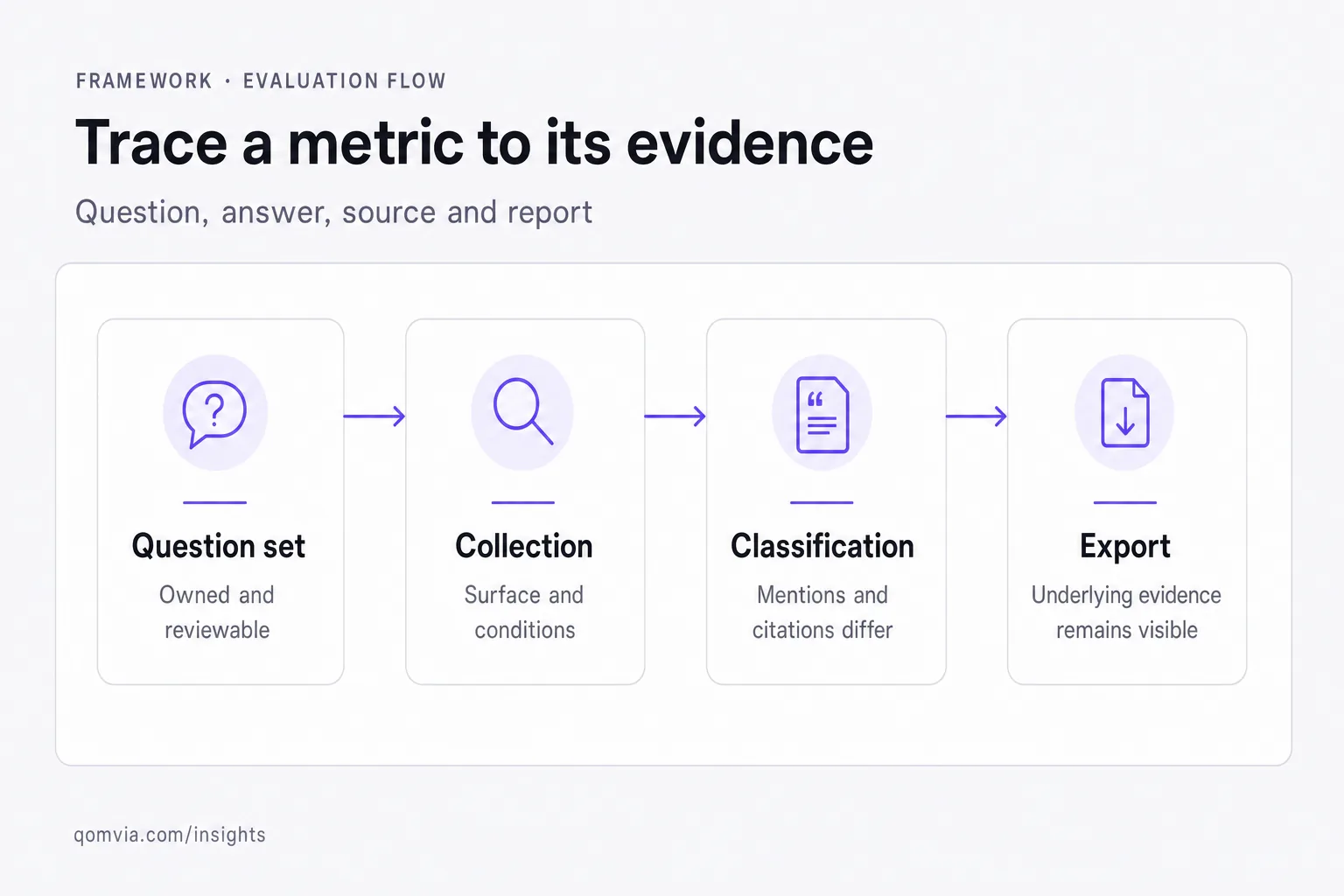
A mention means an answer names an entity under the tool's definition. A citation means a source link is displayed or otherwise associated with an answer, depending on the interface. A recommendation suggests a particular choice or preference. Those are not synonyms. Ask for the coding guide and examples of ambiguous cases before treating the metrics as business outcomes.
Check whether the tool distinguishes a first-party page from an external article, directory or retailer. Ask whether it records the exact cited URL and the nearby passage, and whether reviewers can mark an attribution as uncertain. A brand can be mentioned positively while a competitor receives the link, or cited in a response that does not recommend it. Each situation needs a separate interpretation.
Inspect how the system handles errors and sentiment. Does a negative statement get preserved with its source? Can the analyst tell a factual correction from a preference? Are paraphrases reviewed against the full answer? A tool should make it possible to challenge a label and retain the correction, rather than forcing every response into a simplified favorable or unfavorable bucket.
Request examples that separate a brand mention from a recommendation and show how a source link is attributed. A response may name a company in a caution, cite its policy as evidence or recommend a competitor. Those outcomes imply different follow-up. The tool should preserve enough of the answer to let a reviewer understand the sentiment and the role the source played.
Can you export and audit the underlying evidence?
Require an export that preserves the prompt, full answer, product surface, collection date and source URLs. Ask whether the export contains labels and their definitions, not only an aggregate score. If a report cannot be taken into the company's own analysis environment, determine whether the provider offers a stable format for review and retention.
Review the raw sample before signing a long-term agreement. Verify that links resolve, timestamps are present and failed collections are visible. Check whether an analyst can trace a summary metric back to individual observations. The audit trail matters when an executive challenges a trend, a source changes or the team needs to compare a content edit with the response that followed.
Data ownership and retention should be explicit. Learn who can access prompts and responses, how long they are stored, whether team members can delete records and what happens at cancellation. Avoid entering confidential strategy or personal customer data until the provider's controls have been reviewed by the appropriate owner.
Check that exported records remain understandable outside the product interface. Include stable identifiers, clear field names, source links and definitions for coded outcomes. Test whether an analyst can join a response to its prompt and collection context after downloading it. If an export drops those relationships, it may be unsuitable for an audit or long-term comparison even when a dashboard looks complete.
How should buyers evaluate actionability and fit?
Ask a reviewer to trace one reported finding from collection through interpretation to an action. The reviewer should be able to identify the prompt, surface, response, citation, label rule and recommended next step. If a dashboard shows a change but the underlying sample cannot be inspected, the team cannot tell whether the change reflects a real observation, an altered question or a classification decision.
Check whether findings can be assigned to the people able to act on them. A crawl or access issue may belong to engineering, an outdated product fact to commerce operations and an unsupported editorial claim to a content owner. The tool should preserve enough context for that handoff without implying that each observed gap has one universal optimization fix.
Test the product with an issue that the team can independently verify. Confirm the public URL, reproduce the relevant answer or crawl observation, and compare the result with the product's report. A trial based only on an attractive dashboard may establish that the interface is polished, but it does not show that the team's decisions will become more reliable.
Separate a product's observable diagnosis from the business outcome it informs. A product can identify an inaccessible page or an inconsistent field; the publisher can then make a change and retest. Use monitoring to track sampled answers, prioritize a specific change and compare later observations. Keep procurement language aligned with the capability the product demonstrates.
A useful tool helps a team decide what to do next without claiming that the dashboard itself improves visibility. Can the analyst group findings by page, topic or question? Can an engineer see access failures while an editor sees source gaps? Does each recommendation link back to the response or request that supports it? A score with no inspectable evidence is difficult to turn into a responsible change.
Match the product to the team's operating model. A small team may need a repeatable report and a clear owner. A larger organization may need roles, export controls, retained history and review workflows. Ask for a demonstration with the questions and pages the team actually cares about, then trace one result from raw evidence to recommendation.
Separate answer monitoring from site readiness. Qomvia describes its AI monitor as tracking answers for tracked questions and its Site monitor as assessing publicly observable website readiness. The AI monitor and methodology pages describe those product boundaries. A buyer should compare each capability only with the question it is designed to answer.
Test actionability with one real issue. Follow an observation to the cited page, decide whether the page supports the answer and identify a responsible owner for the next step. If the tool cannot reveal the evidence or distinguish an access defect from an editorial gap, its recommendation may need substantial outside analysis. Include that effort in the fit assessment rather than assuming automation removes it.
What should a buyer ask before choosing?
Ask the provider to demonstrate how a disputed result can be investigated. The reviewer should be able to move from an aggregate change to the underlying question, answer and citation, then see the rule used to classify it. If the demonstration relies on a prepared screenshot without a traceable record, the procurement team has not yet evaluated the measurement method.
Agree on a shared definition before comparing vendors or internal reports. Write down what counts as a mention, citation, recommendation and share of voice, along with the eligible sample. If two tools produce different figures, compare their collection and classification rules before assuming one is wrong. A documented limitation is more useful than false precision.
Use a procurement scorecard with evidence rather than vague ratings. For methodology, request the sample definition and coding rules. For coverage, list exact products and modes. For prompt ownership, test creation and export. For citations, inspect how source URLs and uncertain cases are represented. For governance, review access, retention and deletion.
Then run a short evaluation using a fixed set of questions. Compare the tool's output with manual review, identify where labels disagree and check whether an analyst can reproduce the reported result. Record unanswered questions as gaps. If the vendor cannot show the underlying evidence, list that as a procurement risk rather than treating an opaque score as proof.
Bring engineering, editorial, analytics, privacy and procurement into the evaluation when their responsibilities are affected. One stakeholder can validate collection; another can judge whether the answer is accurate; a third can review data retention. Ask each person to trace a result from collection to action. This surfaces mismatched assumptions before a contract makes the tool part of a reporting process.
The best fit is the one that supports a decision your team needs to make and lets you explain the evidence behind it. A narrower but auditable method can be more useful than broad coverage with unclear definitions. Revisit the evaluation when your audience tasks, supported surfaces or reporting requirements change.
How Qomvia meets this framework
Qomvia was built to pass these tests: a public method, three models included, rivals per answer, fixes on your own site and a free plan to try it. See the compare page for entry prices.
The free scan runs all 26 checks of the agent-readiness score in about a minute and lists every failing check with a copy-paste fix; the free Site monitor re-scans weekly, no signup for the score. The AI monitor then asks your buyers' questions to ChatGPT, Gemini and Grok every day and shows whether you are named, which rival is named instead and which sources the models used. Qomvia Market and the MCP server take it one step further, letting agents act on the recommendation. Sign up free or see plans and pricing.
Sources and further reading
- Best tools to track brand visibility in AI assistants
- Affordable alternatives to Profound and Peec AI
- How to check if ChatGPT recommends your company
- Compare Qomvia with Ahrefs, Semrush, Peec AI, Otterly.AI and Profound
- OpenAI: ChatGPT search
- Google Search Central: AI features
- Google: Google-Extended documentation
Questions
- What should I look for in an AI visibility tool?
- Evaluate sampling transparency, exact surface coverage, prompt ownership, citation definitions, exports, data controls and whether each result can be traced to evidence.
- How do AI visibility tools measure citations?
- Definitions vary. Ask whether a citation means a displayed URL, which source types count and whether the exact answer and passage can be reviewed.
- Can an AI visibility tool measure every model?
- No tool should be assumed to cover every product or mode. Request the exact supported surfaces and how unavailable or changed experiences are reported.
- Why should I own my tracked prompts?
- Prompt ownership keeps the sample tied to real customer tasks and allows the team to review changes, reproduce results and export its question set.
- What is the difference between mentions and citations?
- A mention names an entity, while a citation presents a source link. A recommendation and factual accuracy are separate outcomes as well.
- Can an AI visibility tool guarantee more brand mentions?
- No. A monitoring product can help observe sampled answers, but a dashboard does not control a third-party product's source selection.
Score your own site against the rubric this is written from.
Is your site agent-ready?
Free score against the same rubric, in under a minute.
Sign up free to keep the fixes and track the score.
AI monitor
PreviewHow often each model names your site across 11 tracked questions.