Published by Qomvia, , 13 min read
Key takeaways
- Eligibility comes first: a useful page cannot contribute to an answer if the relevant system cannot discover, fetch or interpret it.
- Search fundamentals still matter: Google says its AI features use existing Search eligibility and do not require a separate optimization recipe.
- Treat answer visibility as several outcomes: being named, being cited, being linked and being chosen for an action are different observations.
- Build evidence before formatting: direct answers help readers, but first-party proof, clear limits and reliable references make those answers meaningful.
- Use a four-layer operating model: access, evidence, expression and measurement connect technical work to editorial decisions.
What is AI SEO?
AI SEO is the practice of preparing a website to be found, understood and represented in search experiences that use machine learning to retrieve or compose answers. It combines search fundamentals with evidence, passage clarity and measurement. The work supports people first while adapting content and site systems to answer-oriented search surfaces.
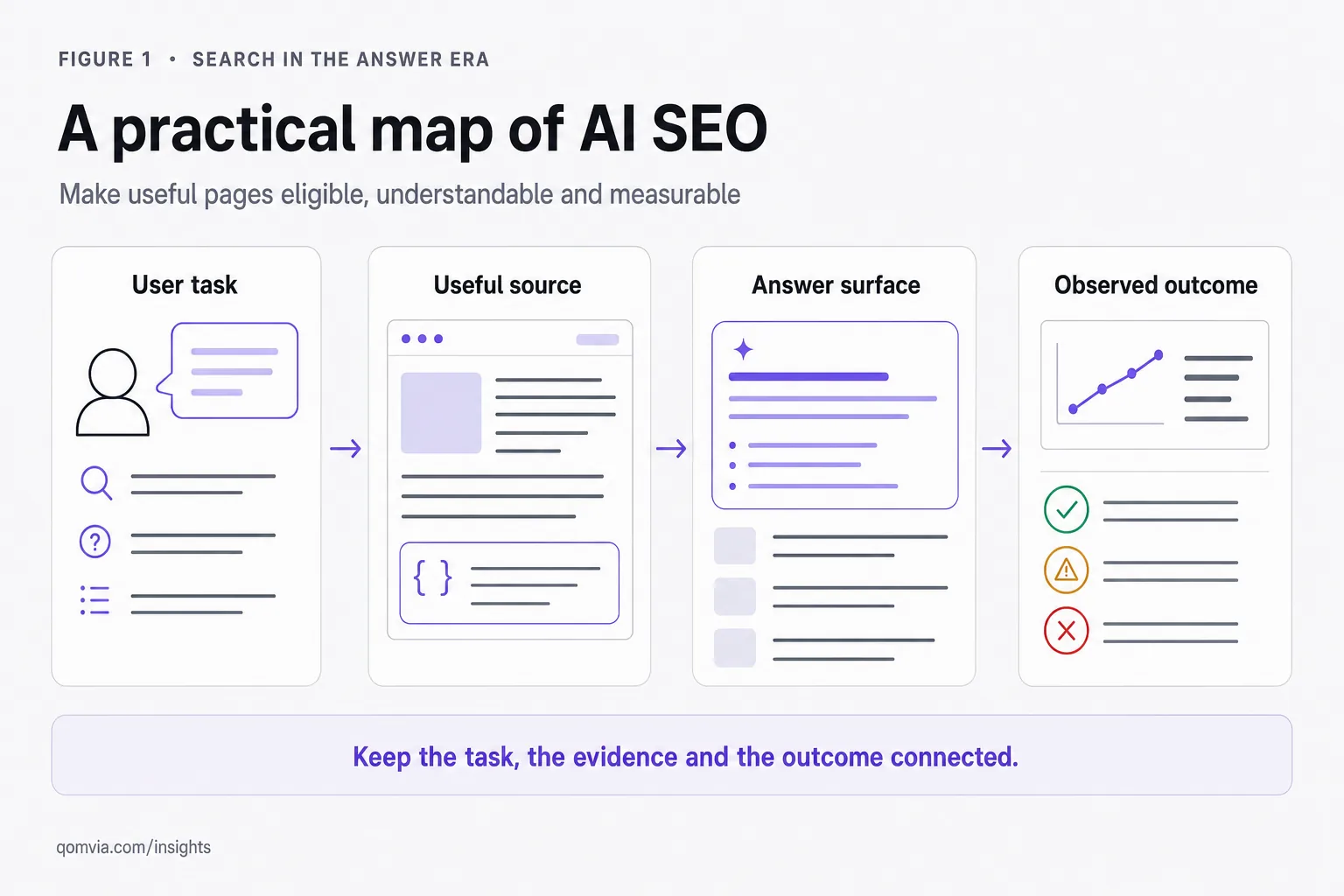
The phrase covers several kinds of work because the interfaces differ. A search engine can place an AI summary above familiar results. An assistant can rewrite a question, look up sources and include citations. A shopping experience can present products or support a transaction. A browser agent can operate a page on a person's behalf. These are not one product with one index or one selection rule. A strategy that says “optimize for AI” without naming the surface leaves the team unable to say what success means.
A more useful brief starts with the audience's task. Is the person trying to learn a definition, compare providers, check a policy or complete a purchase? The page should answer that task with evidence and the appropriate next step. Technical search work makes the page available; editorial work makes the answer coherent; measurement tests whether the intended audience and surface can actually find it. For the neighboring disciplines, see our GEO guide and AEO, GEO and SEO comparison.
What changes when a search result becomes an answer?
Eligibility is not selection
A conventional results page makes the searcher compare a list of destinations. An answer-oriented surface may do some of that comparison in the interface, summarize multiple pages, or invite a follow-up. Google describes AI Overviews and AI Mode as systems that may use query fan-out, which issues related searches across subtopics and data sources. OpenAI says ChatGPT search can rewrite a question into targeted queries and may send more specific follow-up queries. These are published descriptions of particular products, not proof that every assistant follows the same path.
The change is in the journey, not a wholesale replacement of search fundamentals. Google says its AI features use the existing Search eligibility rules and do not require a separate optimization recipe. A page still needs to be discoverable, technically available and useful for a real information need. The interface may then do more synthesis before a person visits, which makes accurate evidence and clear source attribution especially important.
The practical change is that one page competes for several kinds of representation. A page may be eligible but not selected. It may be cited yet contribute only a narrow fact. A brand may be named from other sources while its own domain is absent. A product may be described without a link that can support the next decision. Teams should record these outcomes separately rather than treating a visible logo or a visit as the whole result.
Different surfaces deserve different follow-up reading. Google eligibility and presentation are covered in AI Overviews and AI Mode; source selection and access controls appear in the ChatGPT citation playbook; the search index and webmaster tools are discussed in Bing SEO for AI search. For purchase journeys, the agentic commerce guide addresses a different outcome from an informational citation.
This does not make a click worthless or a citation sufficient. A click can carry purchase intent, while a citation can establish provenance without sending a visitor. The page may also help a person after a later direct visit. Keep the business question explicit: discoverability, source attribution, qualified visits, product inclusion or successful task completion. Each needs its own evidence and reporting rule.
Which parts of AI SEO are established, and which are hypotheses?
A sound program separates documented requirements from research observations and from an operator's working hypothesis. Google's AI-feature guidance says a page must be indexed and eligible to appear with a snippet to qualify as a supporting link in AI Overviews or AI Mode, and says no additional technical requirements apply. That is useful because it keeps the baseline grounded in ordinary Search eligibility rather than a secret markup trick.
Research can suggest content practices worth testing, but the scope must stay attached to the result. The GEO paper introduced the term generative engine optimization and evaluated strategies in its own experimental setting. It is evidence that controlled content changes can affect the paper's measured visibility, not a universal forecast for a commercial website or a specification for a current product. Reproduce a method only when its task, corpus and outcome are relevant to your own decision.
Keep an evidence label beside each proposed task. “Required for eligibility” should point to provider guidance; “reported in research” should name the study and the outcome it measured; “observed in our sample” should link to the saved responses; “we recommend” should state the reader problem the recommendation solves. The labels protect a useful editorial practice from being repeated as a supposedly confirmed ranking signal.
| Evidence class | What it can support | What it cannot establish |
|---|---|---|
| Documented product guidance | A named control, crawler role or eligibility rule | A rule shared across all answer surfaces |
| Peer-reviewed or preprint research | A bounded result under a described method | Transfer to a different answer surface |
| Repeated site observations | A local pattern worth investigating | Causality without a comparison design |
| Editorial judgment | A testable recommendation for a reader | An engine's undocumented behavior |
When a team uses the word “factor,” ask what kind of evidence it means. A published eligibility control is different from a correlation in a study. A cross-client observation is different from a causal experiment. A familiar SEO convention may be reasonable without being confirmed as an AI selection signal. Mark each recommendation with its evidence class and its scope. That discipline makes the program more persuasive, not less, because readers can see where the known boundary ends.
What should an AI SEO program optimize?
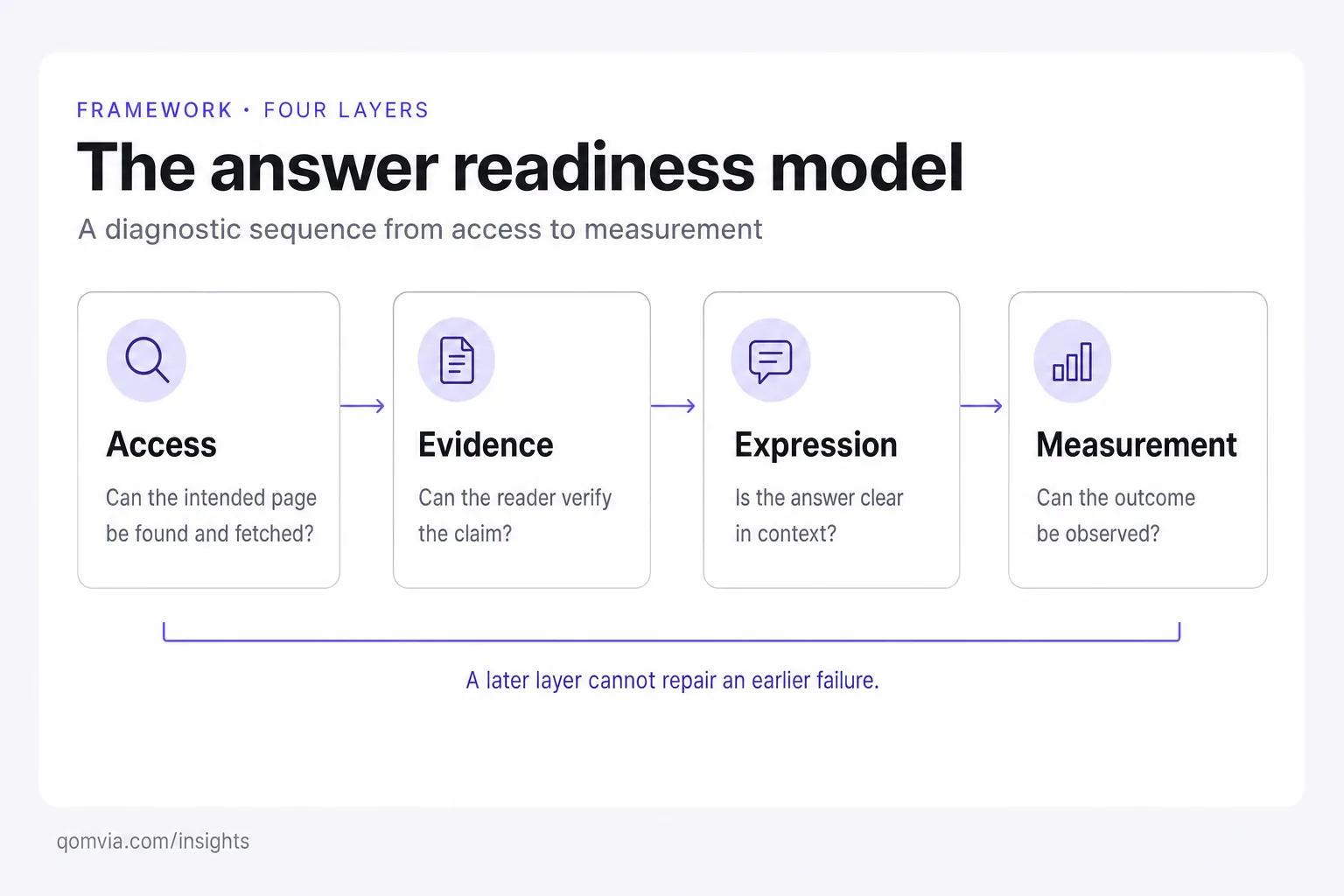
The four-layer answer readiness model organizes the work as access, evidence, expression and measurement. Access asks whether the right page can be discovered and fetched under the site's own rules. Evidence asks whether it substantiates the claims a searcher needs. Expression asks whether the important point is explicit in readable content. Measurement asks whether a defined test shows the page or brand in the intended answer context. The layers are an editorial operating model, not a vendor rubric.
Access includes crawl policy, response behavior, canonical URLs, internal navigation and the availability of useful text. It is not a request to open every endpoint or ignore security. Keep private data private, distinguish user-triggered fetches from automated discovery, and test what an allowed crawler actually receives. Our existing guides to AI crawler policies and bot protection cover those technical tradeoffs in detail.
Evidence is the reason the page deserves to answer the question. Make product claims specific enough to verify. Put qualifications near the sentence they limit. Link policies, documentation and original research rather than treating a polished summary as proof. If evidence is internal, describe the method and the relevant time period. If a page uses an illustration, identify it as a hypothetical example. A clear passage can still be untrustworthy when its claim has no visible support.
Expression is the structure a human reader encounters: descriptive headings, direct opening sentences, stable terminology, tables that expose comparisons and content that remains available without interaction. Do not strip out context just to create a short extract. The passage should answer the question and preserve the conditions that make the answer true. Measurement then ties the work to a fixed set of prompts, markets, modes and outcomes, instead of a single screenshot that cannot be compared later.
Use the layers as a sequence, not four independent scorecards. A page may be accessible but contain no first-party answer; improving its wording will not fix a missing policy. A well-supported page may still be difficult to interpret if the product name changes between sections. Measurement comes last because the team first needs to define what a successful representation means for the customer task. That sequence keeps diagnosis focused on the earliest verified constraint.
How should teams build an AI SEO operating model?
Assign each layer an owner
Begin with a surface map. List the search products, assistant modes and agent tasks that matter to the audience, then identify the information each task needs. A support question may need a current policy page. A category comparison may need a transparent product table. A research query may need a methods section and a primary citation. This map prevents a team from optimizing a generic “AI presence” while neglecting the page that could resolve a real customer question.
Next, assign an owner to each layer. Engineering owns server responses, access policy and rendering behavior. Editorial owns answer structure and maintenance dates. Subject-matter experts validate claims and exceptions. Analytics defines which events and referrers can be observed. Legal or security reviews the places where openness would expose restricted material. The assignment need not create a new department. It should make clear who can approve the correction when a page is wrong, blocked or stale.
Build a backlog from observed failures rather than an abstract checklist. A crawler receives a challenge page, an answer quotes an obsolete policy, a comparison omits the condition that distinguishes plans, or the citation points to a third-party summary instead of the source. Each issue needs a proposed page or system change, a responsible owner, the evidence that triggered it and a retest method. That turns AI SEO from a one-off content sprint into ordinary site stewardship.
Review the backlog with evidence labels. A required product control should have a primary-source link. A research-based hypothesis should include the paper and its limits. An internal pattern should show the sample and the observation window. An editorial recommendation should say what reader problem it is intended to solve. If nobody can name the evidence or the user need, lower its priority until the claim is clarified.
Set a review rhythm that fits the content's rate of change. A stable explainer may need an occasional source and accuracy review; pricing, eligibility or support instructions may need an owner who checks after each material policy change. Put the review trigger in the workflow, not only in a date field. A date can tell a reader when the page was touched, but the reviewer should confirm that the underlying claims and links still hold.
How can AI SEO be measured without confusing visibility with traffic?
Visibility is not one number. Define the unit before reporting it: a question, an answer, a citation, a linked page, a named entity or a referred session. Decide the denominator as well. A brand mention rate across sampled answers cannot be compared directly with the share of questions that cite the brand's own domain. A metric without its sampling rule invites teams to optimize the label instead of the user outcome.
Keep answer observation and web analytics in separate layers. An answer archive can record whether the brand was named, which domains were cited and where the brand appeared in a recommendation. Web analytics can record a visit when a tagged referral reaches the site. A missing referral does not prove that no answer exposure happened, and a visit does not prove that the page caused an answer to appear. The method should explain what each system can observe and what it cannot.
Hold a question set and collection method steady long enough to compare like with like. Save the full wording, answer mode, collection date, market and citation URLs. When a prompt or model changes, mark the new sample rather than blending it with the previous series. Pair the quantitative view with a small number of answer reviews that explain what the cited page contributed. Use Qomvia's AI monitor to review answer samples for tracked questions; its Site monitor measures public readiness separately.
Report the unit beside the result. A response can contain a brand mention without a link; a link can point to a third-party article instead of the company's own page; a visit can come from a tagged referral without revealing every earlier exposure. These are complementary observations, not interchangeable proof. A decision-maker should be able to tell whether a change improved source inclusion, answer accuracy, referral quality or completion of the intended task.
What should a team do first?
Audit a small set of high-value pages across the four layers. Check that the canonical page is linked from the site, loads for the intended audience and exposes its central content in the initial response. Read the page as a skeptical customer: can you identify the subject, the answer, the evidence and the condition that might change it? Then inspect a defined sample of relevant answers and record the domains and passages that appear.
Fix blocking defects before making cosmetic revisions. If the page is unreachable, a better introduction cannot help. If the page is readable but makes an unsupported claim, add evidence or narrow the statement. If the answer is strong but buried below navigation or repeated boilerplate, restructure the page around the reader's question. If the brand is absent from a sample, do not assume that adding a schema field will solve it; inspect the sources, identity evidence and task fit.
Close each change with a retest and a record. Keep the before-and-after page, note what changed, and repeat the same query set where possible. A result may remain unchanged because the page was not the limiting factor, or because the sample varied. That is useful information. It prevents a team from attributing every movement to the most recent edit and helps it invest in the next verified constraint.
A practical first review can end with three decisions: protect what is already accurate, repair a concrete access or evidence defect, and test one editorial hypothesis. Assign each decision to the person who can make it and identify how the result will be checked. Track citation visibility alongside access, relevance and accuracy so the team can explain what changed and what the evidence shows.
Use the wider series as a map, not as a reason to repeat work. The GEO guide and AEO, GEO and SEO comparison define adjacent disciplines; AI search visibility measurement separates answer sampling from visits. If competitors are being preferred, a separate guide covers that diagnostic. For a page-by-page audit, use the AI search optimization checklist.
Sources and further reading
Questions
- What is AI SEO in simple terms?
- It is the work of making a site discoverable, understandable and useful in search experiences that may retrieve or compose answers. It combines technical access, evidence-rich content and a way to measure the intended outcome.
- Does SEO still matter with AI search?
- Yes. Google says its AI features use existing Search eligibility and require pages to be indexed and snippet-eligible. Strong technical and editorial fundamentals remain a practical starting point.
- Is AI SEO the same as generative engine optimization?
- The terms overlap, but AI SEO is often used as a broader operating label across search and answer interfaces. GEO describes work focused on generative-engine responses; neither term names one shared ranking system.
- How do I start an AI SEO strategy?
- Choose the audience task and search surface, map the page that should answer it, then audit access, evidence, expression and measurement. Prioritize defects observed in that path.
- Can schema markup guarantee inclusion in AI answers?
- No. Structured data should describe visible content accurately; the guidance cited here treats it as a description of the page, not a selection control.
- How do I measure AI SEO without relying on clicks?
- Define answer-level measures such as brand mentions and first-party citations separately from web sessions. Preserve the question set, mode and collection conditions so observations can be interpreted later.
Score your own site against the rubric this is written from.
Is your site agent-ready?
Free score against the same rubric, in under a minute.
Sign up free to keep the fixes and track the score.
AI monitor
PreviewHow often each model names your site across 11 tracked questions.