Published by Qomvia, , 13 min read
Key takeaways
- Name the surface first: Gemini app answers, AI Mode and AI Overviews are not interchangeable products.
- Google-Extended has a defined scope: Google documents controls for use of crawled content in specified Gemini training and grounding contexts.
- It is not a Google Search switch: Google says Google-Extended does not affect inclusion or ranking in Search.
- Search eligibility remains relevant to Search features: Google says AI Overviews and AI Mode use existing Search eligibility, without a special optimization requirement.
- Treat grounding as a route to inspect: a source link, crawler rule and answer sample each establish different evidence.
What is Gemini SEO?
Gemini SEO is the practice of making information clear and useful across Google products that can answer with Gemini while distinguishing product controls and evidence. It combines Search readiness, accurate source pages and careful testing. Start by naming the surface, then match the technical and editorial checks to how that product handles the query.
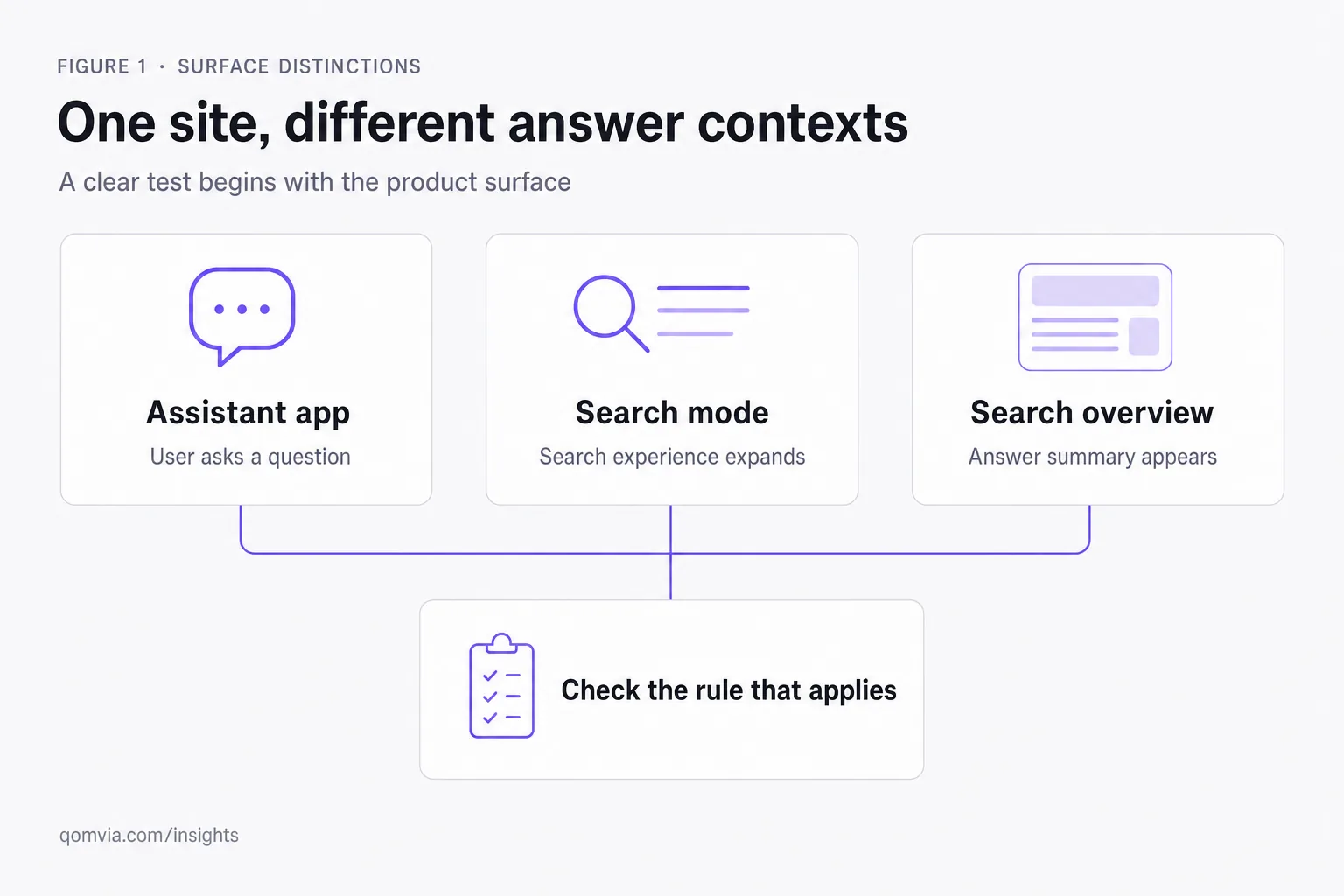
The phrase can refer to several different settings. Someone may ask the Gemini app a question, use AI Mode as a Search experience or see an AI Overview in Search. These surfaces have different interfaces and product purposes. A publisher should not interpret a result in one as proof that the same page was used in another, or assume that a control described for Gemini Apps also governs every Search feature.
Start by recording the exact product surface, query, date, answer and source links. Then connect each observation to the relevant public documentation. For the Search-specific experience, see Google AI Overviews and AI Mode. For broader answer-system guidance, read the AI SEO guide and AI search ranking factors.
How do Gemini app, AI Mode and AI Overviews differ?
Name the surface before the test
The Gemini app is an assistant surface where people can ask questions and request help. AI Mode is a Search experience, and AI Overviews are answer summaries that may appear within Search. A site owner should log which interface produced an observation rather than grouping them under one label. Product capabilities and source presentation can vary; this article does not assume a uniform retrieval path.
Google's Search Central guidance describes AI Overviews and AI Mode as Search features that may use query fan-out. It also says a page must be indexed and eligible to appear with a snippet to be considered as a supporting link, and that no additional technical requirements apply. That guidance is about those Search features. It should not be automatically projected onto every answer in the Gemini app.
The practical question is “which public rule applies here?” If a page is missing from an AI Overview, check the Search eligibility boundary and the page's ordinary technical state. If a Gemini app answer cites a page, inspect the source and the product mode. If the question concerns use of crawled material for Gemini-related purposes, read the Google-Extended documentation. One broad “Gemini ranking” label obscures these separate diagnoses.
Keep a capture record for each observation. Save the exact prompt, visible interface, date, answer and source links, then note whether the result came from an assistant response or a Search page. A screenshot can help a reviewer understand the layout, but store the text and destination URLs as well. The interface may place citations differently, and a visual crop can hide the context that explains how the answer was presented.
Avoid using one result as a proxy for every query. A page may be relevant to a definition request but not to a local recommendation or purchase comparison. Write a small set of questions that represent distinct customer tasks, keep each task label stable and inspect the source that actually appears. If wording must change for a different surface, record that as a separate test rather than merging it into the same series.
What does Google-Extended control?
Separate model use from Search eligibility
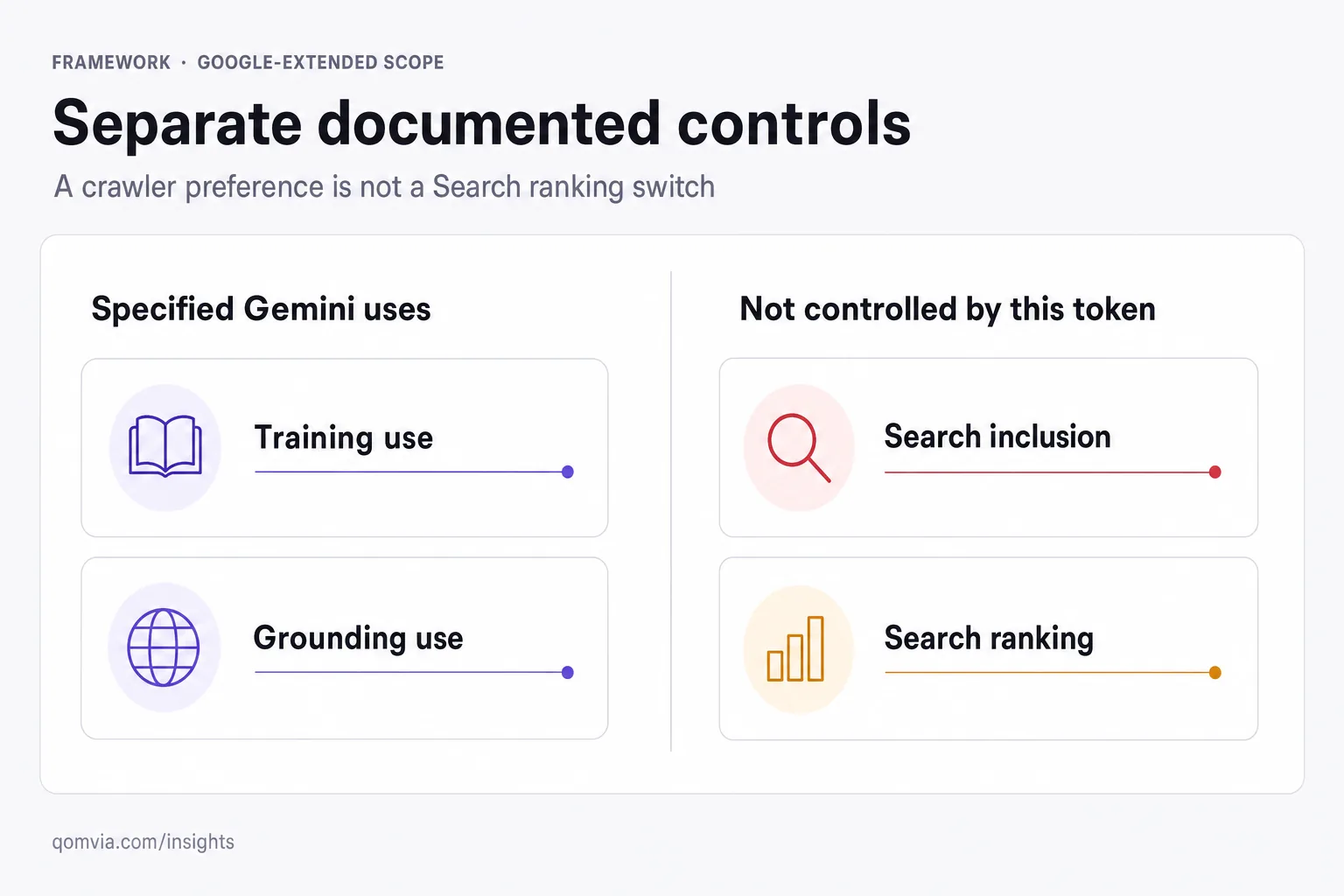
Google documents Google-Extended as a control for how crawled content may be used for training future Gemini models and for grounding in Gemini Apps and Grounding with Google Search on Vertex AI. That scope is specific. A publisher reviewing robots.txt should read the description closely and decide which uses it intends to permit or restrict.
Google says Google-Extended does not affect a site's inclusion or ranking in Google Search. This is an important boundary for search teams. Blocking that token is not a way to remove a page from ordinary Search, and allowing it is not a way to request Search visibility. Search index eligibility and the use of crawled content for the documented Gemini contexts should be tracked separately.
Do not generalize the token beyond its stated scope. It does not decide whether a public page is accurate, whether an answer is grounded in a particular source or whether a user sees a citation. It expresses an access preference for specified uses. Teams should maintain a policy record that names the intended behavior, its owner and the date the policy was reviewed, especially when product documentation changes.
Before editing a crawler directive, describe the organization's intent in plain language. Decide whether the goal concerns Search availability, the documented Gemini training use or a specified grounding path. Then compare that goal with Google's current description of the token and confirm the exact syntax in the official documentation. Keep a record of the policy decision so later teams do not mistake an old robots rule for a current product recommendation.
After deployment, confirm the public response reflects the intended file and that the syntax is valid. Test the relevant route through the production hostname, not only a local preview. A correct robots directive expresses the site's preference to a crawler. Evaluate page selection and visible links separately on the relevant surface, and keep those results outside the policy change's acceptance criteria.
| Question | Relevant distinction | What not to infer |
|---|---|---|
| Will the page appear in Google Search? | Google-Extended does not affect Search inclusion or ranking | That the token is an indexing control |
| Can crawled content be used for specified Gemini purposes? | Google documents training and grounding scope | That every answer will use the page |
| Will an AI Overview cite the page? | Search eligibility is a threshold for consideration | That eligibility proves source selection |
| What did a Gemini answer consult? | Review the answer surface and visible sources | That one robots rule proves answer provenance |
How can a site make a Gemini answer easier to verify?
Write the source page for a person who needs to check the answer, not merely for a parser. Put the defining fact near the relevant subject, name the organization responsible and explain any limit that changes how the claim should be read. Link to primary documentation or policy where readers can inspect the full context.
Make page relationships visible. An author biography, product page and company About page should make clear who wrote the material, who owns the product and who is responsible for customer support. When two entities have similar names, include a short distinction. This helps a human verify identity without assuming that a particular model uses an undocumented knowledge graph.
For claims that change, record the effective date and the source that triggered the revision. A visible update date is useful only when the content has actually been reviewed. If an answer quotes an older statement, compare it with the current page and note whether the old version remains available in an archive or a linked policy.
State the exact conditions under which a product works and place region, plan or configuration limits close to the answer. Clear limitations make the passage safer to reuse and more useful to a prospective customer.
Give each important subject one clear source page. Explain the entity, product, policy or method in language a person can understand without knowing internal shorthand. State the core answer early, then include the limits, dates and evidence needed to evaluate it. If a claim depends on an external standard, link that standard and distinguish a quotation from your interpretation.
Keep statements close to their evidence. A feature description should link to the relevant product detail, not a generic homepage. A policy should identify its scope and exceptions. A research summary should name the method and the measured outcome. When a page changes, preserve a useful revision history or explain what is current so a reader can understand why an earlier answer may differ.
Search features still depend on accessible, eligible pages, but citation visibility is a separate outcome. Check that your canonical URL returns the intended article and that its answer is present in readable text. Do not add markup or a special file solely on the assumption that Gemini requires it. Google's AI Search guidance says no additional technical requirement applies to AI Overviews and AI Mode beyond the existing Search requirements.
When a source link appears, test whether it supports the exact sentence beside it. A correct citation can still be incomplete if a qualification is missing. A source page may be relevant to one part of an answer and not another. Save the response and page version together so that editorial review can check what changed instead of relying on a screenshot without context.
Use descriptive page titles and headings that tell a person what evidence the page contains. When a headline offers a comparison, include the criteria and tradeoffs, not only a list of keywords. A policy page should distinguish the current rule from exceptions. This makes the source easier for a visitor to evaluate even if an answer extracts only a small passage.
State who is responsible for the material and when a changing fact was checked. If a claim comes from an external source, link it near the relevant explanation. Do not rely on a citation panel to supply context that the page itself omits. The source page should be understandable when opened from a result without the reader first visiting the homepage or learning internal product terminology.
When a generated answer is incomplete, repair the passage that should carry the qualification. Avoid adding repetitive boilerplate to every page. A precise explanation near the claim gives readers a better way to verify it and helps a short extraction preserve the condition.
How should teams test Gemini SEO work?
Assign a reviewer who did not make the page change to inspect the result. Ask them to verify the fact against its cited source, confirm that the page answers the intended question and note any mismatch. Independent review reduces the chance that a team interprets its own preferred wording as evidence that the answer has improved.
Create a small test plan with representative tasks rather than a list of favorite prompts. Include informational, comparison and brand-specific questions only where they match real audience needs. Keep the exact wording, product surface, collection date and available source links with each response so another reviewer can understand what the sample represents.
For each test row, record the surface, exact question, target URL, Search eligibility where relevant, robots response, visible source links and reviewer decision. If the page is eligible but not cited, log a selection outcome; if the URL errors or the answer is missing, fix the specific obstacle first. Repeat the same question after one change and preserve both results. This keeps surface comparisons useful without merging them into one broad Gemini metric.
Change one controllable input at a time when evaluating a page update. If the site changes its access rules, page content and structured data together, the next response cannot identify which change mattered. Production work may require several fixes at once; record them as a combined repair and do not claim an isolated causal result.
Review a sample manually for factual accuracy and task fit. A mention can be visible but wrong, and a cited source can be unrelated to the adjacent claim. Save the passage, source destination and the reviewer's rationale. This gives an editorial or product owner something concrete to fix rather than a vague visibility score.
If an observation cannot be reproduced, preserve that uncertainty. The surface, account context or query may have changed. A second run can provide another observation, but it does not establish a universal answer. Report the sample and conditions instead of presenting one successful response as proof of durable inclusion.
Build separate question sets for the Gemini app and Search features. A broad information question, a branded question and a product comparison represent different tasks. Record the surface, exact query, market context where available, visible citations and page destinations. If you test AI Overviews or AI Mode, preserve the Search context; if you test the Gemini app, do not label that output a Search result.
Classify the outcome precisely: not mentioned, named without a link, first-party page linked, third-party source linked, or citation that does not support the claim. Keep an uncertain category for answers that cannot be coded confidently. Review examples manually before aggregating a trend. A single answer is a sample and does not establish a stable ranking position or a universal rule.
Keep technical and editorial hypotheses separate. If a Search feature cannot show the page, verify indexing and snippet eligibility before proposing content changes. If a Gemini app response gives a wrong fact, inspect its cited source or mark the source path unknown. If a page appears but is not selected for a question, review relevance and evidence without claiming to know the private selection formula.
Make a change only when it addresses an observed problem. A blocked public response calls for an access investigation; a stale policy calls for an editorial correction; an ambiguous organization name calls for identity clarification. Record the expected result and retest the same task. If the answer does not change, that does not automatically disprove the value of an accurate source correction.
Qomvia's AI monitor records answer observations for tracked questions across the models listed in the feature inventory. That monitoring is distinct from a Google Search index diagnosis or a robots-policy decision. Use the Site monitor method to review public readiness, and keep the test question and product surface attached to any answer-level result.
What should a team do first?
Choose one important customer question and trace the page that should answer it. Check access, visible wording, source quality, identity and update ownership, then preserve the test conditions. If the page is already accurate and accessible, the answer's selection may remain outside the publisher's control. Record that distinction rather than inventing a technical defect to fix.
Choose one important page and identify the exact question it should answer. Confirm that the page is public, that its claims are supported and that the canonical URL is correct. Then decide whether the investigation concerns Gemini app behavior, AI Mode, AI Overviews or a documented Google-Extended use. This prevents a team from making a site-wide policy change to solve a problem that belongs to one surface.
If the page is inaccurate, repair the source. If it is inaccessible, trace the request through the public edge. If the policy is unclear, document which use the organization intends to allow or restrict. If the source is accurate and available but not selected, record the result as an unresolved selection outcome and keep testing. Use that evidence to choose a targeted repair rather than broad “optimize for Gemini” work.
Sources and further reading
Questions
- How do I show up in Gemini?
- First identify whether you mean the Gemini app, AI Mode or AI Overviews. Publish clear, accurate source pages and evaluate the relevant surface; no single site change guarantees inclusion.
- Does Gemini use Google Search?
- Google documents distinct Gemini and Search experiences, and describes grounding in specified Gemini contexts. Do not assume every Gemini answer follows the same Search retrieval path.
- What does Google-Extended do?
- Google documents it as a control for use of crawled content in future Gemini model training and specified grounding contexts. Google says it does not affect Search inclusion or ranking.
- Does Google-Extended control AI Overviews?
- Google says Google-Extended does not affect inclusion or ranking in Google Search. AI Overviews are a Search feature, so the token should not be treated as an AI Overview opt-out switch.
- Do I need special schema for Gemini SEO?
- Google says AI Overviews and AI Mode have no additional technical requirements beyond existing Search eligibility. Structured data should represent visible page content; evaluate citations on the answer surface.
- How can I measure Gemini visibility?
- Keep tests for the Gemini app separate from Search features, save the exact question and answer, and record named brands and source links as different outcomes.
Score your own site against the rubric this is written from.
Is your site agent-ready?
Free score against the same rubric, in under a minute.
Sign up free to keep the fixes and track the score.
AI monitor
PreviewHow often each model names your site across 11 tracked questions.