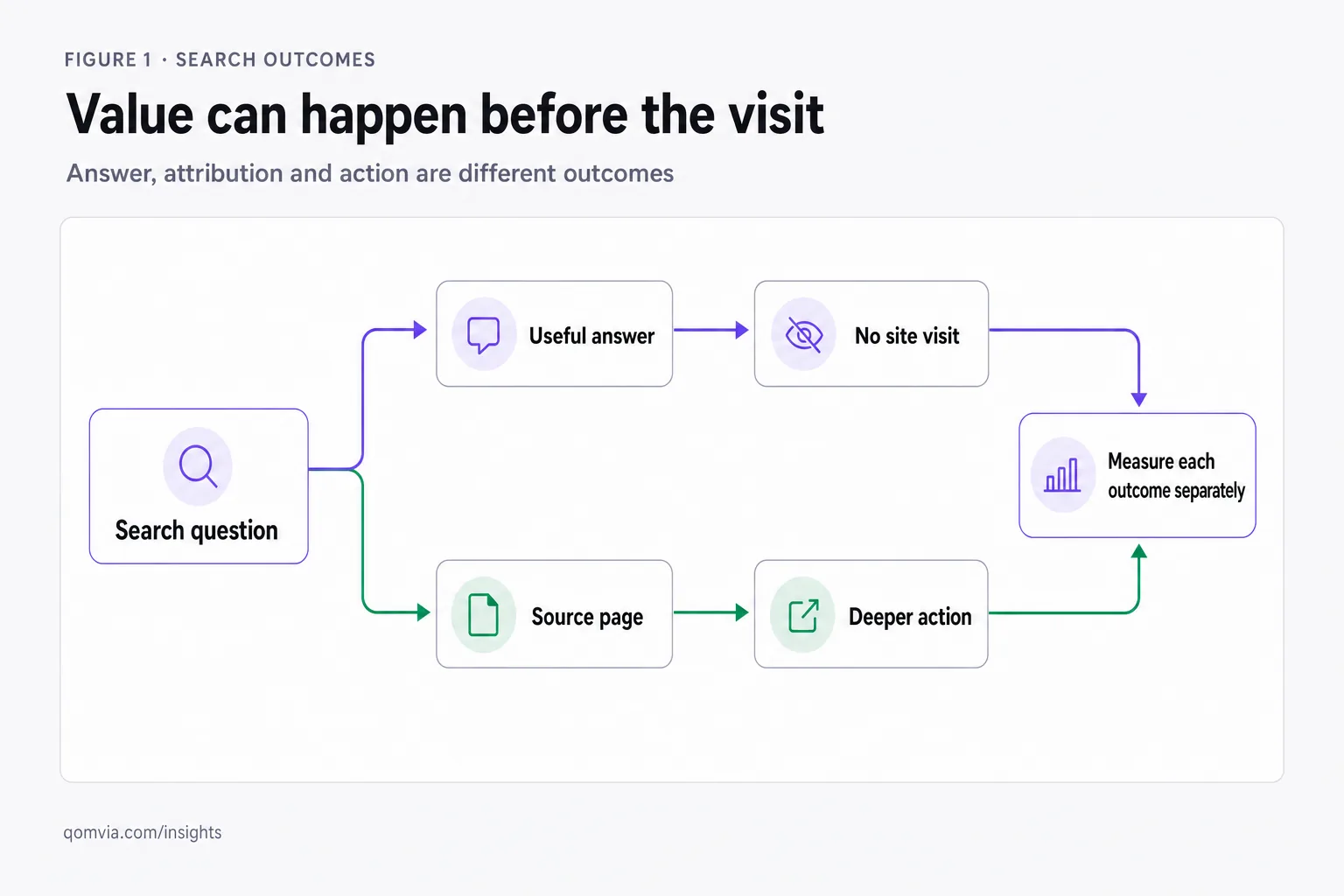
By Qomvia, 14 min read
Key takeaways
More searches end without a click, and a brand's value increasingly lives in the answer itself. AI assistants now answer the question before anyone clicks a result, so you need to know whether the answer names you, not only whether it sends a visit.
- A zero-click outcome is not automatically a failure: a person may complete a simple task from the interface.
- Visibility and traffic are different assets: a source can be useful and attributed without producing an immediate session.
- Some pages still need the visit: complex comparisons, tools, purchases and sensitive decisions often require the full source experience.
- Optimize for the next decision: make the answer accurate, the provenance clear and the route to deeper evidence obvious.
- Report separate outcomes: citations, mentions, referrals, qualified visits and completed tasks need distinct definitions.
What is zero-click search?
Zero-click search is a search interaction in which a person gets enough information from the results interface to end or change the task without opening a website. For publishers, it shifts the question from visit volume alone to the value and accuracy of being represented, while preserving a separate path to measure clicks that do occur.
The term describes an observed behavior, not a judgment about whether the interface or publisher won. A definition, time, address or short factual answer may satisfy a person quickly. A policy explanation or product comparison may require the source page for context, proof and next steps. The right outcome depends on the task, the stakes and whether the response preserves the qualification that makes the answer true.
This strategy article focuses on the value of representation, not the mechanics of answer-visibility measurement. For sampling and metric definitions, see how to measure AI search visibility. For referral reporting, read track AI traffic in GA4.
Why should a publisher care when a search ends without a click?
Separate representation from visit
The publisher still controls the quality and durability of the source, even when the audience uses only a summary. An incomplete or stale answer can mislead someone who never visits the page, while a well-maintained source remains useful to people who do. This is a reason to protect accuracy and context, not to assume that a particular no-click exposure happened.
A result can shape a decision before a site visit. It can explain a category, name a source, narrow a shortlist or direct a person to a specific next step. A publisher may have contributed the evidence even when the interface answers the immediate question. Treat that exposure as its own signal and measure downstream behavior separately across the relevant audience and task.
Google says clicks from Search results pages with AI Overviews are higher quality, with users spending more time on the sites they click. Attribute that claim to Google and keep its scope intact. It does not mean every site receives more qualified visits, or that the statement applies to all search products. It is an example of why click count alone may not describe the whole interaction.
A zero-click answer can also create a liability. If a summary omits a condition, names an outdated policy or attributes a statement to the wrong organization, the reader may act on a distorted version of the source. Being visible is not automatically valuable if the visible information is incomplete. Publishers should care both about whether they are represented and whether the representation preserves the evidence.
Treat the no-click outcome as one possible completion of the person's task, not as a universal loss. A simple query may be resolved by a clear statement in the result. A high-stakes choice may require the full source, a personalized assessment or a direct interaction with the publisher. A useful strategy asks what the person needed and whether the visible answer supported that need safely.
The publisher cannot infer that a person saw a citation merely because a page was eligible to appear, and cannot infer that no value was created because no session was recorded. Keep observed citations, observed visits and unobserved exposure distinct. That discipline prevents both optimistic claims about awareness and pessimistic conclusions from analytics gaps.
Which pages benefit from a click?
A short definition may be answered in a compact result, while a complex decision needs a richer source. Pages that explain tradeoffs, test a choice, disclose assumptions or support an action have a natural reason to earn visits. An interactive calculator, a product configuration, a detailed methodology or a secure account task cannot be fully replaced by a sentence when the visitor needs to inspect inputs and consequences.
A useful page makes the reason to continue explicit. A comparison should reveal the options and the criteria that distinguish them. A policy page should show the rule, exceptions and effective date. A product page should connect specifications to a real offer and terms. A research report should make the method and evidence available. The call to action should follow from the answer rather than interrupt it.
Do not hide the essential answer to manufacture a click. A teaser that withholds a basic fact can frustrate the reader and weaken confidence in the source. Instead, give a useful summary and invite the person to continue for what the interface cannot provide: the underlying evidence, personalized application, complete comparison or transaction. The source should reward the visit with something meaningfully deeper.
Design the page around the next level of the task. If the result states a product's compatibility, the destination can explain the conditions, supported configurations and how to verify a fit. If a policy summary names the general rule, the source should clarify eligibility, exceptions and effective dates. A page that merely repeats the summary gives a visitor little reason to continue.
Ensure the result and destination agree. A headline that suggests an independent comparison should lead to explicit criteria and evidence. A product snippet should lead to the same offer and seller. A tool link should open at the step it describes. Broken or generic destinations waste the reader's intent and can make a correct answer appear less useful than it is.
| Page or task | Value in the result | Reason to visit the source |
|---|---|---|
| Definition | A direct explanation and source attribution | Nuance, related concepts and examples |
| Policy | A short statement of the rule | Scope, exceptions and effective terms |
| Comparison | A high-level distinction | Tradeoffs, criteria and detailed evidence |
| Product offer | A possible match or summary | Variant, current price and purchase terms |
| Tool or transaction | A route to the next step | Inputs, confirmation and completion |
How can a brand create value without a visit?
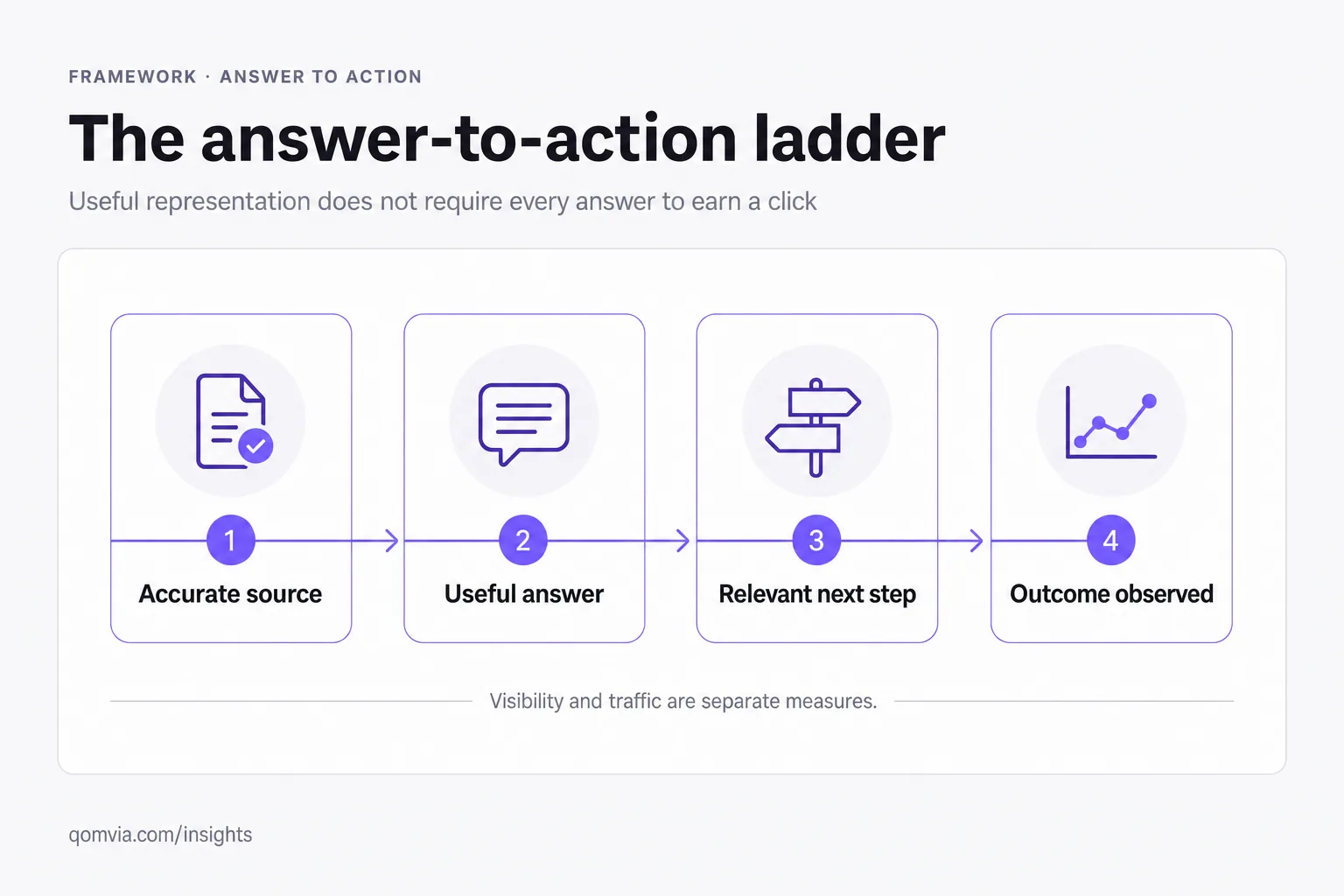
Use the answer-to-action ladder. First, make the source accurate and easy to attribute. Next, ensure the answer gives a person a useful understanding without losing critical limits. Then provide a clear next step when the task needs more evidence or action. Finally, measure whether the intended outcome occurred. The ladder describes a publisher's strategy, not a ranking formula.
At the first step, make the organization and page subject unambiguous. A source link should identify the page that supports the claim, not a generic home page that leaves the reader searching again. At the next step, write the explanation so that a short extract still retains its subject and condition. A concise passage can earn recognition without sacrificing accuracy.
The next step is a useful destination. If a person wants to verify a specification, the source should expose the relevant detail. If the task involves a product, the offer page should support comparison and purchase. If the answer is uncertain or incomplete, the page can show how to resolve the question. A specific next step serves a reader better than a generic “learn more” link.
Build for both paths: the person who has enough information to stop and the person who needs to continue. The answer should not depend on a click to reveal a safety qualification, price condition or important eligibility rule. The destination can add depth, interaction and personal application. This division respects the user's time while preserving a reason to visit when the task demands more.
Let the source page be useful on its own. Provide supporting documents, methods, comparison criteria or tools where they genuinely help. Avoid gating basic facts behind a signup when a person needs them to evaluate a claim. If an interaction requires an account for legitimate reasons, state that requirement before the visitor begins and provide an accessible alternative where possible.
How should teams report zero-click search?
Choose a denominator for each outcome
Keep the label descriptive rather than causal. A report can describe a query or impression pattern under the reporting system's definitions, but the label alone does not explain why an individual search ended without a click. Pair the observation with the page's role and other available evidence, then list alternative explanations that the data cannot distinguish.
Define the evidence before assigning value. A citation can show a visible source link. A brand mention can show that the response names the organization. A referral session can show that a tagged link led to a visit. A conversion event can show that a configured action occurred on the site. None of these alone measures the full effect of a no-click exposure.
Build a reporting view that keeps units separate. Do not add citations, sessions and conversions into one total or treat a higher citation count as proof of business value. Pair a source sample with an editorial review of accuracy. Pair a tagged visit with its landing page and configured events. If the question concerns awareness without a click, define what evidence can reasonably support that conclusion and identify what remains unobserved.
Use language that fits the data. “This page appeared as a citation in the sampled answers” is precise. “This article drove customer demand” needs stronger attribution. “The tagged referral resulted in a visit” is an analytics observation. “The interface answered the question without a visit” is a task interpretation that should be supported by the sampled response and a clear coding rule.
Include a source-quality review beside any visibility summary. Ask whether the cited page supports the sentence, whether a qualification was preserved and whether the link reaches the right destination. A citation count alone cannot answer those questions. A careful content review can explain why a reference mattered even when the report cannot connect it to an eventual visit.
Keep the scope of each report explicit: tested questions, product surfaces, language, dates and how an eligible source or visit was counted. If the collection method changes, annotate the break. Do not compare a narrow sample with a broader one as though both represent the same population. Use a distinct measure for each decision rather than adding incompatible observations together.
What should a team do first?
Document which business outcomes can happen without a page visit and which require one. A public fact may help a person decide to visit later; a detailed comparison may need the full source; a checkout task requires a controlled transaction path. This map gives analytics and editorial teams a shared vocabulary for pages with different jobs.
Review pages where a summary could omit a qualification or make an outdated fact seem current. Keep the definitive source easy to find and correct the underlying page when it changes. Do not add filler simply to force a click, and do not hide an essential answer behind an unnecessary interaction. The page should serve the reader whether they continue or not.
Agree on how the team will describe an unobserved exposure. If no measurement records whether a person saw a summary and left, report that as a measurement gap rather than a count. Keep direct visits, conversions, answer samples and brand research in their own categories until a valid method connects them.
Choose a small set of pages where the audience outcome is clear. Record the question the page answers, the next action a visitor can take and the evidence the team expects to observe. Separate pages intended to resolve a query from pages whose purpose is to start a transaction or a conversation. Their success conditions are different.
Map each page to a business outcome without assuming that every outcome requires a visit. A person may learn a definition, confirm a location or remember a product name without opening the source. Another person may need to compare detailed terms before deciding. Use the journey the business serves to decide which pages deserve deeper on-site content.
Audit snippets and visible summaries for accuracy. Check that the key fact has a supporting passage on the canonical page, that outdated offers are not exposed and that qualifications remain near the claim. This protects the reader even when the person does not click through and gives the publisher a source to update when the fact changes.
Keep site analytics separate from exposure indicators. A recorded session can describe a visit under the property's collection rules; it cannot count every person who saw a summary and left. Search reporting may offer a different view but can group appearances in ways that do not isolate a specific answer feature. State the measurement boundary rather than combining unlike records.
Treat a branded search or later direct visit as a possible journey signal, not proof that a specific summary caused the action. The same person may encounter many sources before returning. If a team runs an experiment, define the comparison and acknowledge other changes that could explain the result.
When reporting to leadership, show the page's intended job, the observed outcome and the remaining uncertainty. A concise report might say that a page was revised to answer a policy question more clearly and that direct visits were tracked separately from sampled answers. It should not claim that a rise or fall in clicks was caused by an unobserved exposure.
Select a small set of questions that matter to customers. For each, decide whether a compact answer can satisfy the task or whether the person needs a visit to inspect evidence, compare options or complete an action. Review the current source page, answer samples and tagged visits separately. Note where the source is accurate, where context is lost and where the destination fails to add value.
Then improve the weakest part of the path. Correct an outdated fact, clarify a source page, add the missing evidence or improve the next step. Retest the same task and preserve its conditions. The goal is not to force a click from every answer. It is to make the best available outcome useful and honest for the person searching.
If an answer completes a simple task without a visit, assess whether the brand and supporting source are represented accurately. If a person needs to act, make the destination worth opening. That balanced strategy treats direct traffic as valuable without pretending it is the only form of search impact.
Prioritize corrections by consequence. A missing definition may be a small editorial gap; an outdated safety instruction, an incorrect price condition or a misleading policy summary deserves faster attention. Assign an owner to the source page and record the answer sample that surfaced the issue. After the correction, check the same task and preserve whether the result changed or remained uncertain.
A no-click strategy is not a reason to abandon the publisher's own site. The site remains the canonical place to explain the full evidence, provide a service and build a direct relationship. It is also the place where the organization can correct its claims. The objective is to earn a meaningful next action when one is useful, not to force every search interaction into a visit.
How Qomvia measures value without a visit
Qomvia measures the zero-click part: whether ChatGPT, Gemini and Grok name you, at what position and with which sources.
The free scan runs all 26 checks of the agent-readiness score in about a minute and lists every failing check with a copy-paste fix; the free Site monitor re-scans weekly, no signup for the score. The AI monitor then asks your buyers' questions to ChatGPT, Gemini and Grok every day and shows whether you are named, which rival is named instead and which sources the models used. Qomvia Market and the MCP server take it one step further, letting agents act on the recommendation. Sign up free or see plans and pricing.
Sources and further reading
Questions
- What is a zero-click search?
- It is a search interaction where the person gets enough information from the interface to end or change the task without visiting a website.
- Is zero-click search always bad for publishers?
- Not automatically. A useful answer and accurate source attribution can matter, while visits remain important for tasks that require evidence, comparison or action.
- How can a brand win without clicks?
- Make the source accurate, make the answer easy to attribute and offer a meaningful next step when the task needs more than a summary.
- Which pages still get clicks from AI search?
- Pages that help with deeper evidence, complex comparisons, tools, product configuration or transactions have a clear reason for a person to continue.
- How do I measure zero-click search?
- Keep answer samples, citations, tagged visits and on-site outcomes separate. Define what each measure observes and what it cannot establish.
- Should I hide information to get more search clicks?
- No. Give a useful answer and make the source valuable for what follows, such as evidence, personalized application, comparison or completion of a task.
Score your own site against the rubric this is written from.
Is your site agent-ready?
Free score against the same rubric, in under a minute.
Sign up free to keep the fixes and track the score.
AI monitor
PreviewHow often each model names your site across 11 tracked questions.