Published by Qomvia, , 13 min read
Key takeaways
- Separate the routes: a model can answer from learned parameters, retrieve current sources, or receive a user-requested page fetch.
- Match the lever to the route: site structure helps retrieval; consistent identity and durable evidence support recognition across contexts.
- A mention is not a citation: distinguish a brand name, a linked source, a cited passage and a recommendation.
- Govern what the publisher controls: configure documented crawler access, then use identity evidence and retrieval tests to evaluate how answers describe the brand.
- Measure what you can observe: preserve the question, answer mode, citations and date instead of treating one output as proof.
What is LLM SEO?
LLM SEO helps a brand make its information clear, attributable and useful when language-model products answer questions. It covers search discoverability when a product retrieves web pages and consistent evidence when it draws on learned information. It does not mean every model searches the web or that a publisher can set the answer.
The phrase can encourage a false mental model: one input called “the website” flows into one model and becomes a predictable answer. In reality, a question may be handled by a model with no live retrieval, a search-enabled mode, a tool that fetches a page at the user's request or a product-specific workflow. These paths leave different evidence. A crawler visit is not proof of training inclusion. A mention is not proof that the page was retrieved. A citation is not proof that the reader accepted the recommendation.
A useful LLM SEO plan begins with the observation you want to improve. If a name is consistently confused with another organization, clarify identity. If a relevant page is inaccessible to a documented search crawler, diagnose access. If an answer cites a third-party summary, improve the primary source and its corroboration. The distinctions in being named versus being cited help keep these outcomes separate.
How do language models answer from memory versus retrieval?
Learned information and retrieval leave different evidence
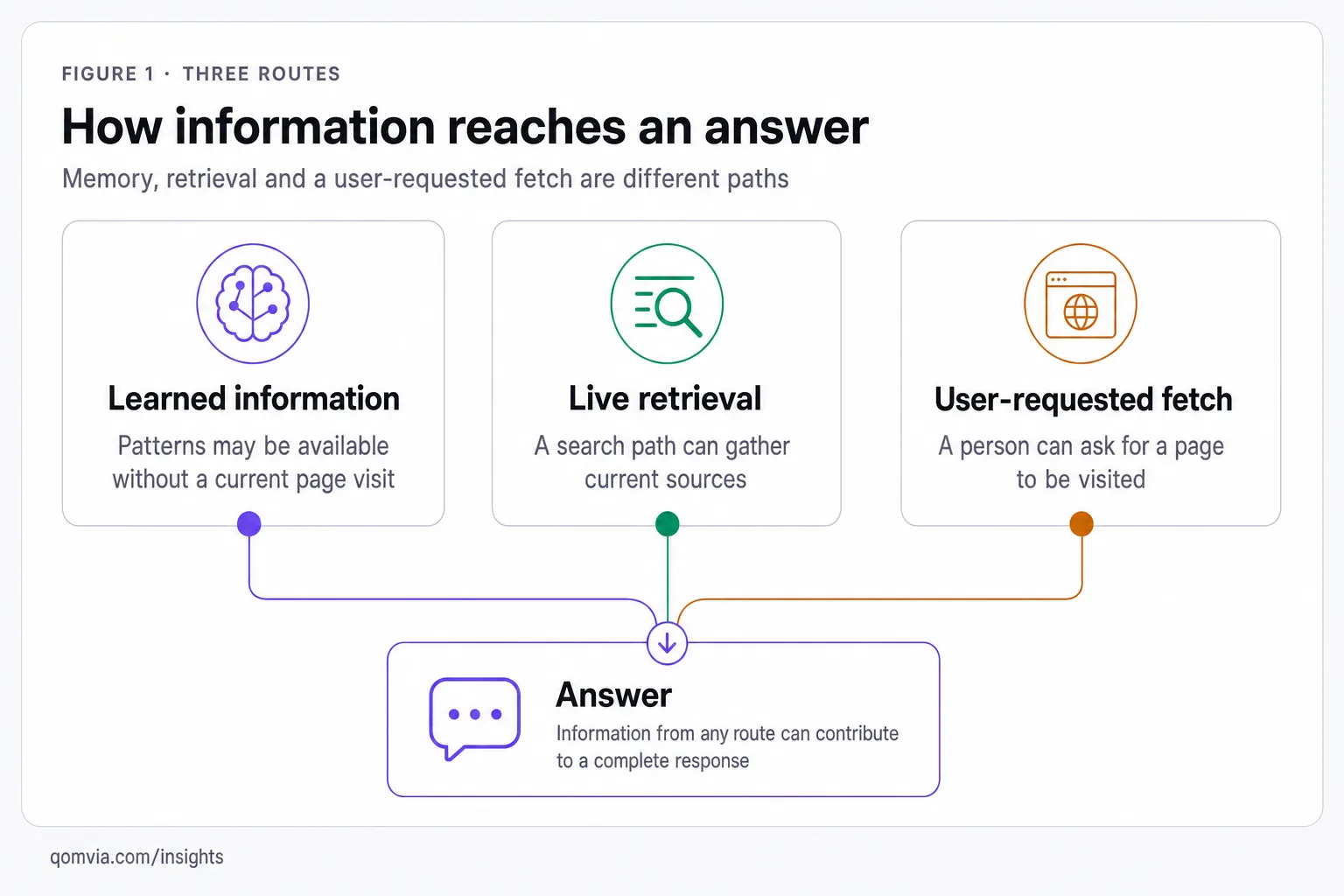
A language model's learned parameters can encode patterns from previously processed material. That route may produce a fluent answer without a current page request, and the model may not expose which training documents influenced a particular sentence. Public crawler controls let publishers govern access to material for potential training; they do not expose an individual memory trace or let a site owner confirm whether a page was included. Treat “teach the model your brand” as a metaphor, not a controllable workflow.
Retrieval adds a distinct path. A product may formulate one or more searches, fetch results, and cite some of the sources it used. OpenAI's help documentation says ChatGPT search can rewrite a query into targeted searches, sometimes with specific follow-ups, while its bot documentation assigns OAI-SearchBot a search-discovery role. Those statements describe published product behavior and crawler functions, not a rule that every question triggers retrieval or that a particular page will be selected. Test visible citations on the questions and surfaces that matter to your audience.
A third route begins with a user action. OpenAI describes ChatGPT-User as serving certain user actions and says it is not used to determine automatic Search inclusion. Perplexity's documentation similarly distinguishes PerplexityBot from Perplexity-User, which can visit a page when a person requests an answer and generally ignores robots.txt because the fetch is user initiated. A team that merges automated search crawls and requested fetches into one “AI bot” category may set the wrong access policy.
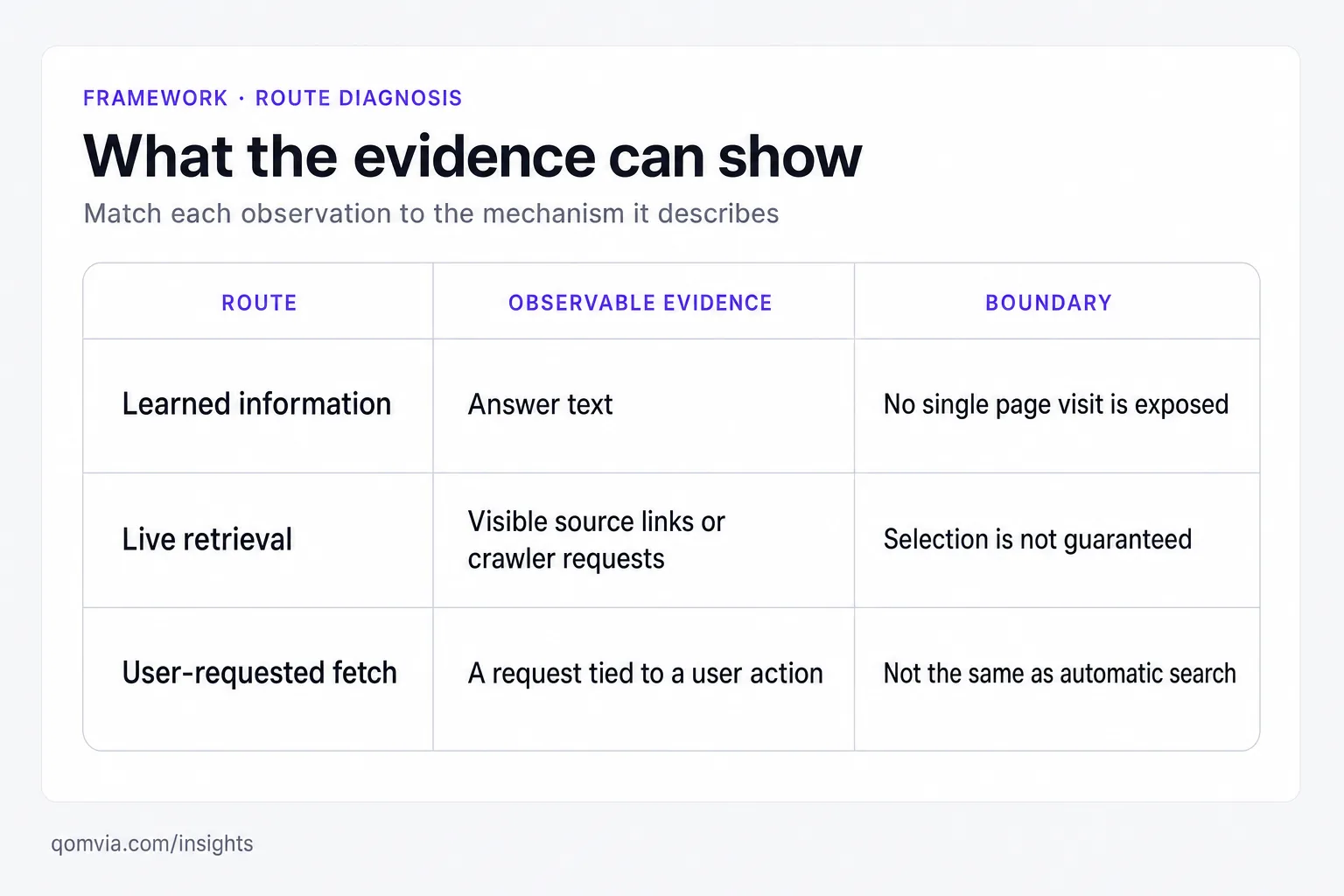
Call this the three-route diagnostic: classify the observable route before choosing a tactic. Learned information points toward consistent identity and credible public references over time. Live retrieval points toward accessible, relevant source pages and a test of the visible citations. A user-requested fetch points toward whether the requested destination can be opened and understood. Use the route to choose a testable task: strengthen identity evidence, improve a retrieval page or verify the requested destination.
The distinction also changes what a result can prove. A successful crawler request is evidence that a URL was fetched under a particular policy. It does not prove the page changed a training set, appeared in a prompt context or influenced a later answer. A citation can show that an interface presented a link, but it does not expose every prior retrieval candidate. State the level of observation directly in reports and avoid turning one mechanism into evidence about another.
The operational question is not simply whether a model “knows” a company. Ask what evidence indicates the route. A visible citation suggests a source link was presented. A crawler log shows a request from a named user agent, but not necessarily that the page affected an answer. A direct answer without citations may provide no source-level trace. Capture the product mode, response, source links and request logs separately, then avoid inferring hidden steps from a surface that does not expose them.
What does it mean for an LLM to mention a brand?
A brand can appear in several ways. The answer may name it, link to its own website, cite a third-party page that discusses it, place it first in a shortlist, or make no reference at all. Those observations answer different questions. A name establishes recall in the response, a link establishes a navigable source, and a cited page may provide independent context. None alone establishes factual accuracy, preference or commercial intent.
Use a classification rule before looking at a trend. Does an alias count as a mention? Does an external retailer page count as a brand citation? What does “first” mean when the answer has prose rather than a numbered list? A small, stable rubric lets two reviewers code the same response consistently. When the answer is ambiguous, preserve the excerpt and mark it uncertain rather than forcing a favorable label.
The source itself also matters. A page may describe the category but not support the sentence attributed to it. Compare the answer with the cited passage, including its date, conditions and named organization. If a response repeats a third-party claim that the brand cannot substantiate, correcting the company's own About page will not be enough. The diagnostic discussion in why an assistant recommends a competitor explains why identity, evidence and task fit should be inspected together.
Separate reference from recommendation. A brand could be mentioned as an example, included as one option among several, or named as the best fit for a defined use. These statements carry different implications and should not be counted as the same outcome. Preserve the surrounding sentence, the user's question and any linked source. A coding guide that discards context may overstate favorable mentions or miss a correction that changes the answer's meaning.
What can a company improve on its own website?
Make the basic entity unambiguous. Use the same organization name, product names and factual descriptions across the homepage, About page, product pages and legal identity. Explain whether similarly named products belong to the same company. A visitor should not have to reconcile one name in the page title, a different name in the footer and a third name in structured data. If the business has changed its name or ownership, state the relationship and keep the old references from looking like separate active entities.
Make claims inspectable. A product page can state what the product does, the conditions under which it works and the limits that affect its use. A methodology page can explain the inputs, scope and limits behind a score. A policy page can identify who is covered, when the rule applies and where the exception lives. A researcher should be able to locate the evidence without reconstructing it from a marketing tagline, a screenshot and a support thread.
Then make the important text available in a stable form. Use headings that name the subject, paragraphs that preserve the question's context, and internal links that connect an explanation to its supporting detail. Avoid making the sole answer depend on an interaction, an image label or a script that runs after a crawler's first request. Our AI agent readiness guide covers how access and legibility fit into a broader site review.
This work is valuable even when no model cites the page. Clear terms reduce customer confusion, consistent names help partners describe the company, and primary documentation is easier to update than a scattered set of summaries. LLM visibility is uncertain; the page's usefulness is under the publisher's control. That is a better investment case than promising a change in unseen training data.
Make the source hierarchy visible. The homepage can establish who the organization is; a product page can carry specifications and limitations; a policy page can explain terms; a methodology page can show how a result was produced. Link those pages together with descriptive labels. If a third party quotes an old feature or a discontinued name, the canonical page should make the current relationship clear without silently rewriting the history.
Which retrieval controls should an SEO team inspect?
Start with the exact page and the intended route. Identify which public user agents a provider documents for search, training-related crawling and user-triggered fetching. Read the current provider policy before changing robots.txt, then compare it with CDN, WAF and authentication behavior. A page can be permitted in a robots file yet receive a challenge at the network edge. Conversely, user-facing account data should remain protected even if a crawler policy is permissive.
Do not infer training from search crawling. OpenAI documents separate user agents and says each setting is independent. A publisher can permit OAI-SearchBot while disallowing GPTBot. That is a concrete control distinction; it is not evidence that permitting one will cause a specific page to be cited or that disallowing another removes every existing learned association. Explain the policy in terms of the documented request path and its intended purpose.
Request logs should be read as operational evidence. Record user agent, URL, response status, response size and edge decision where available. Deduplicate repeat requests and separate successful fetches from blocked attempts. A log line is not a conversion, a citation or proof of model use. If the request source cannot be authenticated under your organization's standards, treat the user-agent string as a label rather than strong identity evidence.
| Observation | Reasonable interpretation | Do not conclude |
|---|---|---|
| Documented search crawler requests a page | The named crawler attempted or completed a fetch | The answer selected the page |
| User agent is blocked by a site edge | The configured access path may prevent that request | All product modes are affected identically |
| A response includes a source URL | The interface presented that source | The source caused the full answer |
| A brand appears without a link | The text includes a brand reference | The first-party site was retrieved |
For the detailed bot distinctions and implementation examples, use training, search and user-fetch bots and how to get cited by ChatGPT. Keep the latter as a source-level playbook rather than using this LLM SEO overview to repeat every step. The aim here is a route-aware diagnosis, not a single crawler checklist presented as the whole discipline.
Robots policy expresses a publisher's preferred access for automated crawlers, but network controls can create a different outcome. Compare the policy with the response at the edge, the status code and any challenge page. Check whether the relevant public page is available without session cookies. Do not weaken authentication or bot protection for a private workflow just to produce a successful crawler test; identify the public material that can safely answer the question instead.
How should teams measure LLM SEO?
Test the route, not just the brand
Build a question set that reflects real decisions: category discovery, a comparison, a branded question and a support task. Keep the wording stable for the baseline and label any prompt revisions. Run the same question in the modes the team intends to understand, and record the product, locale, date, visible search state, full answer and linked sources. Do not report a response collected from one mode as if it represented all outputs from that provider.
Code mention, first-party citation, third-party citation, recommendation order and factual accuracy separately. Preserve an “uncertain” option for outputs that do not fit the rubric. Review a sample manually to check whether the coding guide still works. A tidy chart can conceal a broken definition; an audit trail lets a reviewer return to the actual answer and see what the metric meant.
A question-level monitor and a public-readiness scan answer different questions. Qomvia's AI monitor captures answer-level samples for tracked questions across supported models; Site monitor assesses public website readiness. The product inventory identifies ChatGPT, Gemini and Grok in the core set, with Claude and Perplexity as add-ons. Do not treat a readiness score as proof of answer inclusion or an answer sample as a complete site audit.
Design the sample around the decisions the team may take. Category questions test broad discovery, comparison questions expose tradeoffs, branded questions help find identity errors and support questions test whether policies are discoverable. Keep each task's intent visible in the report. If the test changes from one product mode to another, create a new segment rather than assuming that the output difference came from a page edit.
What should LLM SEO avoid promising?
Describe mechanisms a publisher can demonstrate, such as a public feed, a page update, a search result or a human-facing feedback flow. The available public controls describe crawlers and product behavior; they do not give a publisher a button to edit an answer. A service that says it can “submit your brand to the model” should identify its mechanism and show evidence that matches the work it performs.
Do not manufacture third-party corroboration. Fake profiles, repetitive comparison pages and undisclosed paid endorsements can create inconsistencies that outlive the campaign. Earn legitimate references by publishing original documentation, helping customers understand tradeoffs and giving journalists or partners material they can verify independently. This is slower than inventing a shortcut, but it preserves the truth conditions the company may need to defend later.
Finally, resist the temptation to use one screenshot as a verdict. A model answer is a sample, not a stable rank position. Preserve the conditions, repeat the observation where practical, and identify whether the next useful action is technical, editorial or reputational. A measured non-result can be more valuable than a claimed win if it exposes which part of the route remains unknown.
A credible LLM SEO report should therefore distinguish controllable inputs from external outcomes. A company can correct its own product facts, improve a public source page, adjust a crawler rule or ask a user to review an answer. Report when these changes were made and what later samples show about retrieval, selection and ranking. Keep the service brief tied to a mechanism the team can actually inspect.
The same discipline applies to competitor mentions. An answer naming another company does not reveal whether the cause was product fit, a cited source, outdated identity information or a different interpretation of the question. Save the complete response, inspect the evidence and classify the observation before proposing a fix. The competitor recommendation guide provides a separate diagnostic for that case.
Sources and further reading
Questions
- What does LLM SEO mean?
- It means improving how clearly a brand and its pages can be identified, retrieved and evaluated in language-model products. It does not mean every product uses live search or that publishers control model memory.
- How do LLMs choose sources?
- The route depends on the product and mode. Some responses may use learned information, while search-enabled modes can retrieve pages and present sources; public documentation describes only the specific product behavior it covers.
- What is the difference between LLM training data and retrieval?
- Training relates to material a model may learn from before a response. Retrieval is a separate process in which a product searches for or fetches information for a particular task. A crawler visit is not proof of either outcome in a response.
- How can I get my company mentioned by LLMs?
- Clarify the company's identity, publish useful evidence, maintain accurate public information and make relevant pages accessible to documented retrieval paths. Then compare answers over time and inspect any visible source links.
- Does allowing an AI crawler make my site appear in answers?
- Allowing the documented crawler removes an access barrier; retrieval, source selection and citation are separate outcomes to assess on the relevant surface.
- How do I track LLM brand mentions and citations?
- Use a stable question set and record full answers, linked sources and collection conditions. Count mentions, citations and recommendations separately, and keep a manual review trail.
Score your own site against the rubric this is written from.
Is your site agent-ready?
Free score against the same rubric, in under a minute.
Sign up free to keep the fixes and track the score.
AI monitor
PreviewHow often each model names your site across 11 tracked questions.