By Qomvia, 14 min read
Key takeaways
Your buyers spread their questions across ChatGPT, Gemini, Grok, Perplexity and Google's AI features, and each engine sources answers differently. AI assistants now answer the question before anyone clicks a result, so being visible in one engine says little about the others.
- Compare observable mechanisms: index context, documented crawler roles, citation display and available measurement are separate dimensions.
- Do not assume one shared index: product documentation describes different search partners, crawlers and source experiences.
- Citations are not rankings: a visible source link does not disclose every candidate or prove why it was selected.
- Measurement coverage differs: Search Console, Bing AI Performance, tagged referrals and answer sampling report different outcomes.
- Choose by audience task: the useful comparison is how a target surface handles the question your customer asks.
What are AI search engines?
AI search engines are products that combine search or other information sources with generated answers, summaries or recommendations. The category includes interfaces with different indexes, retrieval paths and source displays. A website owner comparing them should study what each provider documents and exposes, rather than assume one shared ranking system or treat a single answer as a market-wide result.
The term can cover a search engine that adds an overview, an assistant that searches the web for a question, a product that cites retrieved pages, or an agent that uses sources while completing a task. These experiences may share broad concepts while differing in controls and reporting. A crawl token describes an access purpose; a citation panel describes what a person can inspect; neither is a complete account of model behavior.
This field guide compares the site-owner view: what source path is documented, what access controls are described, what links appear and what measurement a publisher can inspect. It does not rank products by popularity. For a closer analysis of individual surfaces, read Gemini SEO, Perplexity SEO and Bing SEO for AI search.
How should a website owner compare AI search products?
Compare observable evidence
Begin with the audience's task. A product question may require current specifications, a policy question may need a primary source, and a comparison may need clear tradeoffs. Choose a small set of surfaces that matter to those tasks, then observe them under comparable conditions. Avoid asking “which engine is best?” without defining best for whom, in which market and for what decision.
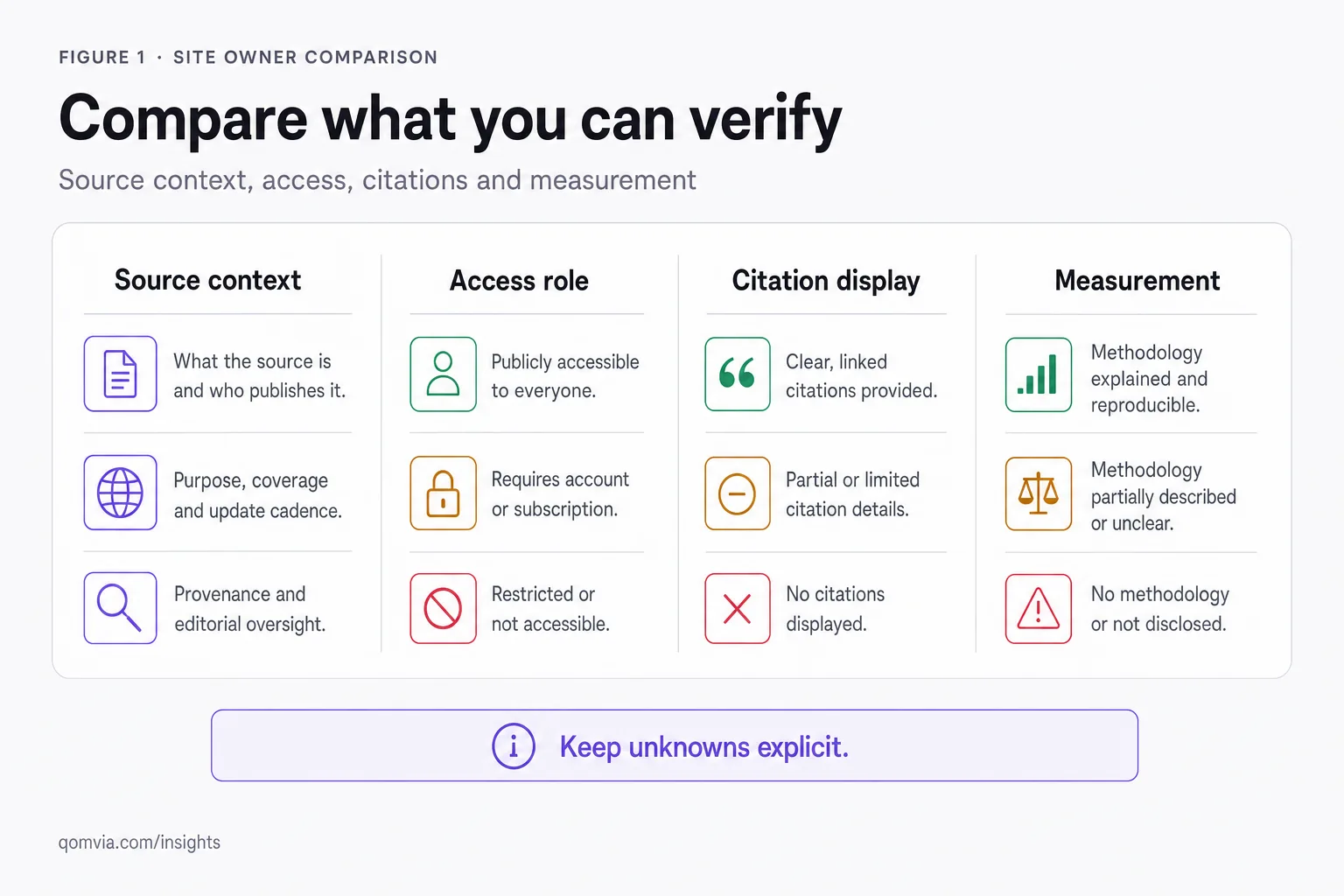
Use a four-part comparison: source context, crawler or access role, citation presentation and measurement availability. Add the product mode and exact query to the record. If an item is not documented, label it “not established by the sources reviewed” rather than filling the gap with an assumption. That restraint makes the matrix useful to engineering and editorial teams because they can tell which facts support a policy change.
Keep the same question where the intent fits more than one surface, but do not pretend that every interface accepts an identical task. Save a prompt variant when wording needs to change. Record why it changed and whether it still tests the same decision. If the product mode changes, create a separate row rather than merging answers under one provider name.
What source and crawler information is documented?
Keep each product's policy separate
OpenAI says ChatGPT search sometimes partners with other search providers and names Bing and Shopify in its help material. That is evidence that a source path can involve partners, not that one index supplies every answer. OpenAI also documents OAI-SearchBot for surfacing websites in ChatGPT search. Publishers should keep crawler access distinct from any assumption about which source a specific response used.
Perplexity documents PerplexityBot as a crawler that surfaces and links websites in its search results, and distinguishes it from Perplexity-User, which may fetch a page after a user action. Google-Extended has a different documented purpose: it controls certain uses of crawled content for Gemini training and grounding, and Google says it does not affect Search inclusion or ranking. A crawler name should therefore be read with its documented purpose, not treated as a shared “AI search bot” label.
Microsoft's Bing Webmaster guidance and Bing AI Performance expose different kinds of evidence. The published AI Performance preview describes citations across Microsoft Copilot, AI-generated summaries in Bing and selected partner integrations. The announcement does not establish that every product in the matrix uses the same index or crawl token. The comparison should stay anchored to the documentation for each specific surface.
| Surface | Documented source or access context | Publisher-side boundary |
|---|---|---|
| ChatGPT search | Sometimes partners with search providers; OAI-SearchBot is documented | Partner use does not establish an exclusive index |
| Perplexity search | PerplexityBot surfaces and links websites | A crawler request records access, not answer selection |
| Gemini and Search | Google-Extended covers specified Gemini uses; Search eligibility is separate | Google-Extended does not affect Search inclusion or ranking |
| Copilot and Bing AI features | Bing AI Performance reports cited pages and grounding queries | The cited metrics do not measure ranking or authority |
The useful answer to “what index does it use?” may be limited. A provider can disclose that it works with a partner without revealing every source, query route or ranking decision. If your review requires a crawler token and the source you have does not name one, record that as unknown. Do not substitute a familiar crawler name simply because it appears elsewhere in the provider's ecosystem.
Build a product-by-product access record. Save the official description of each crawler, the control that governs it and the test URL used to confirm the public response. A successful request verifies access for that request and page; it does not prove that every template works or that the page will be selected. Keep policy text, network logs and answer samples as separate evidence artifacts.
If a provider's public documentation does not establish a named search crawler for a particular answer surface, do not infer one from a shared corporate brand. Large products can have separate systems for training, search, user-requested fetches and feature reporting. A comparison table should make those distinctions visible and give a reader permission to leave a cell blank.
What can citation displays tell you?
A citation display makes at least one destination inspectable. ChatGPT search may show inline citations and a Sources panel; Perplexity's crawler documentation describes surfacing and linking websites. A link gives the reader a route to a page, but it does not show the entire candidate set or the exact influence of each source on the response. Treat it as interface evidence with a bounded meaning.
Review source quality at the passage level. Does the page support the sentence? Is the source current for the claim? Does it preserve a qualification that the answer left out? A source can be reputable and still fail to support a particular wording. Conversely, a less prominent page may contain the primary data the user needs. A useful audit records the full answer, the cited URL and the relevant passage.
Capture the answer context around every source link. A citation may be attached to one sentence while the rest of the response makes a broader claim. Record which clause the source appears to support and whether the destination is the exact evidence page or a general page on the same domain. This creates a reviewable distinction between domain presence and claim-level attribution.
When comparing layouts, describe what a reader can actually inspect: inline links, a source panel, a list of references or no visible source. Do not turn a more prominent interface element into a higher citation quality score. If the source display is absent in a particular mode, preserve that observation and compare only with other modes that expose equivalent evidence.
Compare the way each interface exposes sources without turning design differences into a quality score. A citation beside a sentence, a list of related sources and a grounding report are distinct artifacts. Tell the reader what they can verify in each. For methods to classify names, citations and source accuracy consistently, see how to measure AI search visibility.
Which measurement tools cover each surface?
Measurement should be matched to the event. Google says AI Overviews and AI Mode activity is included in Search Console Performance reporting under the Web search type. Microsoft's Bing AI Performance public preview describes total citations, average cited pages per day, grounding queries and page-level citation activity across specified Microsoft and partner experiences. Microsoft says these are not measures of ranking, authority or importance.
OpenAI's publisher FAQ says it adds utm_source=chatgpt.com to referral URLs, which can help identify tagged visits in web analytics. A tagged session measures a visit, not every source impression. A Perplexity citation sample, a crawler log and a referral report also answer different questions. Do not add their counts together as if they shared a denominator or represented the same event.
Create a measurement inventory with one row per surface: the product mode, available first-party reporting, observable referral convention, server-log signal and limits. If no source-level dashboard is documented, use a repeatable answer sample and state its scope. Qomvia's AI monitor supports tracked-question observations according to the product inventory; it is not a substitute for the reporting provided by a search platform.
Keep the denominator visible when bringing these sources into one report. A platform citation count, an analytics session and an answer-sample percentage do not describe the same event. Give each its own label, collection window and owner. If two dashboards use overlapping but not identical product coverage, disclose the difference before comparing their totals.
Use direct referral data to study what happens after a visit, and use source samples to study which links appear in answers. A request log can help explain a fetch problem, but it cannot stand in for either outcome. The comparison is useful when it helps locate a gap in the journey, not when it produces a single all-purpose AI visibility number.
When the same brand appears in two products, compare like with like. Use the same customer task, similar wording and a clearly named surface, then preserve the full response and link context. If one product does not expose the source or the test conditions differ, report that boundary instead of forcing a direct score comparison. A side-by-side view can still be valuable as a qualitative review.
Keep any referral tag tied to the documented product that generated it. Do not infer that a familiar UTM value applies across every assistant or search surface. Check landing-page redirects and analytics settings, then label sessions by the exact recorded source. This produces a defensible view of visits while leaving untagged exposure explicitly unmeasured.
Record the mode, language, location and date with the test. A product label alone may not identify whether search was enabled, a source panel appeared or a follow-up action occurred. Keep configuration details beside the answer, and repeat a comparable task before describing a difference as a product characteristic.
Use a referrer only as a session-acquisition clue. It cannot reveal a view that ended before the site visit, and a missing referrer may be consistent with privacy controls or a link path that removed attribution. Label the evidence as observed traffic rather than total answer exposure, and keep the underlying analytics filter available for review.
How can teams prepare a site across products?
Build a shared inventory of public facts, canonical URLs, key pages and access rules before treating each product as a separate optimization project. A product page with an outdated price or unclear seller relationship is a site-quality issue that should be corrected once at the source. Surface-specific checks can then identify whether a particular crawler or answer presentation exposes a separate problem.
Give each observation a product and task label. Do not blend a browser assistant's interaction with a search engine's cited answer into one category simply because both use generative technology. The interface, action available to a user and evidence exposed to a reviewer can differ. Labeling those differences makes the comparison useful to engineering, editorial and business owners.
The shared work is mostly ordinary source quality and dependable delivery. Make important pages discoverable, keep the canonical answer readable, identify the publisher and link claims to evidence. Check that public content is served without an account session and that security rules do not accidentally replace the page with a challenge. Protect private workflows and data instead of opening every endpoint for a crawler.
Then adapt to the specific surface. Search products may have eligibility rules; a search assistant may expose citations; a commerce interface may need accurate product offers; a browser agent may need accessible controls. Do not use a change intended for one surface as proof that every other surface will respond. Our AI agent readiness guide gives the cross-surface framework, while Bing SEO for AI search covers Microsoft-specific discovery.
Keep facts consistent across a site, but avoid flattening every page into the same answer template. A method page should explain its method, a policy page its rule and exceptions, and a product page its specific offer. Source clarity comes from structure and evidence, not from repeating the same keywords in every title. Update important claims when the underlying evidence changes.
Map shared work and product-specific work explicitly. A crawlable canonical page is a shared publishing concern; a Search snippet setting belongs to the relevant Search context; a user-fetch permission belongs to its documented access path; a visible citation belongs to answer review. Assign separate owners when those decisions fall to engineering, legal, editorial or analytics. One generic “AI SEO” ticket often hides the dependency.
Do not open every route to every automated request. Public informational pages and sensitive account workflows have different risk. Make policy decisions by resource, enforce private access at the application boundary and verify that public article pages return their substantive content. A broad comparison should help the team understand the surface, not encourage one access rule for all products.
What is the practical comparison framework?
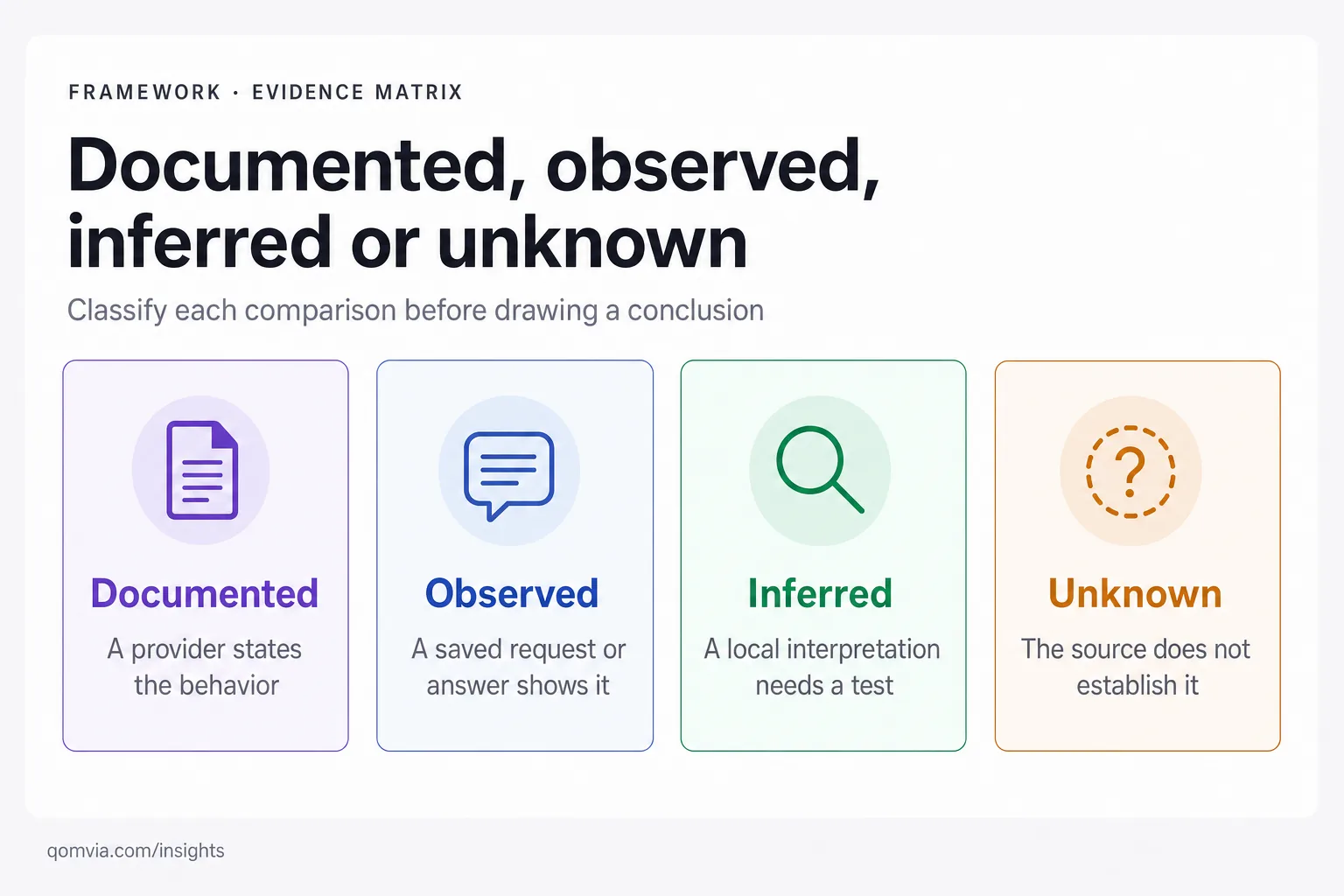
Use the surface-source-observation matrix. For each customer task, record the surface, the documentation that applies, the access path you can verify, the source links the interface displays and the measurement available. Mark each cell as documented, observed locally, editorially inferred or unknown. This framework is deliberately not a league table; it helps a team make one evidence-based decision at a time.
For example, a Search eligibility rule belongs in the documentation column, while a successful request in your server log belongs in the local-observation column. A hypothesis that a clearer page may help the source reviewer belongs in the editorial-inference column. An undocumented selection rule stays in the unknown category. Keep the categories stable so a later team member does not turn an inference into a fact while preparing a dashboard.
Review the matrix when a provider changes its documentation, when a site access rule changes or when the audience adopts a new task. Do not refresh every product score on a calendar if the evidence is static. The goal is a current map of what is known, what can be measured and which next test would actually reduce uncertainty.
Give every matrix entry an owner and a review trigger. A published product announcement, a new crawler control, a change to the site's edge configuration or an updated customer task can make a row stale. Store the source URL and the relevant statement beside the entry. Label conclusions by evidence type: public documentation, internal observation or editorial hypothesis.
Use the matrix to choose the next discriminating test. If the documentation is clear but a request is blocked, reproduce the access path. If sources appear but do not support the answer, review the cited passages. If there is no reporting surface, define a manual sample and its limitations. A useful comparison ends with a testable question, not a ranking that pretends uncertainty has disappeared.
How Qomvia tracks the engines that matter
Qomvia's AI monitor asks ChatGPT, Gemini and Grok your buyers' questions every day, with Claude and Perplexity as add-ons, so you see each engine side by side.
The free scan runs all 26 checks of the agent-readiness score in about a minute and lists every failing check with a copy-paste fix; the free Site monitor re-scans weekly, no signup for the score. The AI monitor then asks your buyers' questions to ChatGPT, Gemini and Grok every day and shows whether you are named, which rival is named instead and which sources the models used. Qomvia Market and the MCP server take it one step further, letting agents act on the recommendation. Sign up free or see plans and pricing.
Sources and further reading
Questions
- What is the best AI search engine for citations?
- There is no universal answer. Compare source links for the task and audience you care about, and inspect whether each citation actually supports the answer.
- Do all AI search engines use the same index?
- No shared index is established by the cited documentation. Providers describe different partners, crawlers and Search contexts, so avoid assuming one system supplies every answer.
- How do I compare ChatGPT, Perplexity, Gemini and Copilot?
- Compare documented access roles, visible source displays and measurement for the exact product surface. Keep unknowns explicit rather than assigning an unsupported overall rank.
- What can Bing AI Performance measure?
- Microsoft's public preview describes citations, cited pages per day, grounding queries and page-level citation activity across specified experiences. Microsoft says the measures are not ranking, authority or importance scores.
- Can Google-Extended affect Google Search rankings?
- Google says Google-Extended does not affect inclusion or ranking in Google Search. Its documented scope concerns specified Gemini training and grounding uses.
- Are AI search citations a ranking report?
- No. A citation is a visible source link and can be inspected for support. It does not disclose a complete candidate set or the provider's internal selection formula.
Score your own site against the rubric this is written from.
Is your site agent-ready?
Free score against the same rubric, in under a minute.
Sign up free to keep the fixes and track the score.
AI monitor
PreviewHow often each model names your site across 11 tracked questions.